
Gemini 4 Carbon in Google AI Mode may change which brands get named, but nobody has published evidence that it does. Google said on 10 November 2026 that the model is rolling out to all Google AI Ultra subscribers. Run the same buyer prompts on Gemini 4 Carbon AI Mode and your current baseline this week, then compare mention rates.
Key takeaways
- Gemini 4 Carbon is available in AI Mode only to Google AI Ultra subscribers so far, so your buyers may not be seeing it yet.
- There is no published study of Carbon's effect on brand mentions or citations. Treat any claim of one as unproven until you have run your own test.
- Run a paired test: the same 20 prompts, three runs each, with the model noted for every answer.
- A swing of 10 points on 60 answers is inside the noise. Decide your threshold before you look at results.
- Check sources as well as names: a new model can cite different pages while naming the same brands.
- Keep a daily fixed-prompt log running so the next model change shows up as a step on a chart, not as a rumour.
What did Google release, and who can see it in AI Mode?
Google announced Gemini 4 Carbon on 28 October 2026 for trusted cyber defenders, and on 10 November 2026 said it is rolling out to all Google AI Ultra subscribers in Google Antigravity, the Gemini app, and AI Mode in Search. The wording is from Google's announcement of Gemini 4 Carbon (Google, November 2026). Search Engine Roundtable reported that paid subscribers can see the option in the AI Mode model selector (Search Engine Roundtable, November 2026).
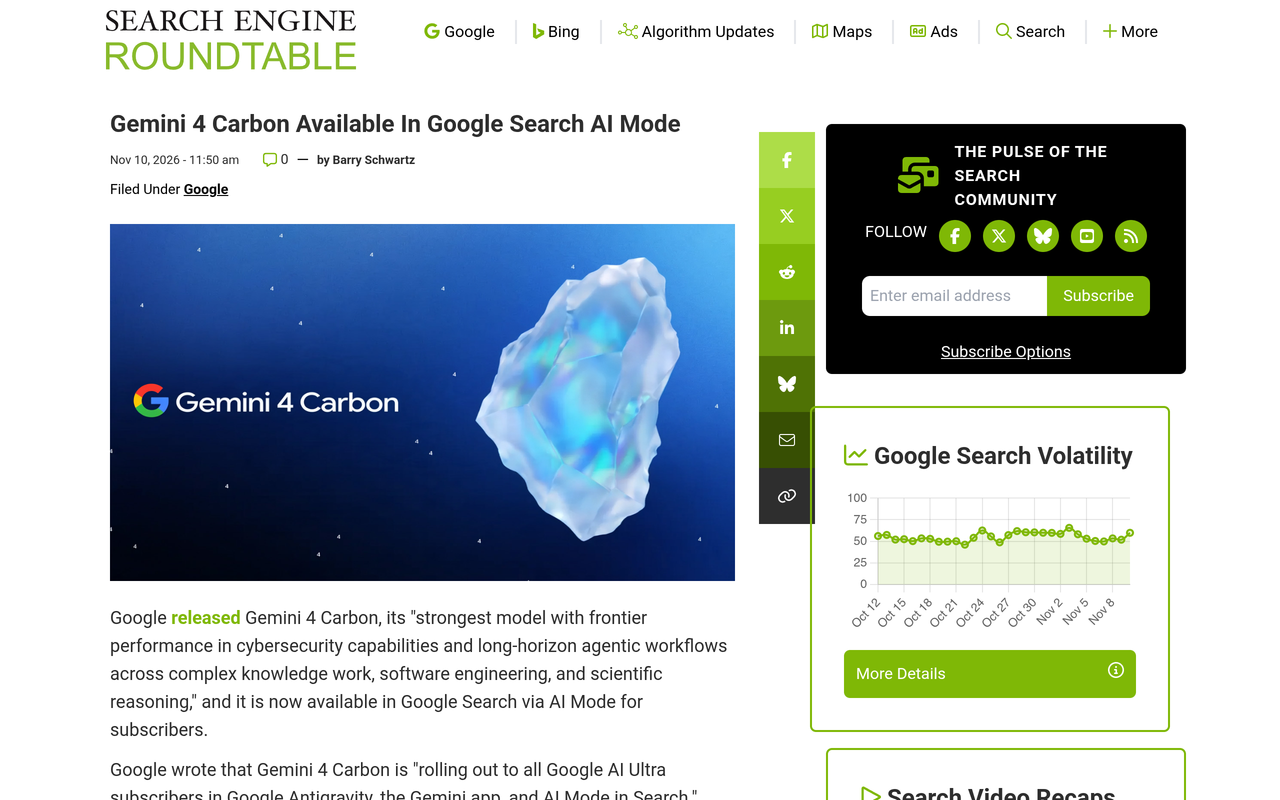
Google's Robby Stein described the change as deeper reasoning and better instruction following for hard questions in AI Mode, and Rajan Patel said the model better understands intent so people can hold longer back-and-forth conversations, per the same Search Engine Roundtable report. Both are Google's own descriptions of the model, not measurements of brand recommendations.
The rollout is narrower than the last one. According to PPC Land, November 2026, Gemini 4 Argon reached AI Mode for both AI Pro and AI Ultra subscribers on 13 October 2026, while Carbon reaches only Ultra. Search Engine Roundtable adds that Carbon reached cyber defenders about two weeks before the wider release.
Does Gemini 4 Carbon in AI Mode change which brands get recommended?
Possibly, and the mechanism is plausible, but it is unmeasured. Google says its generative AI features in Search rely on retrieval-augmented generation and query fan-out, drawing on its core ranking systems, as summarised by Search Engine Journal, 2026. A model that reasons more deeply could write different sub-queries, read different retrieved pages and weigh them differently. Any of those can move which brands appear.
"From Google Search's perspective, optimizing for generative AI search is optimizing for the search experience, and thus still SEO." Google Search Central guidance, quoted by Search Engine Journal.
That guidance is a reason not to panic. Pages still need to be indexed and eligible for snippets, and the fundamentals do not change with a model version. It is also not a prediction about Carbon's output, so you still need to measure.
What the noise looks like
Single answers are a poor guide. SparkToro's study with Gumshoe.ai, reported by Search Engine Journal, January 2026, found less than a 1-in-100 chance that ChatGPT or Google's AI in Search returned the same brand list across repeated runs of one prompt. Each prompt was run 60 to 100 times per platform. The same report says how often a brand appears across many runs is more consistent. That is the number to compare before and after.
Google's AI Mode already varies run to run, so a new model can look like a change when it is only variation. Noma by Nurdd's own writing on AI citation stability covers how often answers change between runs.
How do I check if my brand visibility changed after a new AI Mode model?
Use a paired before-and-after test. Because Carbon is already live, a clean "before" exists only if you logged answers earlier. If you did not, build the comparison from the same day instead: Carbon against whatever AI Mode serves without it.
- Fix 20 prompts. Use unbranded buyer questions across funnel stages, such as "best [category] for [use case]". How to choose prompts to track has a scoring sheet.
- Define the arms. Arm A is AI Mode as your usual account sees it. Arm B is AI Mode with Carbon selected on an Ultra account. If the selector also lists an earlier model, add it as Arm C.
- Run each prompt three times per arm in fresh sessions, same location, same day, signed-in state recorded. That gives 60 answers per arm.
- Log five fields: prompt, arm, date, brands named in order, and URLs cited.
- Compute per arm: mention rate (answers naming you divided by 60), average position, and the share of cited domains that are your own or third-party.
- Repeat in seven days. A difference that survives a second window is more likely real.
For a quick look first, the free Google Rank vs AI Mode Checker shows your Google rank next to what AI Overviews and AI Mode cite for the same query, and who they cite instead. It is a one-off check, not a sample, as AI Mode Checker: What It Can and Cannot Test explains.
A worked example of when to believe a change
This is illustrative arithmetic, not observed data. Suppose your brand is named in 21 of 60 answers in Arm A (35%) and 27 of 60 in Arm B (45%). With 60 answers each, the approximate 95% margin on the 10-point gap is about 17 points, using the standard formula for two proportions. The gap is well inside that, so you cannot call it a Carbon effect. To detect a 10-point gap reliably you need several hundred answers per arm, which is why daily repeated sampling beats a one-afternoon test.
| Result after one window (60 answers per arm) | What to conclude | Next step |
|---|---|---|
| Mention rate gap under about 17 points | Indistinguishable from run-to-run variation | Keep sampling; do not change content |
| Gap between about 17 and 20 points | Borderline: at the edge of the margin | Keep sampling and repeat in a second window before acting |
| Gap over 20 points, same direction in the second window | Likely a real difference between the arms | Check cited sources for the cause |
| Mention rate flat, cited domains shifted | Model reads different pages, brand still named | Audit the pages now cited instead of yours |
| A competitor appears in Arm B only | Possible new fan-out query or source | Open the cited page and find the claim |
What should I check this week?
Work in this order, because each step is cheaper than the next.
- Crawl and snippet eligibility. Google says pages must be indexed and snippet-eligible for its AI features. Confirm key pages are, using Search Console, and see Technical SEO for AI Search.
- Your brand-claim pages. Pricing, comparison and documentation pages are the ones a reasoning model is likely to retrieve for a buying question. Check that facts on them are dated and consistent.
- Competitor mentions. Record which rivals show up in Arm B and not Arm A.
- Description accuracy. A model that follows instructions more closely may phrase your positioning differently. Compare the wording with what you want said.
- Subscriber reality. Ask whether your buyers are likely to be on Ultra. If few are, the practical impact this month is small, and the test is mostly an early warning for when Carbon reaches wider tiers. Google has not said when that will happen.
For the wider habit of re-baselining after any release, see what to do when a new AI model is released, and for how AI Mode itself works, What Is Google AI Mode?
How Noma fits
Noma asks 13 AI engines, including ChatGPT, Gemini, Perplexity and Claude, a fixed set of buyer prompts every day. Google AI Mode is available as an add-on engine. For each engine it reports visibility, position and sentiment, and lists the sources cited. Because the prompt set stays fixed, a change after 10 November appears as a dated step you can compare with other engines. Record the model you used in your own notes.
See it on your own brand: book a demo or start the 3-day free trial. A card is taken at signup so billing can start on day 3; cancel before then and nothing is charged.
How we researched this
We reviewed Google's announcement of Gemini 4 Carbon, trade-press reports from Search Engine Roundtable and PPC Land, Search Engine Journal's coverage of Google's AI search guidance and of the SparkToro study, and Noma's own product documentation. Facts, dates and prices were checked on 2026-11-11. We ran no tests of Carbon ourselves and report no results on its effect. The worked example is arithmetic, not data.
What to do next
Pick your 20 prompts today, log a baseline in AI Mode and the other engines, and repeat after seven days. If you would rather have the sampling run daily across engines, book a demo or start the free trial. For method detail, read How to Measure AI Share of Voice Across Engines.
Read next: what to check for Gemini 4 Hydrogen in AI Mode.
See what AI engines say about your brand
Free · no account · or start a 3-day trial
Questions people ask
Does Gemini 4 Carbon in Google AI Mode change which brands get recommended?
There is no published evidence either way yet. A model with deeper reasoning could generate different sub-queries and weigh retrieved pages differently, which could move brand mentions. Run a paired test with repeated prompts to find out for your category.
How do I check if my brand visibility changed after a new AI Mode model?
Fix about 20 unbranded buyer prompts, run each three times before and after, and record brands named, position and cited URLs. Compare mention rate per window and count a change only if it exceeds run-to-run noise and repeats in a second window.
Who can use Gemini 4 Carbon in AI Mode?
Google said Carbon is rolling out to all Google AI Ultra subscribers in AI Mode in Search, the Gemini app and Antigravity. Search Engine Roundtable reported the option appears in the AI Mode selector for paid subscribers. Google has not said when it will reach other tiers.
Why do AI Mode answers differ between runs of the same prompt?
Generative answers vary each time they are produced. SparkToro's study, reported by Search Engine Journal in January 2026, found under a 1-in-100 chance of the same brand list repeating across runs of one prompt. That is why you compare rates over many runs, not single answers.
Do I need to change my content because of Gemini 4 Carbon?
Not on the strength of the release alone. Google's guidance says optimising for its generative AI features is still SEO, with pages indexed and snippet-eligible. Change content only if your test shows a repeatable drop or a wrong description.
Can I check AI Mode quickly without a tool subscription?
Yes. Noma's free Google Rank vs AI Mode Checker shows your Google rank beside what AI Mode and AI Overviews cite for the same query. It is a single check, so use repeated sampling before drawing conclusions.