

An AI Mode checker shows you one Google AI Mode answer for one query at one moment: whether your site is cited or your brand is named, and which sources appear instead. It cannot give you a ranking, because AI Mode has no positions and its sources change between runs. Use it as a spot check, then sample repeatedly.
Key takeaways
- A single AI Mode check answers "did we appear in this answer, today, for this wording?" It does not answer "where do we rank?"
- Run the same query several times before you believe a result. SE Ranking's study found only 9.2% of URLs matched across three tests, and its authors note that even same-day repeats often return different sources.
- Per Google Search Central, December 2025 (page last updated 2025-12-10, as checked on 2026-11-07), a page must be indexed and eligible to be shown with a snippet to appear as a supporting link. A checker shows the symptom, not the technical cause.
- Search Console reports AI feature traffic inside the normal Performance report, so it cannot tell you which prompts cited you.
- Start with the free Google rank vs AI Mode checker, then move to a fixed prompt set sampled over time.
How do I check if my site appears in Google AI Mode?
There are three routes, and they answer different questions. Pick by what you need to decide.
| Method | What it tells you | What it misses | Cost |
|---|---|---|---|
| Manual check in your own browser | What AI Mode shows you, with your location, language and account history | What other buyers see; repeat variation unless you log several runs | Free, slow |
| Free one-off checker | The answer or cited sources for one query, depending on the tool | Trend, share of voice across a topic, sentiment over time | Free |
| Scheduled prompt tracking | Mention rate and citations for a fixed prompt set, repeated daily | Anything outside the prompt set | Paid |
The manual check is the one most teams start with. Open AI Mode from the Google Search box, type the question a buyer would ask (not your brand name), and record three things: whether your brand is named in the text, whether any of your URLs is in the source links, and which competitors or publishers appear instead. Do it signed out in a private window and again signed in. The gap between the two is your first lesson about personalisation.
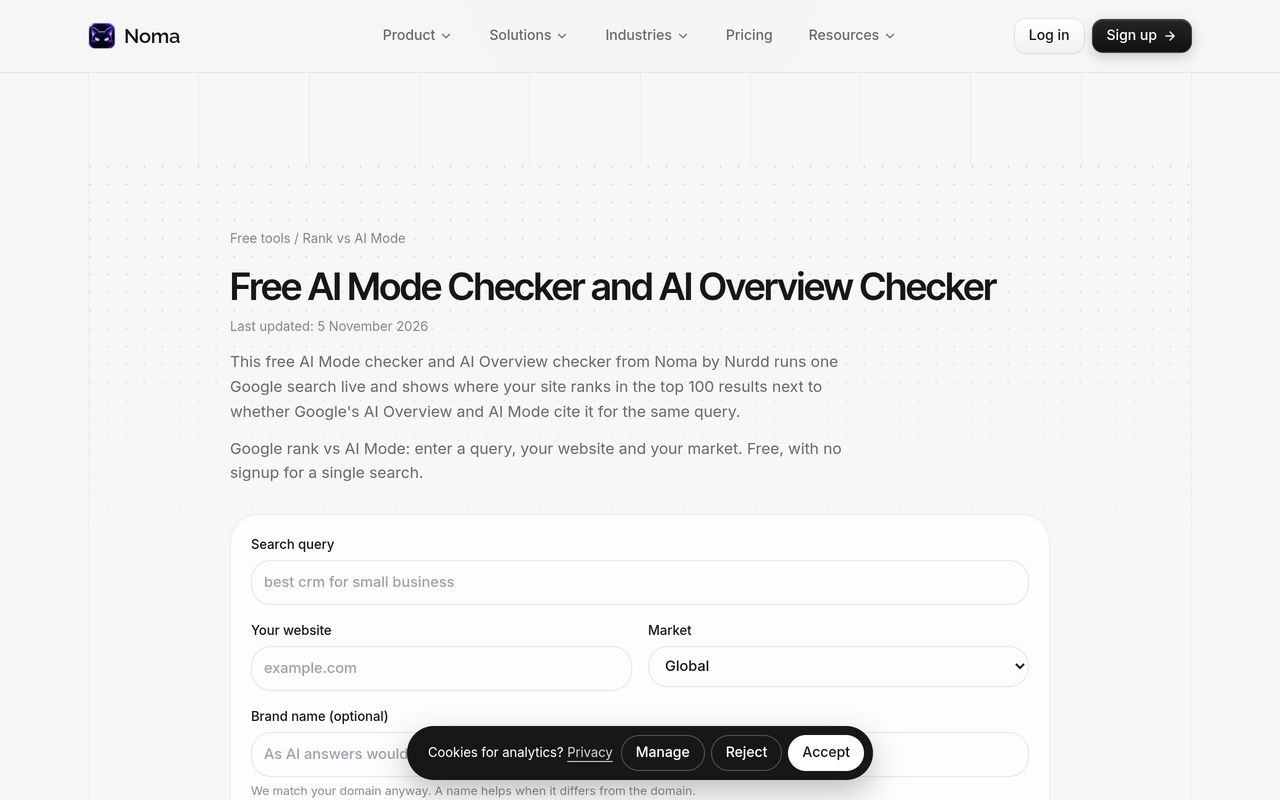
A one-off checker automates that first look. Noma's free Google rank vs AI Mode checker puts your Google rank for a query next to what AI Overviews and AI Mode cite for the same query, and who they cite instead, so you can see in one view whether ranking and citation agree.
Is there a free AI Mode checker?
Yes, several. As checked on 2026-11-07, Ahrefs lists a free AI Mode Tracker that says it needs no signup and checks whether AI Mode mentions and cites your brand. serp.tools offers a free Google AI Mode checker that says it returns the full AI response, every cited source and the cited domains for a keyword. Noma by Nurdd's own free checker, linked above, pairs AI Mode and AI Overviews citations with your Google rank.
They share one limit. Each returns a single answer per request, so each is a spot check. None of their pages claims that one result is a stable position, and you should not read one that way.
What a free checker is good for
- Triage. Is the brand absent from an answer it should be in? Worth a closer look.
- Source discovery. The cited URLs show what Google pulled in. If a forum thread or a review site is cited and you are not, that is your gap.
- Rank versus citation. Checking a page that ranks first but is never cited, or the reverse, tells you which problem you have.
- Client or boss demos. A live answer is persuasive in a meeting. Just label it as one sample.
Why is a single AI Mode answer not a ranking?
A ranking is an ordered list that is broadly the same for everyone who searches. An AI Mode answer is a generated response with a set of supporting links, and Google's own documentation describes how it is assembled. According to Google Search Central, December 2025 (as checked on 2026-11-07), AI Overviews and AI Mode may use a "query fan-out" technique, issuing multiple related searches across subtopics and data sources, and the two may use different models and techniques, so the responses and links they show will vary.
Three consequences follow, and each breaks the idea of a position.
- The sources are a set, not a ladder. Links are shown to support parts of the answer. Being first in the list does not mean being the strongest result for the query.
- The searches behind the answer are not the one you typed. Fan-out means Google may search subtopics you never wrote. A page can be cited for a sub-question while ranking nowhere for your head term.
- The answer can differ per person. TechCrunch reported in January 2026 that AI Mode can draw on a user's Gmail and Photos for tailored responses. Your check reflects your session, not the market's.
Standalone summary: Google AI Mode does not publish a ranking for any query. It returns a generated answer with supporting links, built from multiple related searches, and the links it shows can change between identical requests.
What does the data say about how much the answers change?
The most useful public numbers come from outside Google, and they are older than we would like, so treat them as direction rather than precision.
| Finding | Study | What it means for a checker |
|---|---|---|
| Only 9.2% of URLs matched across three tests; SE Ranking says even the same query run several times on the same day often gives different sources | SE Ranking, August 2025, describing a June 2025 study of 10,000 keywords | A single run can miss a page that appears in the next one |
| 14% URL overlap with the organic top 10, 21.9% at domain level | Same SE Ranking study | Your Google rank does not predict an AI Mode citation |
| Same brand list less than 1% of the time across repeated runs of one prompt (ChatGPT and Google Search AI Overviews, not AI Mode) | Search Engine Journal, January 2026, reporting SparkToro's research | Lists and their order are unstable; visibility across many runs is steadier |
According to SE Ranking's study, only 9.2% of URLs matched across three tests of the same AI Mode query, which is why one check is a sample and not a measurement. The SparkToro figure covers different engines, so do not read it as an AI Mode number. It points the same way: Search Engine Journal reports the researchers found visibility percentage across many queries more consistent than ranking position.
Our own data on other engines is consistent with this. In Noma's citation half-life analysis of 2,545 answers from ChatGPT, Gemini, Perplexity and Claude, two in three cited URLs appeared in one run only. That covers different engines from AI Mode, but the lesson transfers: a URL seen once is weak evidence.
What can a one-off AI Mode check tell you?
Quite a lot, if you ask it the right questions. A single check is good for existence proofs and bad for averages.
It can prove
- The brand or page can appear for this query. One appearance is enough to show that.
- Which publishers, competitors and community pages Google drew on in that run.
- Whether the answer states something wrong about you. One wrong sentence is worth fixing even if it shows only some of the time.
- Whether a page that ranks well is cited at all.
It cannot prove
- That you are absent. A miss in one run is not absence; see the 9.2% figure above.
- That a change you made worked. Two single runs a week apart differ even if nothing changed.
- That your share of voice is up or down.
- Why you were cited. The checker shows the output, not Google's reasons.
The asymmetry is the rule to remember: a hit proves possibility, a miss proves nothing. That is why a first check should never end with "we are not in AI Mode."
How many runs do you need before you trust a result?
Enough that the uncertainty is smaller than the change you are looking for. Here is a worked example using plain arithmetic, not a published benchmark.
Suppose you track 10 prompts and run each 5 times, giving 50 answers. Your brand appears in 10 of them, a 20% mention rate. A rough 95% margin of error for a proportion is 1.96 times the square root of (0.2 x 0.8 / 50), which is about 11 percentage points. So the true rate is plausibly anywhere from roughly 9% to 31%. A move from 20% to 25% next week is inside the noise. Repeated runs of one prompt are not fully independent, so the real margin is likely wider.
| Sample | Answers | Margin at 20% mention rate | Good for |
|---|---|---|---|
| 1 prompt, 1 run | 1 | Not meaningful | Spot check, finding sources |
| 10 prompts, 5 runs | 50 | About 11 points | Baseline, big gaps only |
| 25 prompts, 5 runs | 125 | About 7 points | Spotting a clear move after a fix |
| 25 prompts, daily for 14 days | 350 | About 4 points | Trend and per-engine comparison |
The margins come from the same formula, applied to each sample size. They show why daily scheduled sampling beats a clever one-off: the sample, not the cleverness of the prompt, is what narrows the doubt. For the method in full, see how to measure AI share of voice across engines.
How do you run a repeatable AI Mode check by hand?
If you have no budget yet, this protocol takes about an hour and gives you a baseline you can defend.
- Write 10 prompts a buyer would ask. Use category and problem wording, not your brand name. A branded prompt tells you what Google says when asked about you, which is a different test.
- Freeze the wording. Changing a word changes the fan-out. Keep a spreadsheet with the exact prompt text.
- Fix the conditions. Same browser, same location, signed out. Note the date and time.
- Run each prompt five times, a few minutes apart, opening a fresh AI Mode session each time.
- Log per run: brand named (yes or no), your URL cited (yes or no), competitors named, and the cited domains.
- Compute two rates: mention rate (runs naming you divided by total runs) and citation rate (runs citing your URL divided by total runs). State the denominator every time.
- Rank the cited domains by frequency. The top five are the pages you need to be on or beside.
Repeat monthly at the very least. The Noma AI Mode rank tracking guide goes deeper on what counts as a position and how to compare with Google rank.
Why can't Search Console act as an AI Mode checker?
Search Console tells you how many people clicked, not which AI answer cited you. Per Google Search Central, December 2025 (as checked on 2026-11-07), sites appearing in AI features are included in overall search traffic and reported in the Performance report within the "Web" search type. That means AI Mode clicks are blended with classic clicks, with no prompt-level breakdown.
Use Search Console to see whether total clicks and impressions for a page moved, and use a checker or tracker to see what the answer said. Our note on measuring AI traffic when Search Console shows no AI clicks covers GA4 referrer rules for the rest.
What if the checker says you are missing?
Work through causes in order of cheapness. Google's documentation states there are "no additional requirements to appear in AI Overviews or AI Mode" beyond Search's own, per Google Search Central, December 2025 (as checked on 2026-11-07). So the checklist is mostly ordinary SEO plus content that is easy to cite.
| Symptom in the check | Likely cause | What to do |
|---|---|---|
| Page never cited, not in Google results either | Not indexed or not snippet-eligible | Check indexing and snippet controls in Search Console |
| Page ranks well, never cited | Answer is not in a quotable passage, or other sources cover the subtopics | Add a direct answer near the top; cover the follow-up questions |
| Competitors cited via review sites or forums | Engine relies on third-party sources | Earn presence on those cited domains |
| Brand named but with wrong facts | Outdated or inconsistent source pages | Correct your own pages and the cited third-party ones |
| Appears sometimes, not always | Normal run-to-run variation | Sample more before changing anything |
The free AI crawler checker shows whether GPTBot, OAI-SearchBot, ClaudeBot, PerplexityBot and Google AI can crawl your site, which helps if you also care about other assistants. For the content side, see how to optimise content for AI Mode and AI Overviews queries.
Where does Noma fit?
Noma by Nurdd is an answer engine optimisation (AEO) platform that asks 13 AI engines, including ChatGPT, Gemini, Perplexity and Claude, the questions your buyers ask, every day. Google AI Mode is available as an add-on. Noma shows where your brand is named, which competitors are named instead and which pages each answer cites, as a daily series rather than a single answer.
See it on your own brand: book a demo or start the 3-day free trial. A card is taken at signup so billing can start on day 3; cancel before then and nothing is charged. Plan details are on the pricing page.
AI Mode checker versus rank tracker versus tools roundup
These get confused, so here is the split. A checker answers a question about one answer. A rank tracker, in the AI Mode sense, tries to report presence over time. A roundup compares vendors. If you need to choose a vendor, read what each AI Mode SEO checking tool can test; if you want to compare Google rank with AI Mode presence, use the free tool; if you want to know whether your work moved anything, you need a fixed prompt set sampled daily, as in Noma's prompt tracking.
How we researched this
We reviewed Google Search Central documentation on AI features, the free checker pages published by Ahrefs and serp.tools, independent studies of AI Mode source volatility from SE Ranking and SparkToro (as reported by Search Engine Journal), and TechCrunch's report on AI Mode personalisation. We did not run our own AI Mode experiments for this article; the sample-size table is arithmetic, not measured data. The Google, SE Ranking and Search Engine Journal pages were fetched and their wording checked, and facts about third-party tools were checked on their own pages, on 2026-11-07. The volatility studies are from 2025 and early 2026, so re-test in your own category.
What to do next
Run one query through the free Google rank vs AI Mode checker today, note who is cited, then build your 10-prompt baseline and sample it repeatedly. When you want that running daily across 13 AI engines, book a demo or start the free trial.
See what AI engines say about your brand
Free · no account · or start a 3-day trial
Questions people ask
How do I check if my site appears in Google AI Mode?
Search a buyer-style question in AI Mode, then log whether your brand is named, whether any of your URLs is among the links, and who appears instead. Repeat the same prompt several times, because the sources change between runs. A free tool such as Noma's Google rank vs AI Mode checker automates the first look.
Is there a free AI Mode checker?
Yes. As checked on 2026-11-07, Ahrefs and serp.tools each publish a free AI Mode checker, and Noma by Nurdd offers a free Google rank vs AI Mode tool that sets your Google rank beside AI Mode and AI Overviews citations. Each gives one answer per request, so treat it as a spot check.
Is an AI Mode result the same as a ranking?
No. AI Mode returns a generated answer with supporting links, built from related searches Google runs on subtopics. The links are a set that can change between identical requests, so there is no stable position to report.
How many times should I run an AI Mode check?
Run each prompt at least five times and track 10 or more prompts for a baseline. With 50 answers and a 20% mention rate, the margin of error is about 11 percentage points, so only large gaps are meaningful. Daily sampling over two weeks narrows it further.
Does Search Console show AI Mode data?
Google Search Central says AI feature traffic is included in overall search traffic and reported in the Performance report within the Web search type. It is blended with other clicks, so you cannot see which AI Mode prompts cited your pages.
Why does my brand appear in AI Mode for me but not for a colleague?
Answers can vary by session and by user. TechCrunch reported in January 2026 that AI Mode can use Gmail and Photos for tailored responses, and the sources also vary between runs. Test signed out, repeat the prompt, and compare across several people before drawing conclusions.