

OpenAI's tool to claim your business in ChatGPT is, as of 7 November 2026, a reported feature in development, not a launched product. Search Engine Roundtable, November 2026 describes a Search Console- or Webmaster Tools-like console where businesses track mentions, keep product details current and shape how a business agent answers. OpenAI has not announced it.
Key takeaways
- The tool is reported, not launched. Treat every detail below as provisional until OpenAI publishes documentation.
- It reportedly counts impressions and clicks per day, and reportedly shows no prompts, no user data and no competitor benchmark.
- Log your baseline now: a fixed prompt set, your mentions, your cited URLs and the rivals named instead.
- Confirm that OAI-SearchBot can crawl your pages. Sites opted out of it are not shown in ChatGPT search answers.
- Prepare a verified ownership route, since the report says access needs verified ownership, for example a connected Shopify store.
- A single-engine console cannot show how Gemini, Perplexity and Claude treat you. Keep a cross-engine measure alongside it.
What is OpenAI's tool to claim your business in ChatGPT?
The only public account is the Search Engine Roundtable report by Barry Schwartz, published 6 November 2026. It rests on a LinkedIn post by Juozas Kaziukėnas, who spotted the feature. OpenAI's own pages did not mention it in the searches I ran on 7 November 2026.
Here is what the report says, separated by confidence.
| Detail | What is reported | Status |
|---|---|---|
| Name on the banner | "Claim your business in ChatGPT" | Reported, from a screenshot |
| Mention tracking | How often your business is mentioned in ChatGPT conversations | Reported |
| Metrics | Impressions (appearances in responses) and clicks to your site, daily, as a chart | Reported by Kaziukėnas |
| Business info | Add latest products and keep business details current | Reported |
| Business agent | Answers customer questions with context you control | Reported |
| Access | Part of a larger Business Hub, only for businesses that verified ownership, for example by connecting a Shopify store | Reported |
| Not included | No prompt data, user data or competitor benchmark or ranking | Reported |
| Launch date, pricing, regions | Not stated | Unknown |
Schwartz also notes it looks separate from ChatGPT ads and aimed at organic responses. For how paid placements should be reported apart, see ChatGPT ads and AI visibility.
Why does a first-party ChatGPT console matter?
Scale. At a media event, OpenAI's Adam Fry said ChatGPT search query volume is about 20% of Google's, KuCoin News, November 2026 reports. Big Technology, November 2026 adds that weekly active users rose from 1 billion to 1.2 billion in 60 days. Treat both as company statements relayed by the press, not audited measurements.
Until now, brands had no first-party count of ChatGPT appearances. Referral traffic in analytics shows only clicks, and only those that carry a referrer. A console that counts impressions would be the first official denominator for ChatGPT, which makes click-through rate calculable.
What would the tool not tell you?
According to Kaziukėnas, it would not show prompts, users or competitors. He put it this way: it would not explain why mentions rise or fall, but paired with external prompt tracking it would give first-party data on whether GEO and AEO work is paying off.
That gap defines the job for any measurement stack. A mention count says nothing about which question triggered it, whether the description was accurate, or whether a rival was named above you.
| Question you need answered | Reported console | Needs another source |
|---|---|---|
| How many times was my business shown in ChatGPT? | Yes, reportedly | No |
| How many clicks reached my site? | Yes, reportedly | Cross-check with GA4 referrals |
| Which buyer questions name me? | No | Fixed prompt tracking |
| Who is named instead of me? | No | Competitor tracking |
| Which pages does ChatGPT cite? | Not stated | Citation logging |
| How do Gemini, Perplexity and Claude treat me? | No, it is ChatGPT only | Cross-engine tracking |
How can I track my brand's citations in ChatGPT?
Do it without waiting for the tool. A mention is your brand named in the answer. A citation is a URL the answer links as a source. They differ, and you need both; citation versus brand mention explains how to log each.
- Write 20 to 30 buyer prompts. Use unbranded category questions, comparison questions and use-case questions. The free AI Prompt Finder suggests questions buyers ask about your category.
- Run each prompt several times. Answers vary between runs, so one check misleads. Use fresh sessions.
- Log four fields per run: date, whether you were named, position among named brands, and every cited URL.
- Record who is named instead. This is the competitor view the reported console lacks.
- Compute mention rate: runs naming you divided by total runs, stating both numbers.
The manual method is laid out step by step in how to track brand mentions in ChatGPT. Once your console numbers arrive, you can set the console's impressions beside your prompt-level mention rate and see whether they move together.
What should brands do before the tool launches?
1. Confirm crawler access
OpenAI's documentation says each crawler setting is independent. Per OpenAI, bot overview, 2026, "Sites that are opted out of OAI-SearchBot will not be shown in ChatGPT search answers", though they can still appear as navigational links. The same page says a site can allow OAI-SearchBot while disallowing GPTBot, which governs training use.
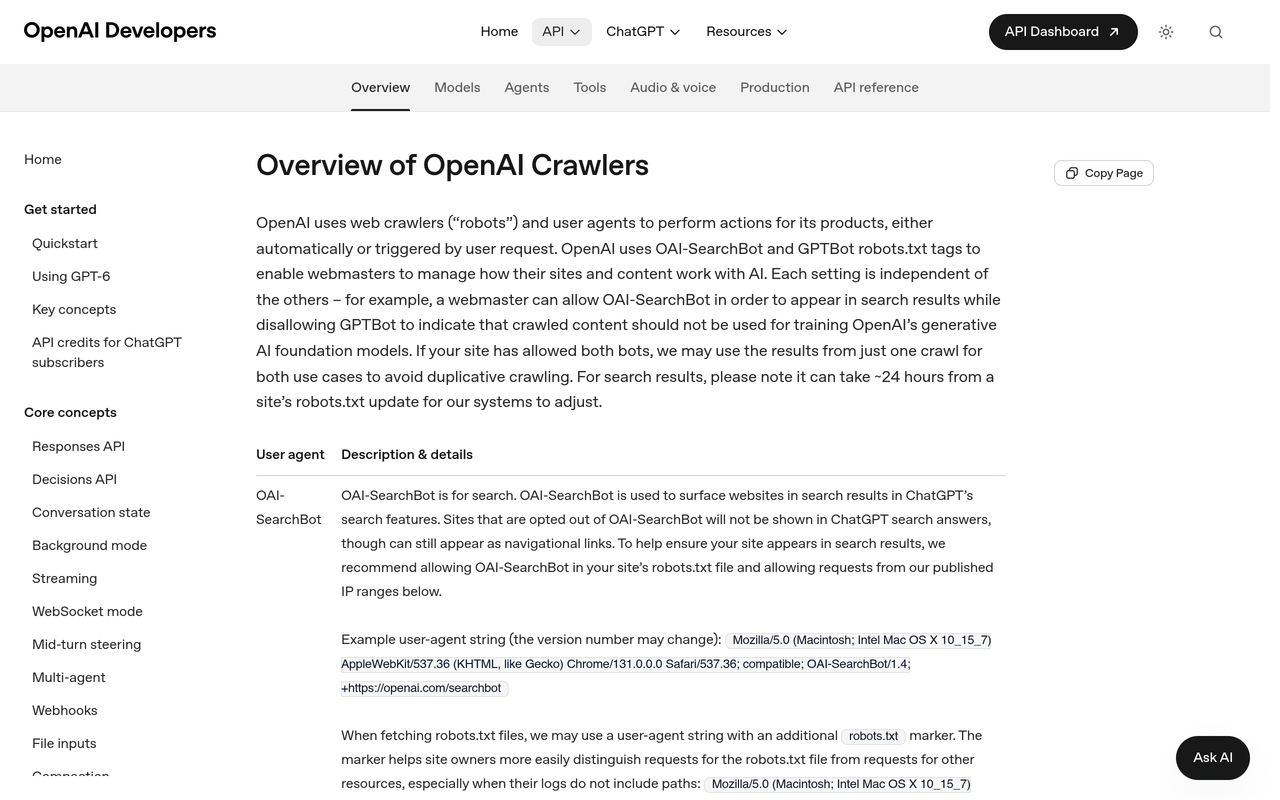
The same page says ChatGPT-User handles certain user-initiated actions, so robots.txt rules may not apply to it. Run your domain through the free AI Crawler Checker to see whether OAI-SearchBot and the other AI bots can reach you, and check your CDN or firewall too. The failure modes are covered in ChatGPT agent blocked your site.
2. Check your pages are readable and quotable
The free AI SEO Checker tests whether ChatGPT, Claude, Perplexity and Google AI Mode can read a page, with 30+ checks and the top fixes. Run it on your homepage, product pages and pricing page first.
3. Prepare for ownership verification
The report says verification came via connecting a Shopify store. Other routes are unconfirmed. Settle now who in your company can authorise a connection, and keep your legal name, domain and product data consistent everywhere. This mirrors the discipline in winning the AI shopping shelf.
4. Write the facts a business agent would use
The report says a business agent would answer with context you control. You cannot configure that yet, but you can draft the material: what you sell, who it fits, prices, returns, integrations. Put the same facts on a public page first, since engines read the open web today.
5. Set a decision rule for the data
Decide now what a change means. Example: a rise in console impressions with a flat prompt-level mention rate suggests exposure on questions outside your tracked set, so add prompts. A rise in mention rate with flat clicks suggests the answer names you without linking you, so review your cited pages.
How do you measure it with or without the tool?
Use a three-layer model.
| Layer | Question | Source |
|---|---|---|
| Exposure | How often was I shown? | Reported ChatGPT console, if it launches |
| Position | On which questions, against whom, on which engine? | Fixed prompt tracking across engines |
| Outcome | Did visits and conversions follow? | GA4 referrals, a "how did you hear about us" option |
Only the first layer depends on OpenAI. The other two work today. For the outcome layer, see the AI search attribution guide, and for the comparison step how to measure AI share of voice.
Where does Noma fit?
Noma by Nurdd is an AEO and AI visibility platform that asks 13 AI engines, including ChatGPT, Gemini, Perplexity and Claude, the questions your buyers ask, every day. It shows where your brand is named, where competitors are named instead and which pages the answers cite, with visibility, position and sentiment per engine. A ChatGPT-only console cannot show that cross-engine view.
See it on your own brand: book a demo or start the 3-day free trial. A card is taken at signup so billing can start on day 3; cancel before then and nothing is charged.
What are the limits of this report?
- It is a single secondary account of a screenshot and a LinkedIn post. OpenAI has not confirmed it.
- Names, metrics and access rules may change before launch.
- Impressions are undefined in the report: it does not say what counts as an appearance.
- The ChatGPT usage figures are company statements relayed by the press.
How we researched this
We read the Search Engine Roundtable report, searched for any OpenAI announcement of the tool and found none, and reviewed OpenAI's crawler documentation and ChatGPT search announcement alongside press coverage of OpenAI's usage statements. Facts were checked on 2026-11-07. We have not tested the tool, which is not publicly available.
What to do next
This week: run the crawler check, log a 20-prompt ChatGPT baseline and name an owner for verification. Then add the other engines so you can compare. To see all of it in one place, book a demo or start the free trial.
See what AI engines say about your brand
Free · no account · or start a 3-day trial
Questions people ask
What is OpenAI's tool to claim your business in ChatGPT?
It is a reported Search Console-like tool, spotted in development and covered by Search Engine Roundtable on 6 November 2026. It reportedly lets verified businesses track mentions, manage product and business info, and set context for a business agent. OpenAI has not announced it.
How can I track my brand's citations in ChatGPT?
Write 20 to 30 buyer prompts, run each several times in fresh sessions, and log whether you were named, your position and every cited URL. Record which competitors appear instead. A tracker such as Noma automates this daily.
Will the ChatGPT business tool show which prompts mention my brand?
Not according to the report. It says the tool shows impressions and clicks but no prompt data, user data or competitor benchmark. You would need separate prompt tracking to see which questions name you.
Do I need to allow OAI-SearchBot to appear in ChatGPT?
OpenAI's documentation says sites opted out of OAI-SearchBot will not be shown in ChatGPT search answers, though they can still appear as navigational links. You can allow it while disallowing GPTBot, which relates to training.
Who will be able to claim a business in ChatGPT?
The report says access is for businesses that have verified ownership, for example by connecting a Shopify store. Other verification routes, regions and pricing have not been reported.
Does a ChatGPT console replace AI visibility tracking?
No. It would cover ChatGPT only, and reportedly lacks prompts and competitor data. Brands still need a fixed prompt set across engines to see Gemini, Perplexity and Claude.