

The best AI visibility tool for a marketing team is the one that does the job you need: measuring how often AI engines name your brand, showing which sources they use, fixing the pages they read, tracing traffic, or reporting. Compare each AI visibility tool on engines, prompt limits, repeat runs, cited URLs and price, then test it before you pay.
Key takeaways
- Pick the job first. Tracking mentions, showing sources, auditing pages, attributing traffic and reporting are five different jobs. Decide which one you are buying for.
- Check engine coverage against the engines your buyers use. Noma by Nurdd does not track Microsoft Copilot or Meta AI, so every tool's list matters.
- Divide price by tracked prompts. Across Noma's own plans the cost per prompt varies by a factor of about 15.
- Ask whether the tool repeats each prompt. A single run is an anecdote, not a measurement.
- Run a free page check and a 3-day trial on the same 20 prompts before you commit.
What is the best AI visibility tool for a marketing team?
No single tool is best for every team. A ranked list may reflect its author's own product, and this post comes from a vendor too, so use it for the feature checklist, then test.
A more useful question is what you will do on Monday morning with the output. A growth lead who needs a weekly mention rate for a board slide wants a tracker. A content lead who needs to know which page to rewrite wants citation sources and a page audit. An agency wants one login per client and a shareable report.
The five jobs an AI visibility tool can do
- Track mentions. Ask engines your buyers' questions on a schedule and record whether your brand is named, how high, and with what sentiment.
- Show sources. List the URLs each answer cites, so you know which pages and third-party sites to work on.
- Audit pages. Check whether your own pages can be crawled, read and quoted.
- Attribute traffic. Separate visits from AI assistants and AI crawler hits in your analytics or server logs.
- Report. Package results for a CFO, client or leadership team.
How do I compare AEO tools? A decision table by job
Use this table to turn your job into the criteria that matter. The right-hand column is the test to run, not a feature to look for on a pricing page.
| Your job | Criteria that matter | Test before you buy |
|---|---|---|
| Track brand mentions | Engines covered, daily or weekly runs, repeat runs, visibility, position and sentiment per engine | Run 20 of your buyer prompts and check whether the tool shows the full answer text |
| Find which sources to work on | Cited URLs per answer, gap analysis | Pick three cited URLs and open them: does the answer really draw on them? |
| Fix your own pages | Structured data, crawler access, content freshness, draft briefs | Run the same page through a free checker and compare the findings |
| Attribute traffic | Server-log crawler data, assistant referrals, Search Console link | Compare its referral numbers with your own GA4 referrer report |
| Report for clients or leadership | Multiple projects, shareable reports, export or API | Export one week of raw answers and check you can rebuild the headline number |
| Meet enterprise security rules | SSO, SOC 2, data location, procurement support | Ask for the security page and read it before the demo |
For a longer buyer's checklist, see AEO tools: how to choose one and what to test before buying. For enterprise questions, the procurement checklist on SSO and on-prem covers what to ask.
Why a single run tells you almost nothing
AI answers change between runs. In Noma's own measurement of 2,545 answers from ChatGPT, Gemini, Perplexity and Claude, two in three cited URLs appeared in one run only, and 36% of cited URLs were cited again within a week (Noma by Nurdd, November 2026). A tool that shows you one run per prompt will make your visibility look better or worse than it is.
Engines also differ from each other, so a blended score across engines can hide the one engine where you are missing. Noma's post on engines disagreeing on the top brand shows how to check this yourself. Ask any vendor to split results per engine.
The AI Visibility Measurement Standard from Noma states the method plainly: run a fixed set of unbranded buyer prompts on each engine several times, state each numerator and denominator, and call a change only when it exceeds the margin of error (Noma by Nurdd). Use that as your yardstick for any tool, including ours.
What do AI visibility tools cost?
Headline prices are not like for like: the prompts, engines and seats behind each number differ. Searchable's own pricing page advertises "Transparent pricing from $125/mo" and says annual plans save 20% on the plan price (Searchable pricing page, as checked on 27 October 2026). We could not re-confirm other vendors' prices on their own pages, so we leave them out rather than quote second-hand figures. Read each vendor's page on the day you buy, and put the same questions to every one:
| Question for each vendor's pricing page | Why it changes the comparison |
|---|---|
| How many prompts are tracked on the entry plan? | Lets you work out price per prompt |
| Is a prompt one question on one engine, or on all engines? | Changes the real answer count several times over |
| Which engines are on the plan, and which are add-ons? | Engine lists on feature pages often cover more than the plan does |
| How many projects, brands and seats? | Decides whether an agency or multi-brand team fits |
| Is there a trial, and is a card needed? | Sets how much you can test before paying |
For extra reading, Noma's AI visibility tool pricing page lists published prices of 12 tools with the date each was read; check each figure against the vendor's own page.
Worked example: price per tracked prompt
A headline price hides the prompt cap. Divide monthly price by tracked prompts, using Noma's published plans on its pricing page (USD, as checked on 7 November 2026):
| Noma plan | Price a month | Tracked prompts | Price per prompt | Projects |
|---|---|---|---|---|
| Starter | $79 | 50 | $1.58 | 1 |
| Growth | $299 | 60 | $4.98 | 3 |
| Scale | $799 | 100 | $7.99 | 10 |
| Studio | $499 | 50 | $9.98 | 10 |
| Agency | $1,199 | 50 | $23.98 | 25 |
Price per prompt is lowest on Starter and highest on Agency. Do the same division on every shortlisted tool, and note what a prompt means to that vendor.
Where does Noma fit?
Noma by Nurdd is an answer engine optimisation (AEO) platform that asks 13 AI engines, including ChatGPT, Gemini, Perplexity and Claude, the questions a brand's buyers ask, every day. It reports visibility, position and sentiment per engine, lists the sources each answer cites, shows competitor share of voice, and audits pages for AEO readiness. Noma does not track Microsoft Copilot or Meta AI.
See it on your own brand: book a demo or start the 3-day free trial. The trial includes 25 tracked prompts; a card is taken at signup so billing can start on day 3, and cancelling before then costs nothing.
How Noma lines up against the criteria
Match these rows against your shortlist. Each row is a fact about Noma as published on its own pages, so you can ask every other vendor the same question.
| Criterion | Noma by Nurdd | Question to put to any tool |
|---|---|---|
| Engines | 13 AI engines, including ChatGPT, Gemini, Perplexity and Claude | Which engines, and which are on my plan? |
| Run frequency | Every day, from fresh sessions | How often, and is each prompt repeated? |
| Metrics per engine | Visibility, position, sentiment | Are results split by engine? |
| Sources | Lists the sources each answer cites | Can I open every cited URL? |
| Page audit | Structured data, llms.txt, FAQ schema, freshness, Core Web Vitals | Does it audit my pages or only track answers? |
| Crawler data | Agent analytics names AI agents such as GPTBot, ClaudeBot and PerplexityBot from server logs | Does it show who crawls me? |
| Connections | Google Search Console; MCP server for Claude, Claude Code and Cursor on every paid plan; API on higher plans | Can I get raw data out? |
| Trial | 3 days, 25 prompts, card taken at signup, nothing charged if cancelled before day 3 | Is there a trial, and is a card needed? |
If your first need is an all-in-one SEO suite, read all-in-one suite or separate tracker; Noma vs Semrush vs Ahrefs has the price and engine detail.
How can I test a tool's claims before I buy?
Vendors will show you their best dashboard. Run these five checks yourself in the trial week.
- Fix the prompt set. Write 20 unbranded buyer questions. Use the free AI Prompt Finder if you need ideas.
- Check one answer by hand. Paste three prompts into ChatGPT, Gemini and Perplexity yourself. Does the tool's answer text resemble what you see?
- Check repeat variance. Run each prompt at least three times. If the tool reports a single number with no range, treat its trend lines with caution.
- Open the cited URLs. Take five citations and confirm each page exists and says what the answer claims.
- Test its page advice. If the tool says a page is unreadable to AI engines, check it independently.
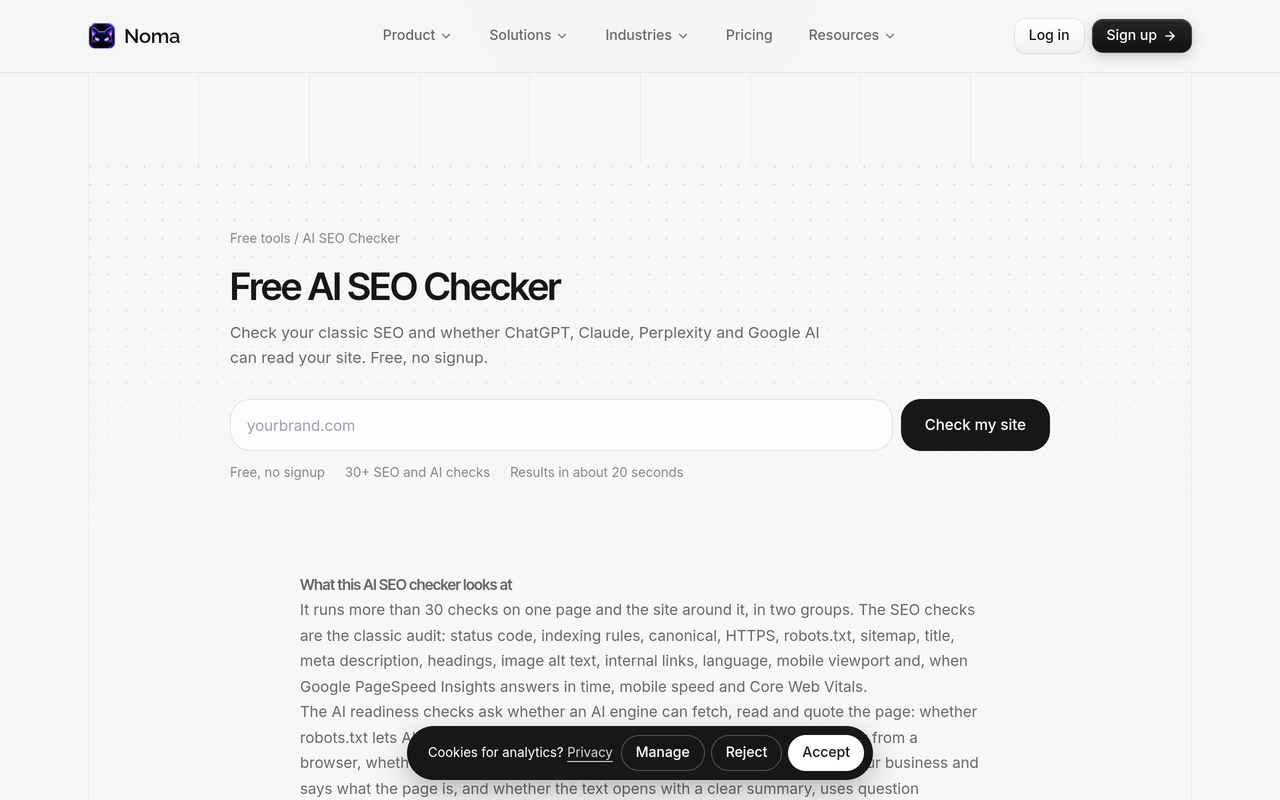
For check five, run the page through Noma's free AI SEO Checker, which shows whether ChatGPT, Claude, Perplexity and Google AI Mode can read a page, with 30+ checks and the top fixes. If a paid tool flags a problem the checker does not, or the reverse, find out why before you spend the fix budget. You can also confirm bot access with the free AI crawler checker.
Sample size arithmetic
Twenty prompts on four engines, repeated five times, is 400 answers a week. If your brand appears in 60 of them, mention rate is 15%, and the denominator is stated. A tool that cannot show both numbers cannot support a claim that visibility moved. The guide to measuring AI share of voice explains margins of error.
Common mistakes when choosing an AI visibility tool
- Buying on engine count alone. A long list of engines on a feature page is not the same as those engines being on your plan.
- Trusting a composite score. A score without numerator, denominator and per-engine split cannot be audited.
- Ignoring the fix side. Tracking tells you that you are absent. Someone still has to change pages and earn third-party mentions. Plan for that headcount.
- Skipping attribution. Mentions are not visits. Read the AI search attribution guide before promising traffic.
- Copying a ranking without checking fit. Any ranked list, this one included, comes from an author with a view. Use it for the feature list, then test.
Which tool for which team?
| Team | First need | What to shortlist for |
|---|---|---|
| In-house marketing team, one brand | Weekly mention rate and sources | Daily tracking, per-engine split, cited URLs, a trial with at least 20 prompts |
| Content team | Which page to write or fix | Gap analysis and page audit, plus a free checker to cross-check |
| Agency | Many clients, branded reports | Project count and report sharing; see AI visibility tools for agencies |
| Team living in an SEO suite | One login, one invoice | The suite's toolkit, tested against a dedicated tracker on the same prompts |
How we researched this
We reviewed vendor pricing pages, Noma's own published comparison pages and measurement studies, and Noma's pricing page. Noma's plan prices and trial terms were checked on 2026-11-07. Searchable's figure was read from its own pricing page, retrieved 27 October 2026. We left out other competitor prices because we could not confirm them on each vendor's own page. We have not tested competitors' products hands-on and do not claim to.
What to do next
Write your 20 prompts, pick your job from the decision table and shortlist two or three tools. Run the free checker on your top page, then put the same prompts through each trial. To see Noma on your own brand, book a demo or start the free trial.
See what AI engines say about your brand
Free · no account · or start a 3-day trial
Questions people ask
What is the best AI visibility tool for a marketing team?
It depends on the job. A tracker suits a team that needs weekly mention rates, a page audit suits a content team, and project count matters to agencies. Shortlist two or three tools, then test them on the same 20 buyer prompts.
How do I compare AEO tools?
Compare engines covered, prompt limits, run frequency, repeat runs, per-engine results, cited URLs and price per tracked prompt. Then run a trial on a fixed prompt set and check a few answers and citations by hand.
How does Noma by Nurdd differ from an SEO suite?
Noma asks 13 AI engines, including ChatGPT, Gemini, Perplexity and Claude, your buyers' questions every day. It reports visibility, position, sentiment and cited sources per engine. It is built for AI answers rather than ranked links.
Is there a free way to test an AI visibility tool's claims?
Yes. Run the page a tool flags through Noma's free AI SEO Checker, which tests whether ChatGPT, Claude, Perplexity and Google AI Mode can read it. Also check a few answers by hand in each engine.
Does Noma offer a free trial?
Noma has a 3-day free trial with 25 tracked prompts. A card is taken at signup so billing can start on day 3. Cancel before then and nothing is charged.
Why do AI visibility results change between runs?
AI answers vary from run to run. In Noma's measurement of 2,545 answers, two in three cited URLs appeared in one run only. Repeat each prompt and report ranges, not single results.