

Yes, Google AI Mode ads now show in follow-up answers, not only in the first response. Google announced multiturn ads for the US on 28 October 2026, and ads in follow-up queries are labelled "Sponsored". For a brand, that means each turn of a conversation is a separate chance to be named, outbid or ignored.
Key takeaways
- Multiturn ads are live in the US: Google's own announcement says they exist "to allow ads in follow-up queries in AI Mode".
- No new campaign is needed. Existing Search, Shopping and Performance Max campaigns take part through the normal auction, with no separate budget.
- Paid and organic are separate. Google's help page says paid advertising does not influence the organic responses generated by Google AI.
- Test whole conversations, not single queries. Run a fixed five-turn script and log the answer, the cited sources and every ad at each turn.
- Report paid and organic in two columns. Google Ads shows ad performance in aggregate, and only a prompt-level log shows whether your brand is in the unpaid answer.
Do ads show in Google AI Mode follow-up answers?
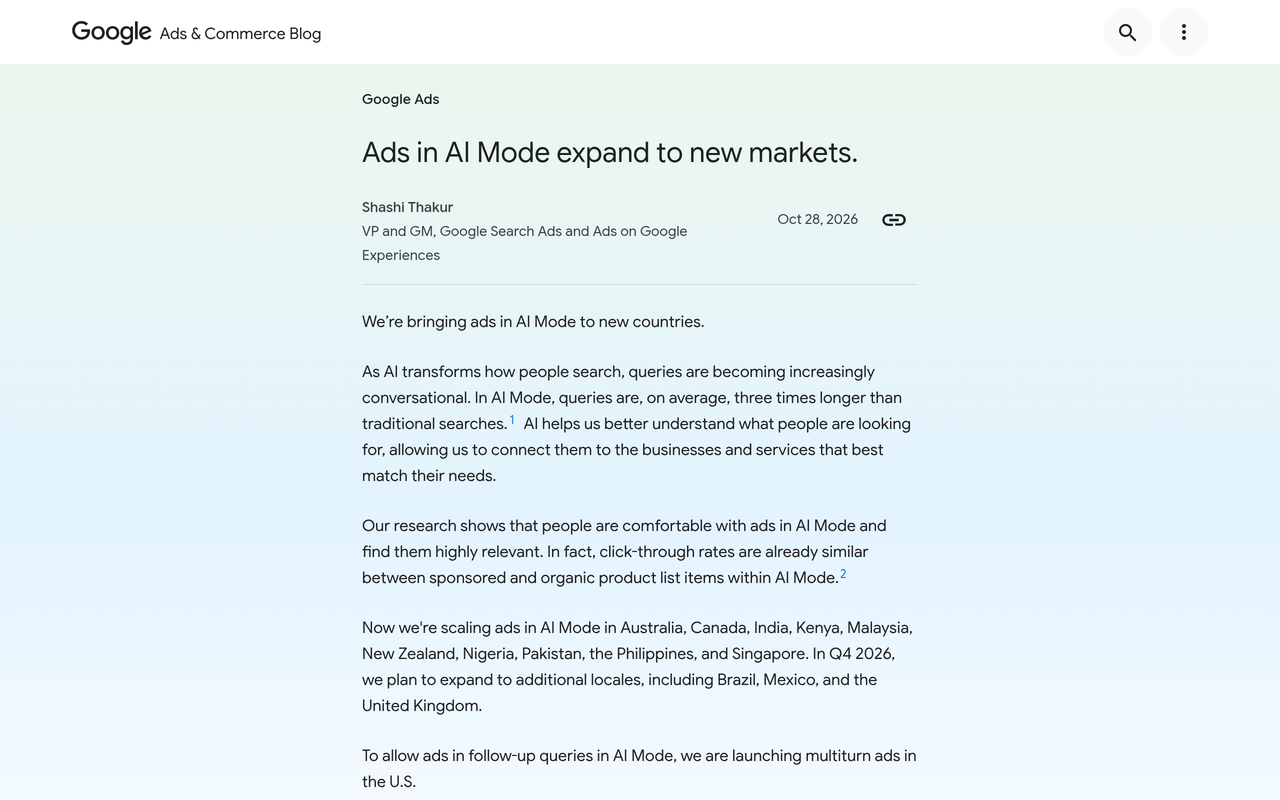
They do, in the US, since the 28 October 2026 announcement by Shashi Thakur, VP and GM of Google Search Ads. The post says: "we are launching multiturn ads in the U.S." (Google Ads & Commerce Blog, October 2026).
Search Engine Roundtable's Barry Schwartz then tested it. He reported ads under both the first and the follow-up response, and additional ads in the third and fourth follow-up queries (Search Engine Roundtable, November 2026). That is one tester's observation, not a measured rate, so treat it as proof the format exists rather than proof of how often it fires.
Google's Ads Help page says ads can appear directly within or alongside AI-generated responses, including across follow-up questions in AI Mode (Google Ads Help, as checked 10 November 2026). The same page warns that the exact layout may change as Google tests formats.
What are multiturn ads, in plain terms?
Multiturn ads are Sponsored placements that can appear on the response to any later question in an AI Mode conversation. Google told Search Engine Roundtable that they show up as users engage in back-and-forth conversations. Before this, the announcement wording implies ads were tied to the opening exchange, although Google does not say so directly (PPC Land, November 2026).
The shift matters because of how people use AI Mode. Google reports that queries in AI Mode are, on average, three times longer than traditional searches (Google, October 2026, citing its US AI Mode report from May 2026). Longer, more specific questions reveal intent at each step, and each step is now a possible ad trigger.
One standalone definition for reference: Google AI Mode multiturn ads are Sponsored text or Shopping ads that Google serves on the response to a follow-up question in an AI Mode conversation, matched to the question and, where intent is exploratory, to the AI answer itself.
How does Google decide which ad appears?
Google Ads Help describes two matching routes. When the query already shows commercial intent, the ad is matched to the query as on a normal results page. When the question is exploratory, the ad is matched to both the query and the AI response.
Google's example: someone asks why their pool is green. The AI answer mentions water testing and vacuuming, so ads for pool vacuums or algae treatment can appear even though the question named no product. In a multiturn conversation, the answer to turn two or three is the context, so the ad can follow the conversation as it moves from "why" to "which" to "where to buy".
| Campaign setup | Direct commercial query | Exploratory follow-up |
|---|---|---|
| AI Max for Search, broad match, Shopping, Performance Max | Eligible | Eligible (query plus AI response) |
| Exact and phrase match keywords | Eligible | Not eligible for contextual matching |
Source: Google Ads Help, as checked 10 November 2026. The practical reading: a brand running only exact-match keywords can be absent from the exploratory follow-ups where buyers compare options.
What changes for brand visibility?
Three things change, and only one of them is something you buy.
- More paid slots per session. One conversation can now carry several ad placements. A competitor with broad coverage can appear at turn two even if you won turn one.
- Ads sit next to the answer, not instead of it. Google states that "Paid advertising does not influence the organic responses generated by Google AI." (Google Ads Help, November 2026) Your presence in the unpaid answer still depends on the pages, mentions and facts Google can retrieve.
- AI explainers add Google-written text near ads. Google says these Gemini-generated lines can introduce a group of Sponsored options or add context using public sources including your website, and advertisers cannot write, edit, approve or opt out of them. Your site copy therefore shapes text that sits beside your ad.
For the organic side, our guides on how Google AI Mode works and picks sources and how to optimise content for AI Mode queries cover what to change.
Who is eligible, and where is it live?
| Question | What Google says | Source, as checked 10 November 2026 |
|---|---|---|
| Where are multiturn ads live? | United States | Google blog, 28 October 2026 |
| Where do ads in AI Mode run beyond the US? | Ten more countries are listed in the announcement, with Brazil, Mexico and the United Kingdom planned for Q4 2026 | Google blog |
| Which campaigns qualify? | Existing Search, Shopping and Performance Max campaigns, automatically | Google Ads Help |
| Which formats? | Text and Shopping ads; local inventory and vehicle ads in experiment | Google Ads Help |
| Can advertisers opt out? | The Keyword reports no separate opt-out for multiturn ads | The Keyword, October 2026 |
Direct Offers, a separate beta asset for promotions to high-intent shoppers in AI Mode, was reported by Search Engine Land on 7 October 2026. It is a different mechanism from multiturn ads, so check whether it applies to you separately.
Google also says it does not show ads in AI Overviews for sensitive verticals such as finance, healthcare, gambling and politics (Google Ads Help on AI Overviews). That page covers AI Overviews, not AI Mode, so do not assume the same list applies. Check the AI Mode page for your vertical.
How do you test multiturn ads on your own brand?
A single query tells you little. Use a scripted conversation, because AI Mode answers and ads vary by session and location. This takes about an hour and needs only a browser and a spreadsheet.
- Write one buyer journey in five turns. Start broad ("how do I choose a project management tool for a 20-person agency"), then narrow: compare options, ask about price, ask about a specific integration, ask where to buy or sign up.
- Use a US location and a clean session. Multiturn ads are US-only for now. Use a logged-out or fresh browser profile and note device type.
- Log every turn. Record the date, the exact prompt, whether any Sponsored block appeared, the advertiser names, and the brands and URLs in the organic answer.
- Repeat three times on different days. One run shows that something appeared. Three runs show whether it is stable. Our piece on how often AI answers change explains why.
- Score two columns per turn. Paid: were you or a rival Sponsored? Organic: were you named in the unpaid answer? Never merge them.
Worked example, with illustrative values only: if across 5 turns and 3 runs (15 turn-checks) a rival's ad appears in 9 and yours in 4, rival paid presence is 60% and yours is 27%. If you are named organically in 6 of the same 15, your organic rate is 40%. The gap between paid (27%) and organic (40%) tells you where the work is. These numbers are a template, not a finding.
For a deeper look at what a one-off check can and cannot prove, see AI Mode checker: what it can and cannot test.
What should you do this week?
If you run Google Ads
- Open the Search terms report and look for queries that are longer and more conversational than your usual terms. Google includes AI Mode and AI Overviews queries in aggregate there, not as a separate line.
- Check whether broad match, AI Max or Performance Max covers your category. Exact and phrase match only reach direct commercial queries.
- Review landing pages and product feeds. Ads combine your headlines, prices, images and landing pages, and AI explainers can draw on your site.
- Confirm negative keywords and asset pinning, which Google says continue to apply.
If you own organic visibility
- Build a follow-up prompt set around comparison, price and "where to buy" turns, not only top-of-funnel questions. See how to choose prompts to track.
- Find which pages Google cites for those turns and fix the ones that are thin, dated or inconsistent.
- Measure the organic answer by share of voice, not rank. Our guide to measuring AI share of voice across engines shows the method.
If you report to leadership
- Split the line: "paid presence in AI Mode" and "organic mention in AI Mode". Combining them hides whether spend is covering an organic gap.
- Say what is unknown. Google gave no ad volume or rates for multiturn ads, and its click-through comparison between sponsored and organic product list items rests on internal US data from 20 August to 3 September 2026, a window of 15 days (PPC Land, November 2026).
Decision table: pay, earn or both?
| Your situation | Likely priority | Why |
|---|---|---|
| Named organically in most buying turns, no ads | Defend organic, watch rivals' ads | Rival Sponsored blocks can sit beside your organic mention |
| Absent from organic answers, strong ad budget | Fix organic sources first | Ads cover the gap but do not change the unpaid answer |
| Absent from both | Start with a baseline, then pick one | You need a measured gap before choosing a budget |
| Exact-match-only account | Review match types and AI Max | Exploratory follow-ups need contextual matching |
| Sensitive vertical | Check AI Mode policy before planning spend | Google's published exclusion list covers AI Overviews |
What mistakes should you avoid?
- Judging by one screenshot. Ads and answers change between sessions, and layouts are still being tested.
- Assuming ads raise organic mentions. Google says paid ads do not influence organic AI responses.
- Ignoring the follow-ups. Most tracking sets use one-shot prompts, which never reach turn three or four.
- Treating a US feature as global. Multiturn ads are US-only in the announcement. Other markets have first-turn ads at most.
- Crediting AI Mode for conversions. Google Ads folds AI Mode metrics into campaign reports in aggregate, so you cannot isolate it there. Pair it with referral checks, as in our GEO referral measurement plan.
The same issue exists elsewhere. If you also see ads in ChatGPT, report them apart from organic mentions in the same way.
Where does Noma fit?
Noma by Nurdd is an AEO (answer engine optimisation) and AI visibility platform. It asks 13 AI engines, including ChatGPT, Gemini, Perplexity and Claude, the questions your buyers ask every day. It shows whether your brand is named, how high, with what sentiment, which competitors are named instead and which pages the answers cite. Keep Google Ads reporting for paid performance.
See it on your own brand: book a demo or start the 3-day free trial. A card is taken at signup so billing can start on day 3; cancel before then and nothing is charged.
How we researched this
We reviewed Google's own announcement and Google Ads Help pages, trade reporting from Search Engine Roundtable, Search Engine Land, PPC Land and The Keyword, and the pages of the vendors named. Facts, availability and policy wording were checked on 2026-11-10. We did not run our own multiturn ad tests, so the observations of ad frequency come from the cited reporter. Google says layouts and formats are still changing, so recheck before acting.
Next step
Write your five-turn buyer script today and run it three times in a US session. Then decide whether the gap is paid, organic or both. To track the organic side daily across engines, book a demo or start the free trial.
See what AI engines say about your brand
Free · no account · or start a 3-day trial
Questions people ask
Do ads show in Google AI Mode follow-up answers?
Yes, in the US. Google announced multiturn ads on 28 October 2026 so that ads can appear on responses to follow-up questions in AI Mode. They are labelled "Sponsored" and sit apart from the organic AI answer.
Do I need a new campaign for multiturn ads in AI Mode?
No. Google Ads Help says existing Search, Shopping and Performance Max campaigns are eligible automatically through the normal auction, with no separate budget. Broad match, AI Max, Shopping and Performance Max can match exploratory follow-ups, while exact and phrase match reach only direct commercial queries.
Do ads in AI Mode change the organic AI answer?
Google states that paid advertising does not influence the organic responses generated by Google AI. Your unpaid presence depends on the pages and sources Google retrieves, so measure it separately from your ad performance.
Are multiturn ads available outside the US?
Not according to Google's announcement, which limits multiturn ads to the US. Ads in AI Mode generally are expanding to ten more countries, with Brazil, Mexico and the United Kingdom planned for Q4 2026.
Can I see AI Mode ad performance separately in Google Ads?
No. Google says metrics for ads in AI Overviews and AI Mode are included in aggregate in standard campaign reports and the search terms report. You cannot isolate AI Mode there, so pair it with a prompt-level log and referral checks.
How do I test whether my brand appears in AI Mode follow-ups?
Write a five-turn buyer conversation, run it in a clean US session on three different days, and log the Sponsored advertisers and the organic brands and cited URLs at each turn. Score paid and organic presence in separate columns.