

Products reach ChatGPT Shopping through pages and data ChatGPT can read, not through a trick. OpenAI says product results are selected independently and are not ads. To get in before Black Friday on 27 November, let OAI-SearchBot crawl your pages, publish accurate Product data, and test a fixed prompt set.
Key takeaways
- There is no paid or secret route into ChatGPT Shopping results. OpenAI states that product results are not ads and are not influenced by its partnerships, so the work is crawlable pages, accurate product facts and credible third-party coverage.
- Allow OAI-SearchBot first. Blocking GPTBot only keeps pages out of model training; blocking the search or user bots is what removes you from search answers and from pages ChatGPT opens for a shopper.
- Keep price, availability, title and images identical on the page, in your Product schema and in any feed. Mismatches are the easiest thing to fix and the easiest to check.
- Direct product feeds exist, but OpenAI describes onboarding as available to approved partners, so most stores should plan around the crawl route and apply for the feed in parallel.
- Measure with a fixed set of 20 shopping prompts, run before and after your fixes. Count named products, cited URLs and competitors, not a single lucky answer.
How does ChatGPT Shopping choose which products to recommend?
OpenAI's own documentation gives a partial answer, and it is worth reading before you believe anyone's ranking-factor list. The OpenAI Help Centre article on shopping with ChatGPT Search says that when a question suggests shopping intent, ChatGPT can show product options with imagery, product details and links to sites where the shopper can learn more or buy. It adds that results are selected independently by ChatGPT, are not ads, and are not influenced by OpenAI partnerships.
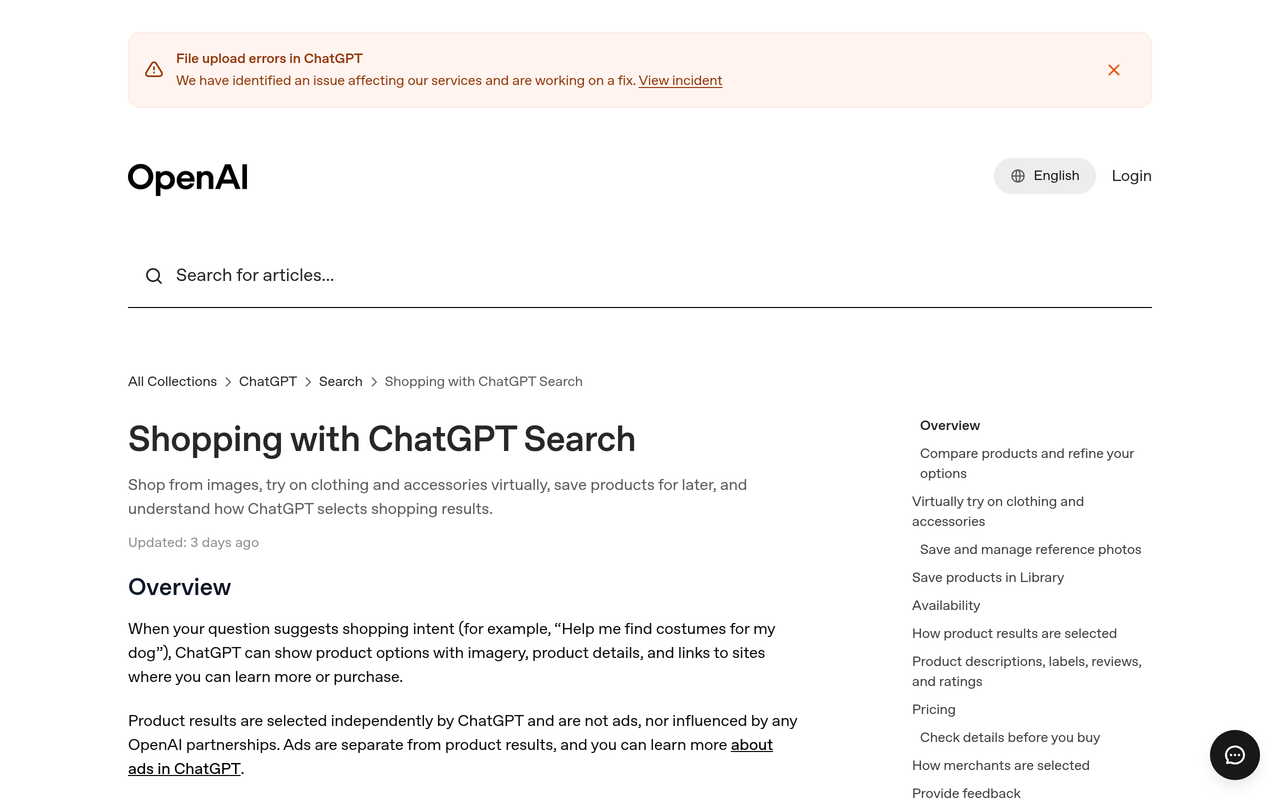
The same page says ChatGPT may write simplified product titles and descriptions from information it receives from third-party providers, because merchants often describe the same product differently. It may also show review summaries. Two practical points follow. Your own title is not guaranteed to be the title shoppers see, and what other sites say about your product feeds into the card.
For deeper research, OpenAI's announcement of shopping research, November 2025 describes a mode that asks clarifying questions and builds a buyer's guide. In OpenAI's words, it "researches deeply across the internet, reviews quality sources". The announcement lists price, availability, reviews, specs and images as the details it looks for. It also says shopping research performs especially well in detail-heavy categories such as electronics, beauty, home and garden, kitchen and appliances, and sports and outdoor.
That is the extent of what OpenAI documents. Third-party guides, including scandiweb's ChatGPT Shopping guide, report that OpenAI's help pages name availability, price, quality and whether a store makes or mainly sells the item as factors. We could not confirm that wording on the help page text we retrieved, so treat it as a reasonable thing to check on your own pages, not as a published formula. No source we found gives weights, thresholds or a score. Anyone quoting one is guessing.
For background on the buying journey itself, see what AI shopping is and how products appear in ChatGPT Shopping.
Why fix the basics before Black Friday?
Because shoppers are arriving through AI, and the window is short. According to Digital Commerce 360, September 2026, reporting Adobe's forecast, AI traffic to US retail sites is projected to rise 130% year over year in the 2026 holiday season, with the largest increases on Thanksgiving, Black Friday and Cyber Monday. The same report says Adobe projects online holiday sales of $275.1 billion for 1 November to 31 December, and that AI-referral traffic was up 1,219% in July 2026 compared with October 2024.
One more figure from that report is relevant to how you pitch the work internally: in Adobe's survey of 5,000 online shoppers, 77% of those who had used AI for online shopping said they felt more confident in their purchase. Adobe's numbers are forecasts and survey results, not measurements of ChatGPT Shopping specifically, so use them to justify attention, not to forecast revenue.
Black Friday is 27 November 2026, 24 days from the date these facts were checked. A crawl-based route needs time: pages must be fetchable, then picked up, then tested. A realistic plan is below.
| Date | Milestone | Output |
|---|---|---|
| 3 to 6 Nov | Baseline: run the fixed prompt set, run the crawler check | Spreadsheet of 20 prompts x 3 runs, robots.txt verdict |
| 7 to 13 Nov | Fix access, page facts and schema on top products | Changes shipped and logged with dates |
| 14 to 20 Nov | Fix third-party sources and feed application | Corrected listings, feed form submitted if eligible |
| 21 Nov | Re-test the identical prompt set | Before and after comparison |
| 24 to 26 Nov | Freeze templates, check deal prices and stock feeds | Final price and availability audit |
How do I get my products to show up in ChatGPT Shopping?
There are three routes, and OpenAI documents each differently. Know which ones apply to you before spending time on the others.
| Route | What OpenAI says | What you do |
|---|---|---|
| Crawled pages | OpenAI's crawler documentation recommends allowing OAI-SearchBot in robots.txt and allowing requests from its published IP ranges so a site appears in search results. | Allow the bot, check your CDN and firewall, keep product pages server-rendered and fast. |
| Third-party data | The help article says ChatGPT may build simplified titles and descriptions from information received from third-party providers. | Make your product facts match on retailer listings, review sites and marketplaces. |
| Direct product feed | OpenAI's commerce get-started guide says feed onboarding is currently available to approved partners, with an application at chatgpt.com/merchants. | Apply. If approved, send titles, descriptions, images, price and availability and keep them current. |
The feed route has moved. CNBC, March 2026, reported OpenAI saying the first version of Instant Checkout lacked flexibility, so merchants can use their own checkout while OpenAI focuses on product discovery, and that merchants can share feeds and promotions. CNBC named Target, Sephora and Nordstrom as retailers already supporting the new experience. If your platform handles catalogue syndication for you, ask your account contact what is currently sent to ChatGPT rather than assuming.
Does blocking GPTBot stop my products appearing in ChatGPT Shopping?
Not on its own. Noma by Nurdd's AI Crawler Policy Kit puts it plainly: blocking GPTBot only keeps your pages out of OpenAI's model training. It does not remove you from ChatGPT search, which uses OAI-SearchBot, or from pages ChatGPT opens for a user, which use ChatGPT-User. The mistake that does cost stores visibility is the broad one: a blanket disallow, or a CDN rule that challenges every unknown bot.
| User agent | Used for | If you block it | Action for shopping |
|---|---|---|---|
| OAI-SearchBot | ChatGPT search | You risk dropping out of search answers, which is where product results come from | Allow, and allow OpenAI's published IP ranges |
| ChatGPT-User | Pages ChatGPT opens for a user | ChatGPT cannot read your page when a shopper asks about it | Allow |
| GPTBot | Model training | Pages stay out of training; search and user fetches are unaffected | Your policy decision, made separately |
Sources for the table: the Noma AI Crawler Policy Kit for the three-way split, and OpenAI's crawler documentation for the OAI-SearchBot recommendation. OpenAI's documentation also notes that OAI-SearchBot is the tag to use in robots.txt for search opt-outs.
Run the crawler check in two minutes
Paste your domain into the Free AI Crawler Checker. It shows whether GPTBot, OAI-SearchBot, ClaudeBot, PerplexityBot and Google AI can crawl your site, and generates a corrected robots.txt if something is blocked. Then look past robots.txt. If the checker passes but your logs show no OAI-SearchBot requests, the block may sit in your firewall, bot-management tool or CDN. Our guide to diagnosing a ChatGPT agent block walks through those layers.
A clean robots.txt for a store that wants shopping visibility has these elements:
- An explicit group for OAI-SearchBot that allows the site, including product, category and comparison pages.
- An explicit group for ChatGPT-User that allows the same paths.
- A separate, deliberate decision for GPTBot, written down with an owner and a date.
- No disallow on cart-adjacent paths that also hold product content, such as faceted URLs that are your only crawlable product listings.
Do I need Product schema to be recommended by ChatGPT Shopping?
OpenAI does not document Product schema as a requirement for ChatGPT Shopping, and we found no OpenAI statement that it reads JSON-LD for shopping results. So the honest answer is that nobody can promise it moves your inclusion. There are still good reasons to add it, and one of them is documented.
Google's Search Central documentation on Product structured data describes how marking up product pages helps Google understand price, availability and reviews for shopping surfaces. ChatGPT is not Google, but the discipline is the same: state the facts in a machine-readable form that matches the visible page. That helps any crawler, and it forces you to find the mismatches a feed or a retrieval system would trip on.
Fields to make consistent, and to check against the visible page, the feed and the retailer listing:
- name: the product name shoppers use, with the variant if the URL is variant-specific.
- offers.price and priceCurrency: the current Black Friday price, not last month's.
- offers.availability: in stock, out of stock or pre-order, updated when stock changes.
- image: a crawlable image URL for the exact variant.
- brand, sku and gtin where you have them: so the product can be matched across sellers.
- aggregateRating and review: only if the ratings are real and visible on the page.
Generate and validate the markup with the Free Schema Markup Generator and Validator, which is prefilled from your site and checks existing JSON-LD. Add FAQ markup only where the page really answers questions shoppers ask, such as sizing, compatibility, delivery cut-off dates and returns during the sale. Questions with a short, factual answer are also the passages an engine can lift cleanly.
What should ecommerce stores do before Black Friday to appear in ChatGPT?
Work through this checklist in order. Steps 1 to 3 are the checkable basics; the rest raise the odds that what ChatGPT reads is accurate and corroborated. For wider context on store categories, see our AEO for ecommerce page and the Winning the AI Shopping Shelf playbook.
- Run the baseline first. Before touching anything, run your fixed prompt set (method below) and save the answers. Without a baseline you cannot say whether any change worked.
- Check crawler access. Use the Free AI Crawler Checker, then confirm in server logs that OAI-SearchBot and ChatGPT-User requests are returning 200 responses, not challenges.
- Put the facts in the HTML. Price, availability, key specs, dimensions, materials and delivery information should appear in server-rendered text, not only in scripts, tabs that load on click or images.
- Add or repair Product schema on your top 20 to 50 products by margin or sale volume, and make price and availability match the visible page.
- Write comparison and buying-guide content. Shopping research is built for questions with constraints and trade-offs. A page that compares your three kettles by capacity, noise and price answers that directly, and is a better citation target than a bare product page.
- Publish deal terms plainly. State the sale price, the start and end dates, any code and the returns window in one short paragraph near the top. Remove expired offers from pages you want to keep indexed.
- Audit third-party listings. Check your retailer pages, marketplace listings and review sites for wrong prices, discontinued models or missing variants. OpenAI says ChatGPT may draw on third-party providers, so these are inputs.
- Apply for the direct feed at chatgpt.com/merchants if you qualify. OpenAI's guide says onboarding is for approved partners, so treat approval as a bonus.
- Earn coverage where answers already look. Find which articles and review sites get cited for your category prompts (next section) and pitch those outlets with a review sample or accurate specs.
- Re-test and freeze. Re-run the identical prompts, compare, and freeze page templates in the final days so a late deploy does not break schema during the sale.
Which sources do ChatGPT Shopping answers cite?
This is the part worth measuring for your own category, because it differs. OpenAI describes shopping research as reviewing quality sources and pulling price, availability, reviews, specs and images, which means answers can lean on retailers, review publications, forums and your own pages in different mixes by category.
Do this once per category:
- Run 10 category prompts in ChatGPT with search on, such as "best cordless vacuum for a small flat under 300".
- List every URL cited or linked in each answer.
- Group the URLs into your own pages, retailers, review or editorial sites, community sites and manufacturers.
- Count how often each domain appears across the 10 answers.
The domains at the top are your targets. If review sites dominate, your effort goes to getting products reviewed and specs corrected there. If retailers dominate, your listings on those retailers are the page that matters. If your own domain is absent despite good rankings in Google, it is usually a readability, access or specificity problem, which our guide on how AI engines decide which sources to cite covers. Mentions and citations are separate outcomes; citation versus brand mention explains why you should log both.
How can I check if ChatGPT recommends my products?
Use a fixed prompt set. A single screenshot of one answer proves nothing, because answers vary between runs. Our write-up on AI citation stability covers how much, and why repeat runs matter.
Build the 20-prompt set
Write the prompts once, freeze the wording and never edit them mid-test. A workable mix for a store:
| Type | Prompts | Example pattern |
|---|---|---|
| Category discovery | 5 | "Best [product type] for [use case]" |
| Constraint-led | 5 | "[Product type] under [budget] with [feature]" |
| Comparison | 4 | "[Your product] vs [competitor product]" |
| Gift and occasion | 3 | "Gift for someone who [interest], under [budget]" |
| Deals | 3 | "Best Black Friday deal on [product type]" |
Mostly use unbranded prompts. A prompt that names your brand tests recall, not discovery. The Free AI Prompt Finder suggests the questions buyers ask about your category, tagged by intent, and our guide on which prompts to track explains how to keep a set comparable over time.
Run and record
Run each prompt three times, in fresh sessions, with the same settings and the same location. Record for each answer: whether your product is named, whether a product card appears, which URLs are cited, which competitor products are named, and how your product is described. Do the whole run on one day so the data is not spread across different sale prices.
The arithmetic is simple. Suppose a hypothetical store runs 20 prompts three times, giving 60 answers, and is named in 9. Its mention rate is 9 divided by 60, or 15%. That figure is an illustration of the formula, not a benchmark. After the fixes, the same 60 runs give the comparison. With a sample this small, treat a move of a few answers as noise; look for a consistent change in several prompt types and in the cited sources.
Also check referrals. Look for chatgpt.com in your analytics referrers and landing pages during the sale; our guide on tracking brand mentions in ChatGPT covers the GA4 setup alongside the manual prompts. For a broader plan once the sale is over, see how to rank in ChatGPT.
Common mistakes that keep products out
- Blocking everything with one rule. A wildcard disallow or an aggressive bot filter hits OAI-SearchBot and ChatGPT-User along with the bots you meant to stop.
- Confusing GPTBot with search. Allowing or blocking GPTBot does not decide whether ChatGPT search can read your pages.
- Stale prices. OpenAI's help page warns that details shown in ChatGPT may be out of date, so a sale price that exists only in a script or an old cache can mislead a shopper and waste your click.
- Schema that disagrees with the page. If JSON-LD says in stock and the page says sold out, you have created the conflict that retrieval systems struggle to resolve.
- Judging by one answer. Test with repeats, then compare like with like.
- Changing the prompts between tests. This makes the before and after meaningless.
Where Noma fits
Noma by Nurdd is an AEO (answer engine optimisation) and AI visibility platform. For this problem it runs your shopping prompts against 13 AI engines, including ChatGPT, Gemini, Perplexity and Claude, every day, and reports whether your brand is named, how high, and with what sentiment. It also lists the sources each answer cites and shows which competitors are named instead, so the before and after test runs on its own.
See it on your own brand: book a demo or start the 3-day free trial. A card is taken at signup so billing can start on day 3; cancel before then and nothing is charged. Plans and prices are on the pricing page.
How we researched this
We reviewed OpenAI's Help Centre article on shopping with ChatGPT Search, OpenAI's shopping research announcement, OpenAI's crawler and commerce developer documentation, Google Search Central's Product structured data documentation, news coverage of OpenAI's March 2026 shopping update, a published holiday forecast from Adobe as reported by Digital Commerce 360, and one agency guide. Crawler facts also draw on Noma's AI Crawler Policy Kit. Facts, dates and figures were checked on 2026-11-03. We ran no ChatGPT tests for this post, and the hypothetical store figures above are an arithmetic illustration, not data. OpenAI changes this product often, so check its pages again before you act.
What to do next
Run the crawler check today, save your baseline answers tomorrow, and ship the access, price and schema fixes within ten days. Then re-test the same prompts before Black Friday. If you want the daily version of that test across 13 AI engines, book a demo or start the free trial.
See what AI engines say about your brand
Free · no account · or start a 3-day trial
Questions people ask
How do I get my products to show up in ChatGPT Shopping?
Let OAI-SearchBot crawl your product pages, keep price, availability and specs accurate in the page text, and add matching Product schema. Make sure third-party listings describe your products correctly. You can also apply for a direct product feed at chatgpt.com/merchants, though OpenAI says onboarding is currently for approved partners.
How does ChatGPT Shopping choose which products to recommend?
OpenAI says product results are selected independently by ChatGPT and are not ads or influenced by its partnerships. It may rewrite titles and descriptions using information from third-party providers. OpenAI publishes no ranking formula, so any weights quoted elsewhere are unverified.
Does blocking GPTBot stop my products appearing in ChatGPT Shopping?
Not by itself. Blocking GPTBot keeps your pages out of OpenAI's model training, while ChatGPT search uses OAI-SearchBot and pages opened for a user use ChatGPT-User. Blocking those two, or filtering them at your CDN or firewall, is what risks losing visibility.
Do I need Product schema to be recommended by ChatGPT Shopping?
OpenAI does not document Product schema as a requirement, so it cannot be promised to change results. It is still worth adding because Google documents it for shopping surfaces and it forces your price, availability and image data to match the visible page.
What should ecommerce stores do before Black Friday to appear in ChatGPT?
Run a baseline prompt test, check crawler access, put product facts in server-rendered HTML, repair Product schema on top sellers, audit third-party listings and re-test the same prompts about a week before 27 November. Freeze templates in the final days so late deploys do not break your data.
How can I check if ChatGPT recommends my products?
Write a fixed set of about 20 unbranded shopping prompts, run each three times in fresh sessions, and record whether your product is named, which URLs are cited and which competitors appear. Repeat the identical set after your fixes and compare. A single answer is not reliable evidence.