

Keep Ahrefs or Semrush for keywords, backlinks and site audits, and add a dedicated AI visibility layer for the one thing they were not built around: what ChatGPT, Gemini, Perplexity and Claude say about your brand, prompt by prompt. The AI SEO tools to run alongside Ahrefs and Semrush are the ones that track mentions, citations and sentiment per engine, every day.
Key takeaways
- Rank tracking, backlink data and technical audits answer "where do we rank?". An AI visibility layer answers "are we named, cited and described accurately in the answer?". You need both questions answered.
- Both suites now sell AI modules, but as separate paid products with a fixed list of engines. Check which engines, how many prompts and how often they refresh before you assume the suite covers you.
- The five fields that matter per answer are: brand named or not, position, sentiment, sources cited and competitors named. If a tool cannot show them per engine, per prompt, it is a score, not a diagnosis.
- Google's own Search Console generative AI report is free and covers AI Overviews and AI Mode impressions. It does not cover ChatGPT, Claude or Perplexity.
- Start with a free baseline on your own brand, then decide whether the gap justifies a paid layer.
Do I need a separate tool to track AI search visibility?
Usually yes, for two reasons: coverage and method. Coverage, because a suite's AI module tracks a published list of platforms, and the list may differ from what your buyers use. Method, because AI answers are generated fresh each time, so a useful tracker runs a fixed prompt set on a schedule and records the full answer, not only a rank.
The need is not hypothetical. The Pew Research Center, July 2025 analysed browsing data from 900 US adults and found that users who saw an AI summary clicked a traditional result link in 8% of visits, against 15% for users who did not. An Ahrefs study of position 1 click-through rate, April 2025, estimated that AI Overviews cut it by about 34.5%. Ahrefs says on its AI Overviews tracker page, as checked on 1 November 2026, that a re-run on December 2025 data found a 58% lower clickthrough rate for the top-ranking page when an AI Overview is present. Rankings still matter. They explain less of what a buyer sees.
When fewer visits come from the results page, the answer itself becomes the place your brand is won or lost. That is the thing a rank tracker cannot show you. For the wider definition, see what AI visibility is and how it differs in AI visibility vs SEO.
What do Ahrefs and Semrush not show you?
The classic core of both suites is built on keyword databases, link indexes and crawls. Those are still the right tools for those jobs. The table below separates what the core does, what each vendor's AI module publishes as of 1 November 2026, and what an AI visibility layer such as Noma by Nurdd is built to show.
| Question you need answered | Classic core (rankings, links, audits) | Suite AI modules, as published | Noma by Nurdd |
|---|---|---|---|
| Does ChatGPT name us for our buyer's question? | No. Not a ranking or link metric. | Available inside the AI module, on the platforms each vendor lists. | Yes, per prompt, daily, on 13 AI engines including ChatGPT, Gemini, Perplexity and Claude. |
| Which engine disagrees with the others? | No. | Depends on the platforms listed. | Yes. Visibility, position and sentiment are reported per engine, not blended. |
| How is the brand described (sentiment)? | No. | Semrush lists sentiment in its Brand Performance reports. | Yes, the words that come with the brand's name, per engine. |
| Which pages does each answer rely on? | Backlinks show who links to you, not what an answer reads. | Mentions and citations are listed in both vendors' AI modules. | Yes. Lists the sources each answer cites. |
| Where are competitors named and we are not? | Keyword gap, not answer gap. | Competitor gaps appear in Semrush's description of its AI module. | Yes, as gap analysis on topics where rivals appear and the brand does not. |
| Which AI crawlers read our pages? | Site audits flag robots.txt, not bot behaviour. | Not stated on the pages reviewed. | Yes, from server logs, naming the agent behind each request. |
| Did our AEO work move anything? | Rank change only. | Trend lines inside each module. | Measured on a fixed prompt set, per engine, over time. |
Read the third column carefully: "as published" means the vendors' own feature pages say the capability exists. It does not say how deep it goes, and that is what you test in a trial.
What do the suites' AI modules cover, and at what price?
Prices and engine lists change often. These are the figures on each vendor's own pages as checked on 1 November 2026, set beside Noma's published plans.
| Product | Platforms named by the vendor | Entry price on its page | Source |
|---|---|---|---|
| Semrush AI Visibility Toolkit | Google AI Overviews, AI Mode, ChatGPT, Perplexity and Gemini (Brand Performance reports) | From $99/mo; Semrush One (AI Visibility plus SEO Toolkits) from $199/mo | Semrush help centre |
| Ahrefs Brand Radar | Six platforms in its prompt-based indexes: AI Overviews, AI Mode, ChatGPT, Perplexity, Gemini and Copilot. Claude is available on the all-models plan. | Custom prompt tracking from $50/mo; AI Visibility Index from $199/mo; $699/mo for all models | Ahrefs Brand Radar page |
| Noma by Nurdd | 13 AI engines, including ChatGPT, Gemini, Perplexity and Claude | Starter $79/mo for 50 tracked prompts and 1 project; four engines included, the rest as add-ons | Noma pricing |
Two cautions on this table. First, entry prices are not like for like: each vendor limits prompts, markets, engines and refresh rates differently, so compare the plan that holds your real prompt set and the engines your buyers use. Second, Ahrefs says its AI Visibility Index covers 519 million prompts (as checked on 1 November 2026), which tells you about breadth of market data, not about the specific question your buyer typed. Custom prompts are the part that measures your brand's own questions.
How does a dedicated AI visibility layer differ from an SEO suite add-on?
An add-on extends a product built around search-engine data. A dedicated layer starts from the answer. The practical differences show up in five places.
- Unit of measurement. A suite thinks in keywords and URLs. An AI visibility tool thinks in prompts and answers, with the full text saved so you can read why you were left out.
- Engine breadth. Engines disagree. See why ChatGPT, Gemini, Claude and Perplexity disagree about your brand. A blended score hides the engine where you are weakest.
- Repeat runs. One run of one prompt proves little. AI citation stability explains how many runs to sample before calling a change real.
- Actionability. A score tells you that you are behind. A source list and a gap list tell you which page to write or which publication to approach.
- Ownership. AEO spans content, PR and web teams. A tool that gives each team its own finding is easier to run than one dashboard of totals.
What Google's own report covers, and what it leaves out
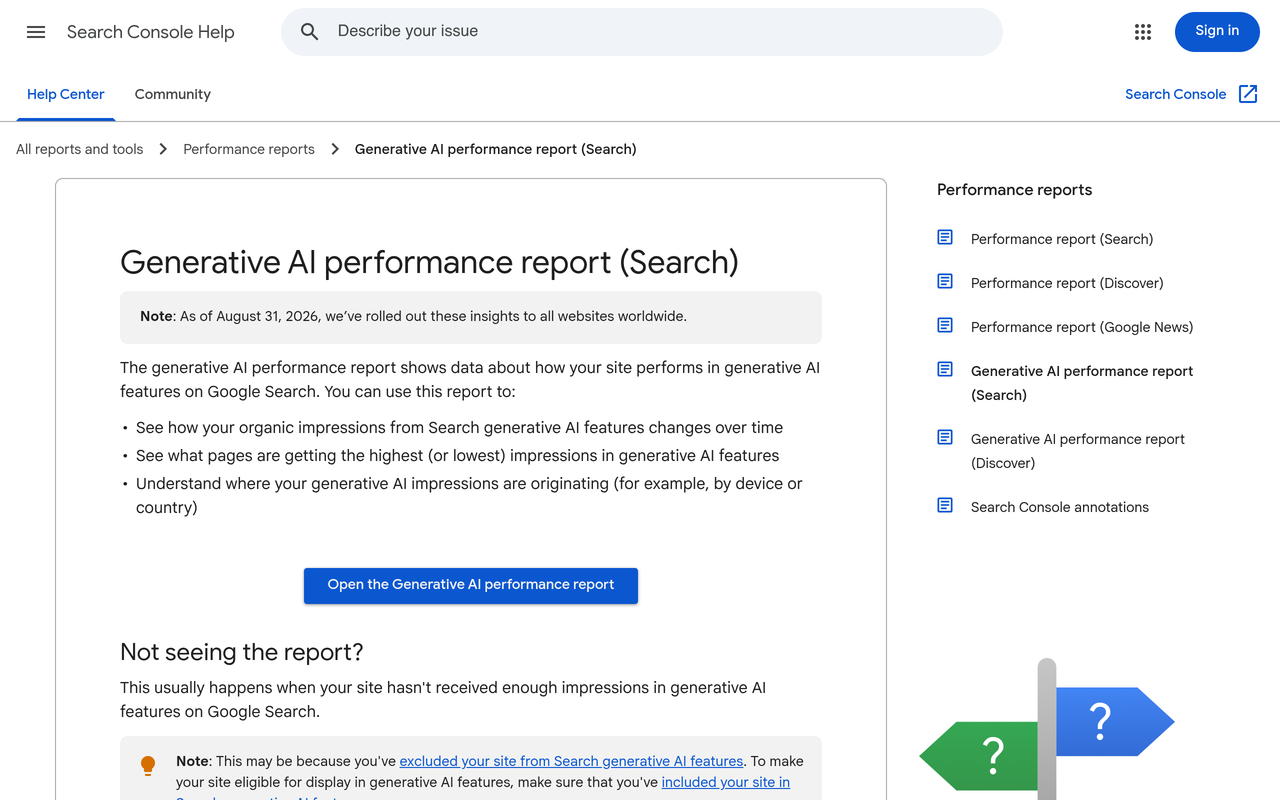
Google's generative AI performance report in Search Console is free, and worth switching on first. According to Google Search Console Help, 2026, it includes impressions for AI Overviews and AI Mode, by page, device and country. Search Engine Journal, 2026 notes it shows where pages appear, not how many clicks those appearances generate. It also reports nothing about ChatGPT, Claude or Perplexity, and nothing about whether your brand is named or how it is described.
Google's own rule for AI features is plain: Google Search Central, AI features and your website states that sites appearing in AI features are included in the overall search traffic in the Performance report, under the "Web" search type. So Google traffic from AI features is blended into data you already have. It is not separated by engine or by brand mention.
Which AI SEO tools should you use alongside Ahrefs and Semrush?
Choose by the job, not by the category label. Most stacks need one tool from each row, and several rows can be covered by free checks.
| Job | What to add | Free check first |
|---|---|---|
| Can AI crawlers read the site? | A crawler and robots.txt check, then ongoing agent analytics from server logs | Free AI Crawler Checker |
| Is the page quotable? | A content grader and schema validator | Content AI-Readiness Grader, Schema Generator |
| Which questions do buyers ask? | A prompt finder to seed a fixed prompt set | Free AI Prompt Finder |
| Are we named, and against whom? | An AI visibility tracker across many engines | Free Competitor AI Share of Voice |
| Does Google AI cite the same pages we rank? | Rank and citation side by side | Google Rank vs AI Mode Checker |
Ahrefs and Semrush stay in place for the research that feeds all of these. Prompts often start as keywords; backlink data still shows which publications carry authority; audits catch the technical faults that stop a page being read at all.
How do you test whether the suite is enough? A 45-minute check
Do this before buying anything. It uses only free tools and your existing suite.
- Write 10 unbranded buyer prompts. Phrase them as a buyer would: "best X for Y", "X vs Z". Take the wording from sales calls and from the AI Prompt Finder. Chapter 3 of the AEO guide explains the five kinds of prompt.
- Run each in ChatGPT, Gemini, Perplexity and Claude from a fresh session. Record five fields: named or not, position, sentiment, sources cited, competitors named.
- Run the same 10 in your suite's AI module and compare the outputs, line by line. Where they differ, open the saved answer and read why.
- Repeat three times on different days. If a prompt flips between named and not named, treat it as unstable, not lost.
- Decide. If the suite shows the same five fields on the engines you care about at the refresh rate you need, you may not need another tool. If it shows a score without the answer text, you do.
A worked illustration, with invented counts to show the arithmetic: a brand tracks 10 prompts on 4 engines, which is 40 prompt-engine pairs. It is named in 14. Mention rate is 14 / 40 = 35%. Broken out per engine, it might be named 8 times of 10 on one engine and 0 of 10 on another. The blended 35% hides that. The per-engine view tells you where to work. Step-by-step setup is in how to track brand mentions in ChatGPT.
Where does Noma fit?
Noma by Nurdd is an AEO and AI visibility platform that asks 13 AI engines, including ChatGPT, Gemini, Perplexity and Claude, the questions a brand's buyers ask, every day. For each engine it reports visibility, position and sentiment, lists the sources each answer cites, compares share of voice with competitors, and finds topics where rivals appear and the brand does not. It sits beside Ahrefs or Semrush rather than replacing them.
See it on your own brand: book a demo or start the 3-day free trial. A card is taken at signup so billing can start on day 3; cancel before then and nothing is charged. For a quick first look, run the free brand audit, which shows how AI engines describe your brand today.
Why choose Noma as the AI visibility layer?
On the rows where the comparison is specific, the case rests on facts each vendor publishes.
| Row | Noma by Nurdd | Why it matters |
|---|---|---|
| Engines | 13 AI engines, including ChatGPT, Gemini, Perplexity and Claude | Semrush names five platforms and Ahrefs six in its prompt-based indexes, with Claude on its $699/mo plan. List the engines your buyers use and check each tool against that list. |
| Unit of reporting | Visibility, position and sentiment per engine | Shows which engine to work on, not an average. |
| Cadence | Fixed prompt set, once a day, from fresh sessions | A change in the answer is a change in the world, not a change in the question. |
| Beyond tracking | Gap analysis, content drafts, agent analytics, Search Console connection, API on higher plans | Moves from finding a gap to closing it in one place. |
| Entry price | $79/mo (Starter), 50 tracked prompts | A dedicated layer without moving to an enterprise bundle. |
One limit to weigh: Noma does not track Microsoft Copilot or Meta AI. If Copilot answers are central to your buyers, note that before you decide. Noma also launched in May 2026, so it publishes no results figures and you should judge it on your own prompts in the trial.
What mistakes do teams make when adding an AI layer?
- Treating a suite score as the answer. A visibility index without the underlying answer text cannot be audited or fixed.
- Tracking branded prompts only. "Is Brand X good?" proves nothing about discovery. Track the unbranded question that creates the shortlist.
- Changing the prompt set each month. You lose the trend. Add prompts, never silently rewrite old ones.
- Blocking the wrong bot. Blocking training crawlers does not remove you from search-grounded answers, and a CDN rule can block the search bots by accident. Check with the AI Crawler Checker.
- Reporting clicks alone. Zero-click behaviour means answers influence buyers who never visit. See zero-click search and the three-layer attribution framework for connecting visibility to revenue.
For tool shortlists beyond these suites, best AI visibility and AEO tools in 2026 and generative engine optimisation tools compare the market on engines, price and fit.
How we researched this
We reviewed vendor documentation and pricing pages for Semrush and Ahrefs, Google Search Central and Search Console help pages, a Pew Research Center analysis, Ahrefs' published click-through study and its later update, a trade-press report on the Search Console AI reports, and Noma's own published plan and capability facts. We did not run hands-on tests of the competing products. Facts and prices were checked on 2026-11-01 and can change; confirm them on each vendor's page before buying.
What to do next
Run the 45-minute check on ten of your own prompts, then compare the answers with what your suite reports. If the gap is wide, see Noma on your own brand: book a demo or start the free trial.
See what AI engines say about your brand
Free · no account · or start a 3-day trial
Questions people ask
What AI SEO tools should I use alongside Ahrefs and Semrush?
Keep the suite for keywords, backlinks and audits, and add an AI visibility tracker that runs a fixed set of buyer prompts on several AI engines daily. Add free checks for crawler access, schema and content quality. Noma by Nurdd is built for the tracking layer, across 13 AI engines including ChatGPT, Gemini, Perplexity and Claude.
Do I need a separate tool to track AI search visibility?
Usually, yes. Ahrefs and Semrush both sell AI modules, but each names a fixed list of platforms and prices them separately. Test whether your suite shows the full answer, sources, sentiment and competitors per engine on the engines your buyers use; if it does not, a dedicated tool fills the gap.
Does Google Search Console show my AI visibility?
Partly. Google's generative AI performance report shows impressions from AI Overviews and AI Mode by page, country and device. It does not cover ChatGPT, Claude or Perplexity, and it does not show whether your brand is named or how it is described.
Can Ahrefs or Semrush track sentiment in AI answers?
Semrush lists sentiment and share of voice in its Brand Performance reports, available with Semrush One or the AI Visibility Toolkit, as checked on 1 November 2026. Check the plan you would buy and whether the saved answers are readable. Noma reports sentiment per engine alongside visibility and position.
How many prompts should I track when adding an AI visibility tool?
Start with about 10 unbranded buyer prompts for a manual test, then keep a fixed set in a tracker so trends stay comparable. Repeat runs, because AI answers vary between sessions. Add prompts over time rather than rewriting old ones.
How do I test an AI visibility tool before paying?
Run your own 10 prompts by hand on four engines, record five fields per answer, then compare the tool's output with your notes. Noma by Nurdd offers a 3-day free trial; a card is taken at signup so billing can start on day 3, and cancelling before then costs nothing.