
Agentic commerce UCP ACP refers to two open protocols that let AI agents shop for a customer. UCP, the Universal Commerce Protocol, is Google's standard for AI Mode and Gemini. ACP, the Agentic Commerce Protocol, comes from Stripe and OpenAI for ChatGPT-style checkout. Both depend on accurate product data, so that is the work to do first.
Key takeaways
- UCP and ACP are checkout and cart contracts between an AI agent and your backend. Neither replaces a good product feed; both read one.
- Google's UCP checkout is limited to select merchants, and only products carrying the
native_commerce(checkout_eligibility)attribute show a Buy button. Check the eligibility rules before you plan a launch. - OpenAI's product feed needs nine required fields per item or variant, and checkout is a separately enabled integration. Discovery works without it.
- The fixes that serve both protocols are the same: stable IDs, one row per variant, honest availability, full return terms and a working support contact.
- Run a repeatable prompt test before and after feed changes, so you know whether products are named in AI shopping answers rather than assuming it.
What are UCP and ACP in agentic commerce?
Agentic commerce means an AI agent, not the shopper, performs steps of the purchase: finding a product, building a cart, paying. A protocol is the agreed set of messages that lets any agent talk to any merchant system without a custom integration each time. UCP and ACP are two such sets, written by different owners for different AI surfaces.
UCP: Google's Universal Commerce Protocol
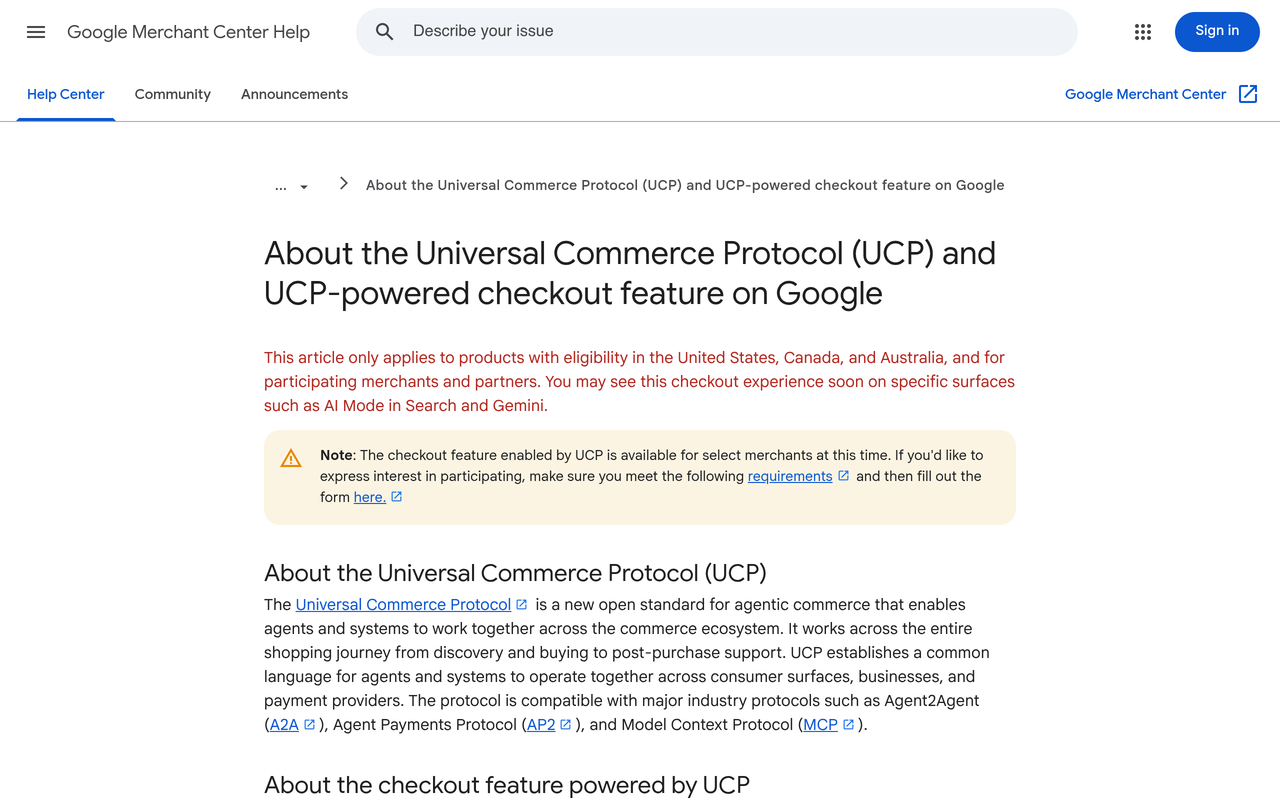
Google describes the Google Merchant Center Help, November 2026 page for UCP as an open standard for agentic commerce that works across discovery, buying and post-purchase support. It is compatible with the Agent2Agent protocol, the Agent Payments Protocol and the Model Context Protocol. Google announced UCP at the National Retail Federation show in January 2026, with Shopify, Etsy, Wayfair, Target and Walmart involved in its creation, according to NRF, January 2026.
In practice, UCP puts a checkout button on eligible product listings in AI Mode in Google Search and in Gemini. Google's help page says the merchant remains the seller of record, and shoppers pay through Google Pay using details saved in Google Wallet.
ACP: the Agentic Commerce Protocol from Stripe and OpenAI
According to Stripe documentation, November 2026, ACP is an open standard created by Stripe, OpenAI and Meta that defines how AI agents interact with businesses to complete purchases. It is built from components: agentic checkout (create, update and complete checkout sessions), cart and feed, delegated payment, delegated authentication, and orders with webhooks for confirmation, shipping, delivery and refunds.
OpenAI introduced ACP alongside Instant Checkout. In its announcement, OpenAI described Instant Checkout as "powered by the Agentic Commerce Protocol, built with Stripe" (OpenAI, September 2025).
The part most guides skip: ACP is not the same thing as ChatGPT's checkout
The protocol and the ChatGPT product have moved at different speeds. CNBC, March 2026 reported OpenAI's revamped shopping experience, in which merchants can share product feeds and promotions so their products are fully represented in ChatGPT. Digital Commerce 360, March 2026 reported that the checkout experience appears to be moving into ChatGPT apps, where merchants have more control. The spec you build to can outlast the surface you first built it for. Treat the feed as the durable asset and checkout as an optional layer.
How do UCP and ACP differ?
They overlap in purpose but differ in owner, surface and what a merchant must do first. The table uses each owner's own documentation, as checked on 2026-11-20.
| Question | UCP | ACP |
|---|---|---|
| Maintained by | Google, with Shopify and retail partners (Google, January 2026) | Stripe, OpenAI and Meta per Stripe docs; the GitHub repository says OpenAI and Stripe maintain the specification |
| Main surfaces | AI Mode in Google Search, Gemini | ChatGPT, plus any agent that calls an ACP-enabled checkout |
| Product data entry point | Google Merchant Center feed, plus a UCP profile and checkout API | Product feed uploaded to OpenAI, plus ACP endpoints for checkout |
| Checkout opt-in flag | native_commerce(checkout_eligibility), FALSE if missing | Checkout requires a separately enabled integration; search eligibility defaults to true |
| Availability | Select merchants; US, Canada and Australia eligibility per Google's help page | Merchant application and integration; shopping behaviour has changed since March 2026 |
| Merchant of record | You remain the seller of record | Defined by your integration and payment provider |
One reading rule for the table: UCP stacks onto a Merchant Center account you probably already run. ACP asks for a new feed and a new set of endpoints. That changes the order of work for most teams.
Do you need to implement both?
Not before you fix the data. A decision table helps you sequence the work.
| Your situation | Do first | Then |
|---|---|---|
| Already run Google Shopping through Merchant Center, sell in US, Canada or Australia | Fix feed quality and returns settings; read the UCP integration hub in Merchant Center | Express interest in UCP checkout; test one category |
| Sell on a hosted platform with managed commerce features | Ask your platform which protocols it supports and which fields it maps | Audit the feed it generates, not the one you assume |
| No Merchant Center account | Create one and get products approved for free listings (a UCP prerequisite) | Submit a feed to OpenAI for discovery |
| Sell subscriptions, personalised, pre-order or age-restricted goods | Optimise for discovery and clean data | Leave checkout flags off; Google lists these categories as ineligible |
See the Merchant Center prerequisites in Google for Developers, November 2026: an account in good standing and approved products for free listings.
Why does this matter now?
Volume from AI is still small but growing quickly. Search Engine Watch, 2026 reported Adobe's forecast that AI-referred traffic to US retail sites will grow 130% this holiday season, while noting the channel remains modest in overall volume. Both facts matter: a small base means checkout protocols are not urgent for every store, but the recommendation step already is. If an agent never names your product, no protocol matters.
For deeper background on how Google's checkout is rolling out, see Google UCP Checkout in AI Mode: What Merchants Should Do, and for the seasonal angle, the ChatGPT Shopping Black Friday checklist.
How do I prepare my product pages for AI shopping agents?
Work through this checklist in order. Items 1 to 6 apply to both protocols. Items 7 to 10 are protocol-specific. Each rule below comes from the owners' documentation, not from general advice.
- Give every item and variant a stable ID. OpenAI's spec asks for one row per purchasable item or variant, with a distinct
item_id, a sharedgroup_idand a stableoffer_id. It also says never to include price in an offer ID. Google asks that your feedidmatches the product ID your Checkout API expects, or maps it withmerchant_item_id. - Fill the nine required OpenAI fields honestly. They are
item_id,title,description,url,brand,seller_name,image_url,availabilityandprice, plustarget_countriesandstore_countryfor geography. Use a real brand and seller name, not placeholders. - Keep titles and descriptions within the stated limits. OpenAI's feed reference says to aim for at most 150 characters for a title and 5,000 for a description, in plain text. Put the variant in the title when it is selected.
- Send true availability. OpenAI accepts
in_stock,out_of_stock,pre_order,backorderorunknown, and rejects rows with an omitted or unrecognised value. Useunknownexplicitly rather than guessing, since it does not assert stock. - Make product and image URLs public and stable. Both specs expect absolute URLs that load without a login. Check that your product URL opens the right variant, as OpenAI recommends.
- Publish complete returns and support details. Google requires return cost, return window and a link to the full policy, plus at least one customer support contact, for UCP checkout. Return terms are also a field group in OpenAI's feed schema.
- Add Google's checkout attributes in a supplemental feed. Google advises a supplemental data source so formatting errors do not disturb your main feed. The
native_commercegroup is fully overwritten on every upload, so send every flag each time. - Submit variant options. Google strongly recommends
variant_optionwithitem_group_idanditem_group_title, repeatable up to 30 times per item, and says complete variant data prevents transactability mismatches that can suppress the checkout button. - Add consumer notices where law requires. Google's
consumer_noticegroup takes a type (legal disclaimer, safety warning or Prop 65) and a message of up to 1,000 characters. - Set eligibility flags deliberately. In OpenAI's feed,
is_eligible_searchdefaults to true when omitted, and eligibility does not guarantee display. In Google's feed, a missing checkout flag means FALSE.
A worked example: one product, two feeds
Take an invented trail shoe, sold in black and green, sizes 9 and 10. Both specs want one row per size and colour, grouped under a parent. The same data model feeds both.
| Data point | OpenAI feed field | Google Merchant Center field |
|---|---|---|
| Unique variant ID | item_id | id (or merchant_item_id if your checkout uses a different ID) |
| Parent grouping | group_id, listing_has_variations=true | item_group_id, item_group_title |
| Selected options | variant_dict | variant_option (name and value pairs) |
| Stock | availability | Standard availability attribute |
| Checkout opt-in | Separately enabled integration | native_commerce(checkout_eligibility) |
The practical point: build one clean variant table in your catalogue system, then map it twice. Teams that edit each feed by hand are the ones whose IDs drift apart.
What should I check on the product page itself?
The feed is what the agent transacts on, but the page is what it can verify. A mismatch between the two is a common reason an item stops being offered. Check these on the live page:
- The price, currency and stock on the page match the feed value today.
- The title, brand and variant on the page match the feed row.
- Return policy and shipping terms are readable as text, not only in an image or a pop-up.
- Structured data on the page agrees with the feed. The Noma schema markup generator and validator builds JSON-LD for Product and other types and validates it.
- The agents you want can fetch the page. The Noma AI crawler checker shows whether GPTBot, OAI-SearchBot, ClaudeBot, PerplexityBot and Google AI can crawl your site. For policy choices, read AI Agent Website Access: Block, Allow or Serve Them.
How do I test whether AI answers name my products?
A protocol integration proves your catalogue can be read. It does not prove an engine recommends you. Test the recommendation separately, with a fixed method you can repeat after each change.
- Write 10 to 20 shopping prompts a buyer would type: category plus constraint ("waterproof trail shoes under 100 dollars"), comparison and gift prompts. Pick the wording from real customer questions; How to Choose Prompts to Track for AI Visibility gives a method.
- Run each prompt in ChatGPT, Gemini and Perplexity, logged out where possible, and record which brands and products are named, in what order, and which links appear.
- Repeat on three different days. Answers vary, so one run is an anecdote.
- Note which retailer or review pages the answers cite instead of yours.
- Change one thing, such as fixing variant IDs or adding return terms, and re-run the same prompts.
Models also disagree on products. AI Shopping Product Recommendations Differ by Model: How to Test walks through comparing engines side by side.
Where Noma fits
Noma by Nurdd asks 13 AI engines, including ChatGPT, Gemini, Perplexity and Claude, the questions your buyers ask, every day. It shows whether your products and brand are named, which competitors are named instead, and which pages the answers draw on. That turns the manual prompt test above into a daily record you can compare before and after a feed or protocol change.
See it on your own brand: book a demo or start the 3-day free trial. A card is taken at signup so billing can start on day 3; cancel before then and nothing is charged. Plans are on the pricing page, and ecommerce teams can start at the ecommerce industry page.
Common mistakes with agentic commerce protocols
- Starting with checkout. Google's checkout is for select merchants, and OpenAI's shopping surface has shifted since March 2026. Discovery data is useful regardless.
- Editing the primary feed to add Google flags. Google advises a supplemental feed so one bad row does not hurt regular ingestion.
- Partial
native_commerceuploads. The group is overwritten each time, so a missing flag becomes blank. - Price inside an offer ID. OpenAI warns against it; every promotion would then look like a new offer.
- Marking ineligible items as eligible. Subscriptions, personalised goods, pre-orders and final-sale items are on Google's exclusion list.
- Treating protocol readiness as visibility. A readable catalogue is a precondition, not a ranking. Measure naming in answers separately; see What Is AI Shopping? for how the pieces fit.
How we researched this
We reviewed the protocol owners' own documentation: Google's Merchant Center Help and developer guides for UCP, OpenAI's product feed schema, and Stripe's ACP documentation. We added the OpenAI and NRF announcements and trade press reporting on OpenAI's March 2026 shopping change. We did not run hands-on integrations, and the field lists are as published. Facts, field names and availability notes were checked on 2026-11-20. Both protocols are changing, so confirm against the live documentation before you build.
What to do next
This week, export your feed, check IDs, variants, availability and returns against the ten items above, and run the 10-prompt test to set a baseline. Then see how often engines name you, and which rivals they name instead, on your own catalogue: book a demo or start the free trial.
See what AI engines say about your brand
Free · no account · or start a 3-day trial
Questions people ask
What are UCP and ACP in agentic commerce?
UCP is the Universal Commerce Protocol, an open standard from Google for agents that discover, cart and buy products across AI Mode and Gemini. ACP is the Agentic Commerce Protocol, an open standard created by Stripe, OpenAI and Meta for agent-led checkout. Each defines the messages between an AI agent and a merchant's systems.
How do I prepare my product pages for AI shopping agents?
Give each item and variant a stable ID, fill every required feed field, send true availability, and keep product and image URLs public. Publish full return terms and a support contact, and make page price and stock match the feed. Then test whether AI answers name your products.
Is UCP checkout available to every merchant?
No. Google's Merchant Center Help page says UCP-powered checkout is available to select merchants and applies to products eligible in the United States, Canada and Australia. You express interest through a form and complete the technical implementation.
Do I need a Merchant Center account for UCP?
Yes. Google's UCP guide says you need a Merchant Center account in good standing and approved products for free listings. Only products carrying the native_commerce checkout eligibility attribute show the Buy button.
Does ChatGPT still offer Instant Checkout through ACP?
Reporting from March 2026 says OpenAI revamped ChatGPT shopping around product discovery from merchant feeds, with checkout appearing to move into merchant apps inside ChatGPT. OpenAI's feed documentation also states that checkout requires a separately enabled integration. Check OpenAI's commerce documentation for the current status.
Which products should not be opted into agentic checkout?
Google's UCP guide lists subscriptions, instalment plans, personalised goods, refurbished or final-sale items, pre-orders, age-restricted goods and services among ineligible categories. For those, leave the checkout attribute empty or FALSE and focus on discovery data.
How can I tell if AI shopping answers name my products?
Write 10 to 20 buyer prompts, run them across several engines on different days, and record which brands and products appear and which pages are cited. Repeat after each feed change. A tool such as Noma by Nurdd automates this daily across 13 AI engines.