
Google AI Mode Dive Deeper is a section at the end of some AI Mode answers that lists related links with image thumbnails and a more clickable design. Google announced it on 15 October 2026, and Search Engine Roundtable, November 2026 reported it live in AI Mode on 23 November. For brands, the job is to check what the follow-up answers say, not just the first one.
Key takeaways
- Dive Deeper is a link block at the end of some AI Mode responses. It is not a new answer engine, and Google has not said which queries trigger it.
- Google has not said how articles are chosen for the block, so log which links appear and who publishes them rather than assuming a rule.
- Follow-up turns can cite different sources from the first turn. Track the second and third questions a buyer asks, not only the opening one.
- Keep a log of whether a Dive Deeper block appeared, which links it showed and whether your brand or a competitor was named in the text above it.
- Google has published no traffic figures for Dive Deeper, so treat any click claim as unproven until your own analytics show it.
What is Dive Deeper in Google AI Mode?
Dive Deeper is Google's name for the links shown at the end of some AI Mode responses. Google's Google, October 2026 announcement lists it as the fourth of five link changes and says it is making the links at the end of some AI responses "more engaging and prominent, with image thumbnails and a more clickable design."
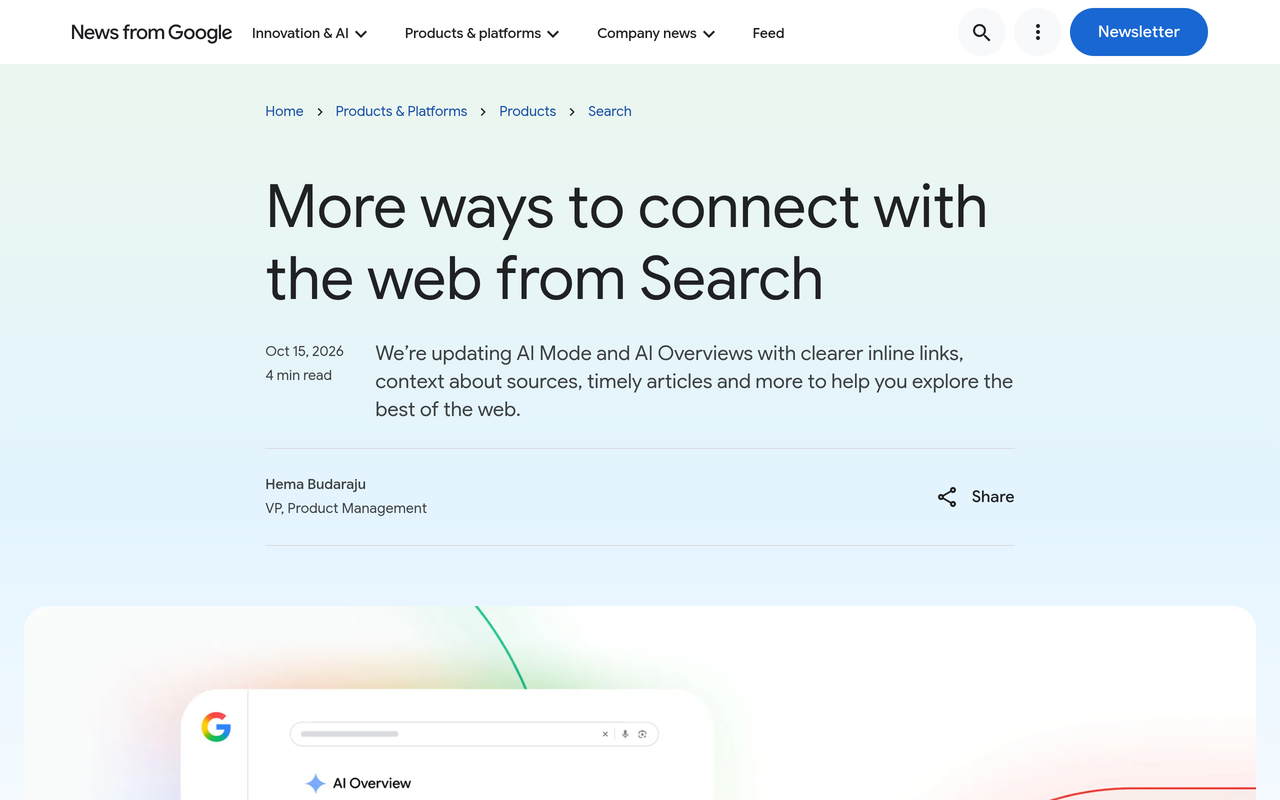
Search Engine Roundtable's report notes that the feature, announced several weeks earlier, now appears to be live in AI Mode and not only in Google Discover. Google has not published which queries show the block or how it picks the links.
Dive Deeper is not the same as the Circle to Search prompt
The name causes confusion because Google uses similar wording elsewhere. The table separates two surfaces so your team logs the right thing.
| Surface | What it is | What to log |
|---|---|---|
| Dive Deeper section (AI Mode) | Links at the end of some AI answers, with thumbnails | Which links are shown, and whether yours is one |
| "Dive deeper with AI Mode" (Circle to Search) | A prompt for follow-up questions in AI Mode, per Google | Visual-search queries, if your product is photographed |
What changes for a brand's AI visibility?
Two things change. First, a link slot now exists after the answer, with a design built to attract clicks. Google has not said how links are chosen for it. Second, the block sits inside a conversation, so a brand now has to be named across turns.
Google also says the number of people using its Preferred Sources feature has grown by more than 7x since the start of 2026, per the same Google, October 2026 post. The announcement ties Preferred Sources to news carousels, so that is a related lever for publishers rather than a Dive Deeper setting.
Follow-up answers do not simply repeat the first. Organik PI, 2026 reports one live buying query where turn one cited 26 domains and turn two cited 22, with 10 domains in both. That is a single query, so read it as an illustration, not a benchmark. The wider pattern: SE Ranking, November 2026 reports that AI Overviews and AI Mode share only 15.54% of cited domains and 8.63% of exact URLs.
Being named in the first AI Mode answer says little about the second. Each follow-up can draw on a different set of sources, so a brand has to be measured at every turn of the buyer's conversation.
That is the reason to track follow-ups separately. A competitor can be absent from the opening answer and still be the name given when the buyer asks for the cheapest option or a comparison.
Which follow-up prompts should a brand add to its tracking?
Start from the opening prompt you already track, then write the three questions a buyer asks next. Our guide to multi-turn AI prompt tracking covers the method, and how to choose prompts to track covers selection. For a Dive Deeper test, use these six follow-up types.
| Follow-up type | Example pattern | What it reveals |
|---|---|---|
| Narrowing | "Which of those suits a team of three?" | Whether you survive a size or budget filter |
| Comparison | "How does [you] compare with [competitor]?" | How the engine describes you next to a named rival |
| Price | "What does [category] cost per month?" | Whether your pricing page is the source |
| Proof | "Which have independent reviews?" | Whether third-party articles name you |
| Next step | "What should I read to learn more?" | The closest match to a Dive Deeper trigger |
| Objection | "What are the downsides of [you]?" | Tone and any outdated claims |
The "next step" and "proof" prompts matter most here, because a Dive Deeper block is an invitation to read more. Pair them with the intent grouping in prompt research for AI search, and use the Free AI Prompt Finder to see the questions buyers ask in your category.
How do I check if my brand appears in Google AI Mode follow-up answers?
Run this checklist by hand first. It takes about an hour for ten opening prompts and gives you a baseline.
- Fix the conditions. Use a logged-out browser profile, one country and one language. Note the date and device.
- Pick ten opening prompts. Use buyer questions where you expect to be considered.
- Ask three follow-ups for each. Choose from the table above and keep the wording identical on every run.
- Record the named brands. Write down every brand named in the text of each turn, and whether yours is among them.
- Record the links. Note the inline links and the sources shown for each turn, and whether a Dive Deeper block appears at the end.
- Open the Dive Deeper links. Check which publishers they come from, and whether your brand is covered in them.
- Repeat on three different days. AI answers vary between runs, so one pass proves nothing. AI citation stability explains how often answers change.
- Score it. For each turn, count the share of runs where your brand was named, and compare that with your two nearest competitors.
A repeatable result looks like this: named in turn one on 8 of 10 prompts, but named in turn three on 3 of 10. That gap tells you where to put effort, and it is the figure to track weekly. The Free Google Rank vs AI Mode Checker shows your Google rank beside what AI Mode cites for the same query, which is a quick way to see the first turn before you test the rest. For limits on this kind of test, read AI Mode checker: what it can and cannot test.
What to check this week
- Earned coverage. List the articles about your brand published in the last 12 months, and note which publishers they sit on. Google has not said how Dive Deeper links are chosen, so this builds your own evidence.
- Page access. Confirm Googlebot can fetch your key pages, and review your policy for other AI bots with the Free AI Crawler Checker.
- Page readiness. Run your top article through the Free Content AI-Readiness Grader to see which passages are quotable.
- Thumbnails. Check that article pages have a meaningful image. Google has published no thumbnail rules for Dive Deeper, so this is a sensible check, not a confirmed requirement.
- Baseline. Save today's follow-up results so you can compare after the next Google update.
How do I measure the effect?
Google has not published a measured traffic uplift for Dive Deeper, so the effect has to come from your own data. Two measures are worth setting up: the share of follow-up turns that name your brand, and referral visits from Google to the articles that appear in Dive Deeper blocks. Compare the four weeks after your baseline with the four weeks before, and keep AI Mode visits apart from ordinary organic ones where your analytics allow. Search Console AI report has no clicks: how to measure AI traffic explains the gap.
Do not assume a link in the block is a citation in the answer. A related link below the answer is a click opportunity. A brand named inside the answer is a mention. Our explainer on citation versus brand mention shows how to count them separately.
Where Noma fits
Noma by Nurdd asks 13 AI engines, including ChatGPT, Gemini, Perplexity and Claude, the questions a brand's buyers ask, every day. It shows where the brand is named, where competitors are named instead, and which pages the answers draw on. That gives you a daily baseline to set beside your hand-run AI Mode follow-up tests.
See it on your own brand: book a demo or start the 3-day free trial. A card is taken at signup so billing can start on day 3; cancel before then and nothing is charged. For a first look with no setup, the free brand audit asks ChatGPT, Perplexity and Gemini ten buyer questions and shows whether your brand is named.
How we researched this
We reviewed Google's own announcement, Search Engine Roundtable's report and third-party studies of AI Mode citations. Facts, dates and figures were checked on 2026-11-26. The citation-overlap figures come from third-party studies with their own methods, and the 26-domain example is a single query, so none of them is a Google statement. We did not run our own AI Mode tests for this post.
Next step
Pick ten buyer prompts, add three follow-ups to each and record the results this week. To run buyer questions every day across 13 AI engines, book a demo or start the free trial.
See what AI engines say about your brand
Free AI visibility checker · no account · or start a 3-day trial
Questions people ask
What is Dive Deeper in Google AI Mode?
Dive Deeper is a section at the end of some AI Mode responses that shows links with image thumbnails and a more clickable design. Google announced it on 15 October 2026, and Search Engine Roundtable reported it live in AI Mode on 23 November 2026. Google has not said which queries trigger it.
How do I check if my brand appears in Google AI Mode follow-up answers?
Ask ten buyer prompts in AI Mode from a logged-out browser, then ask three follow-ups for each. Record the brands named, the links shown and whether a Dive Deeper block appears. Repeat on three days, because answers vary between runs.
Is Dive Deeper the same as the Circle to Search prompt?
No. Google's Circle to Search offers a dive deeper with AI Mode prompt for follow-up questions after a visual search. The Dive Deeper section is a block of links at the end of some AI Mode answers.
Will Dive Deeper send more traffic to my site?
Google has not published a traffic figure for Dive Deeper. Measure referrals to any linked pages in your own analytics, comparing the weeks before and after your baseline.
Do follow-up answers in AI Mode cite the same sources as the first answer?
Not necessarily. Organik PI reported one buying query where turn one cited 26 domains and turn two cited 22, with 10 shared. That is a single example, so test your own prompts.
How can I get an article into a Dive Deeper block?
Google has not published criteria for which links appear. Sensible steps are to publish clear, original reporting or analysis, keep pages crawlable, use a meaningful image and earn coverage from publishers. Treat these as hypotheses to test.