
To fix brand name search results that show the wrong company, make your identity unmistakable on every surface a search engine reads: one exact name, Organization and WebSite schema on the home page, a sameAs list of profiles you control, and matching descriptions on those profiles. You are not outranking a rival. You are teaching engines which entity the query means.
Key takeaways
- Run the check first: search your name in a private window, then ask ChatGPT, Gemini, Perplexity and Claude "what is [brand]?". Record which entity each one names.
- Put Organization and WebSite structured data on your home page, with name, alternateName, url, logo and sameAs. Google's documentation says this markup helps it disambiguate your organisation.
- Write one canonical description sentence that states what you are and what you are not, and reuse it on your site, LinkedIn, Crunchbase-style directories and review sites.
- Link only to profiles you control in sameAs. A wrong or abandoned profile ties you to the wrong signals.
- Expect weeks, not days. Re-run the same searches and prompts on a fixed schedule and log changes.
Why does another company outrank my brand name?
Search engines rank pages, but a brand query is resolved to an entity first. When two organisations share a name or a string, the engine picks the one with the stronger, more consistent set of signals: an older domain, more profiles, more mentions, a verified listing. A newer company with a coined name, or a name that is a substring of another, loses that contest by default.
Noma by Nurdd is the worked example in this guide. The platform launched in May 2026, is also written NomaHQ, and is not affiliated with Noma Security. A short, new name that overlaps with older companies is exactly the case where name collision plus a young entity can send engines to the wrong organisation. We make no claim here about what the changes below produced.
A local-SEO agency's guide, Otepsphere, August 2026, lists the usual causes: overlapping names, old listings that were never cleaned up, rebrands, unclear website identity and outdated directory entries. It is written for local businesses and Google Business Profiles. For a software or online brand you also need the AI-engine side, covered below.
How do I diagnose which problem I have?
Match the symptom to the cause before you touch any markup. The fix differs.
| What you see | Likely cause | First fix |
|---|---|---|
| Another company holds results 1 to 5 for your exact name | Their entity signals are stronger and older | Home page schema, consistent name, profile build-out |
| Google shows a wrong site name or an odd name for your domain | No WebSite markup or conflicting names on the home page | Add WebSite with name and alternateName |
| A knowledge panel or listing shows another business | Name overlap or a stale profile | Claim and correct the listing; remove duplicates |
| AI engines describe a different company when asked about you | Training and retrieval sources mix the entities | Canonical description, matching profiles, entity audit |
| Your own pages do not appear for the name at all | Indexing or crawl problem, not identity | Check indexing and AI crawler access |
What do I put in schema to separate my brand from a similar name?
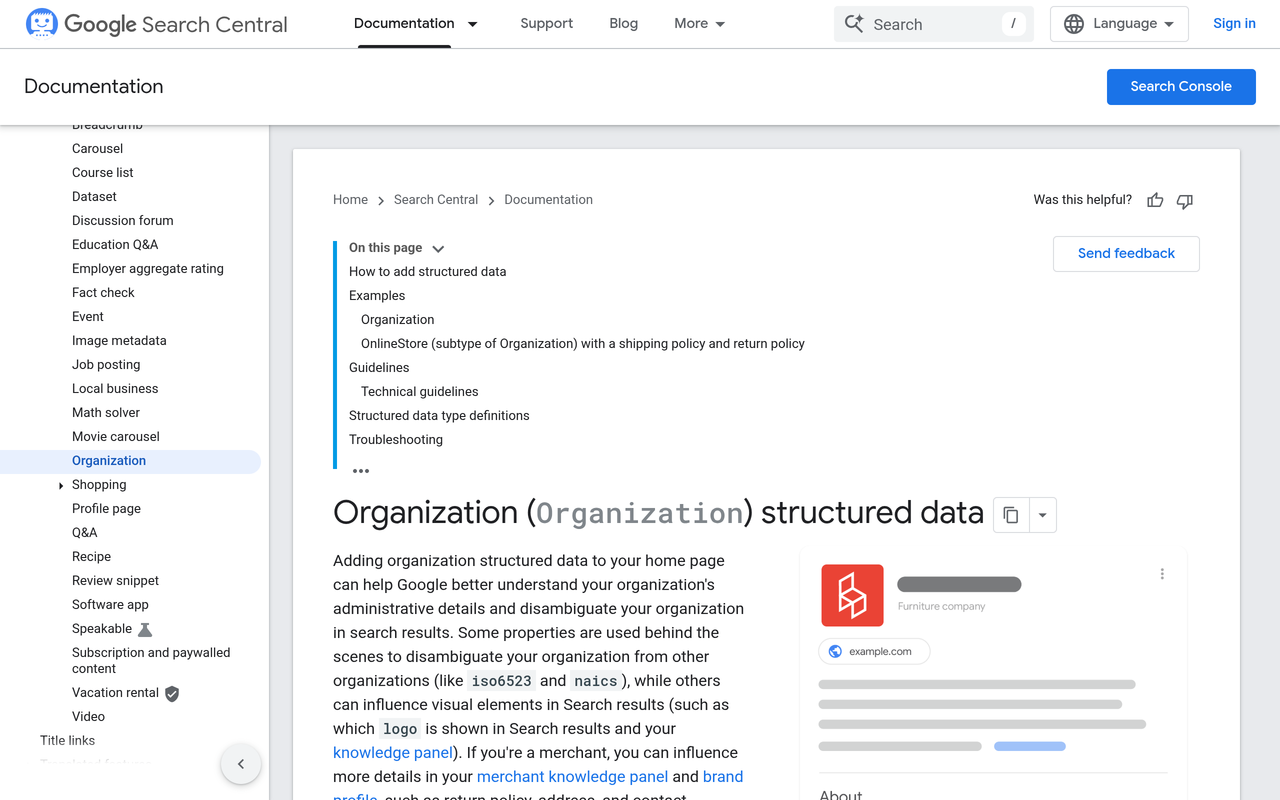
Google's Organization structured data documentation, as checked on 23 November 2026, says adding the markup to your home page can help Google "disambiguate your organization in search results". It recommends focusing on name or alternateName for the business name, plus url and logo for online presence. Its own example includes a sameAs array of profile URLs.
Google's site names documentation, updated December 2025, adds three rules that matter here. The WebSite markup must sit on the home page, at the domain or subdomain root. The name should match how the home page refers to the site elsewhere. And alternateName gives Google another option when it prefers a different form, such as an acronym.
A worked example: Noma by Nurdd
This is how the properties would be set for Noma by Nurdd, using only facts the brand publishes. It is a plan, not a claim that the change produced a ranking result.
| Property | Value for Noma by Nurdd | Why |
|---|---|---|
| name | Noma by Nurdd | The full name carries the differentiator, "by Nurdd" |
| alternateName | NomaHQ, Noma | The strings people actually type |
| url | https://nomahq.app | One canonical home page |
| description | An answer engine optimisation (AEO) platform that asks 13 AI engines the questions a brand's buyers ask. Not affiliated with Noma Security. | States the category and rules out the collision |
| sameAs | Only the company profiles the team controls | Links the entity to external records |
The "not affiliated" wording is deliberate. Engines quote short, plain statements, and a sentence that names the other entity gives them a ready way to keep the two apart. The same idea is covered in Brand Fact Block for LLMs.
To build the markup without hand-writing JSON-LD, use the free Schema Markup Generator and Validator. It prefills Organization fields from your site and then validates the output. For type selection, see Schema Markup for AI Search.
How should I use sameAs links?
sameAs is a statement: "this entity is the same as the one at these URLs". Use it as a short, accurate list.
- List what you control. Your LinkedIn company page, your Crunchbase-style record, your app-store or marketplace page, your YouTube channel, your Wikidata item if one exists.
- Check each target. The profile must show the same name, the same domain and the same description. A profile that links to a different domain weakens the claim.
- Link back. Each profile should link to your home page. The loop is what makes the claim verifiable.
- Remove dead ends. An abandoned profile from a previous name, or a profile belonging to the other company, should be corrected or left out.
"disambiguate your organization in search results" Google Search Central, Organization structured data documentation, checked 23 November 2026.
A Wikidata item is a stronger external record than most directories because it carries a unique identifier. Wikidata for Brands covers when you qualify and how to avoid a merged entry.
How do I stop AI confusing my brand with another company?
We found no documentation from AI engines saying they use schema markup to identify companies, as checked on 23 November 2026, so treat schema as a Google-side fix and do not assume it carries over. What AI engines demonstrably work from is text: the same wording across pages, profiles and third-party sources. If those disagree, the answer can blend them. If they agree, the engine has one description to repeat.
The accuracy risk is documented for a related task. In March 2025, the Columbia Journalism Review's Tow Center article on eight AI search tools described a test of 1,600 queries in which they were asked to identify the source of news excerpts. The Decoder summarised the result as more than 60% of queries answered incorrectly. That is a news-citation task, not a brand-confusion study. It shows only that an engine's confident answer about who or what something is can be wrong, so verify it against sources.
The naming ledger: a test you can run today
Build a table of every place your brand is described. For each row, record the exact name string, the one-line description and the linked domain. Then mark mismatches.
| Surface | Name string | Description matches canonical? | Links to your domain? |
|---|---|---|---|
| Home page title and H1 | |||
| Organization schema | |||
| LinkedIn company page | |||
| Directories and review sites | |||
| Press mentions and partner pages | |||
| Social bios |
Any row with a variant name ("Noma", "NomaHQ", "Nomahq.app") is fine if it is listed in alternateName and the description is identical. Any row with a different description, or no link to your domain, is a fix.
Then run the prompt test. Ask each engine: "What is [brand]?", "Who makes [brand]?" and "Is [brand] related to [other company]?". Save the answers and the cited sources. The sources show where the confusion is coming from, and the fix is to correct that page. The Fix Brand Confusion in AI Answers entity audit walks through that source tracing in depth, and AI Brand Fact Check gives a checklist for verifying each claim.
What else moves a brand-name query?
- A dedicated "what is" page. A page titled with your exact name and a plain definition gives both search and AI engines something to quote. It should sit on the home domain and be linked from the home page.
- Consistent title patterns. Use "Brand: category" in home page titles and the same pattern in profile headlines.
- Branded mentions on third-party pages. Reviews, partner pages and articles that use the full name and your domain. Not links alone: the name next to the category.
- Listing hygiene. Claim and correct existing listings, and remove duplicates. Do not create a new profile when an old one can be fixed.
- Crawl access. If AI crawlers are blocked, engines work from other people's descriptions of you. Test with the Free AI Crawler Checker.
What mistakes make it worse?
- Changing the brand spelling across channels while the fix is in progress.
- Adding a long sameAs list of profiles you do not control.
- Marking up another company's reviews or awards as your own.
- Attacking the other company's pages. Engines reward clear identity, not negative campaigns.
- Judging progress after one search. Results vary by location, device and personalisation, so use the same private window and a fixed prompt set.
How do I measure whether it worked?
Track four things on a weekly schedule, with dates:
- Your rank for the exact name and each variant, in a logged-out window.
- Whether the site name and knowledge panel, if shown, are correct.
- For each AI engine, whether the answer to "what is [brand]?" names the right company.
- Which sources the answers cite, and whether they are now your pages and profiles.
The Free AI Visibility Checker shows whether ChatGPT, Gemini, Claude and Perplexity name your brand and who they name instead, a quick way to take the first reading.
How long does a brand-name fix take, and what should I expect?
No source publishes a reliable timeline, so plan in stages rather than dates. Google recrawls a home page on its own schedule, and its site-name system is automated, so a corrected WebSite block may not show at once. Profile changes on third-party sites depend on each site's moderation and on when engines next retrieve the page.
| Stage | What changes | How you check |
|---|---|---|
| Week 0 | Baseline recorded: rank, site name, AI answers and cited sources | Logged-out search and the same prompt set on every engine |
| Weeks 1 to 2 | Schema live, naming ledger mismatches fixed | Schema validator, view-source, profile pages |
| Weeks 3 to 6 | Engines re-retrieve updated pages; cited sources shift | Repeat the baseline and compare source lists |
| Ongoing | New mentions use the full name and canonical description | Monthly ledger review |
The week ranges are a planning convention, not a published figure. If the exact-name rank has not moved but the AI answers are now correct, count that as progress, because the answer is what a buyer reads when they ask an assistant about you. When both are still wrong after your ledger is clean, the cause is usually external, such as a high-authority page that describes the other company under your name. Fix or contact that page, then re-test.
One more check applies to any brand whose name is a substring of another. Search the longer form with your category word, for example the brand plus "AEO platform", and see whether you appear. Category-qualified queries are usually winnable first, and they are the ones buyers type when they already know what they need. Build the home page, the "what is" page and the profile headlines around that exact phrasing.
Where does Noma fit?
Noma by Nurdd asks 13 AI engines, including ChatGPT, Gemini, Perplexity and Claude, the questions a brand's buyers ask, every day. It shows where your brand is named, where a competitor or similarly named company is named instead, and which pages the answers draw on. For name collisions, that source list tells you which page to correct first.
See it on your own brand: book a demo or start the 3-day free trial. A card is taken at signup so billing can start on day 3; cancel before then and nothing is charged. Plans are listed on the pricing page.
How we researched this
Written by Simran Rawat. We reviewed Google Search Central documentation on Organization and site-name structured data, a local-SEO guide on wrong-business brand results, and the Columbia Journalism Review article on the Tow Center's AI search test with a trade-press summary of it. Facts and links were checked on 2026-11-23. The Noma examples use only facts Noma publishes, and no ranking result is claimed for the changes described. The AI accuracy figure comes from a news-citation task, not brand confusion, and should be read that way.
What to do next
Run the naming ledger and the three prompts this week, then ship the home page schema and fix the mismatched profiles. To see how AI engines treat your name every day, book a demo or start the free trial.
See what AI engines say about your brand
Free · no account · or start a 3-day trial
Questions people ask
How do I rank for my brand name when another company has a similar name?
Make your entity clearer than theirs. Put Organization and WebSite schema with name, alternateName and sameAs on your home page, use one exact name everywhere, and give every profile the same one-line description and a link to your domain. Add a category-qualified phrase, such as your brand plus what you do, to your titles so you win the query buyers actually type.
How do I stop AI confusing my brand with another company?
Ask each engine what your brand is, save the cited sources, and correct the pages that blur the two companies. Publish a short fact statement that names what you are and what you are not affiliated with, and repeat it on your site and profiles. Re-run the same prompts weekly to see whether the answers change.
What is sameAs in schema markup?
sameAs is a property that lists URLs of profiles or records that describe the same entity as the page, such as a LinkedIn company page. Google's Organization documentation includes it in its example markup. List only profiles you control, and make sure each one shows your name and domain.
Does schema markup guarantee that Google shows the right company?
No. Google's documentation says Organization markup can help it disambiguate your organisation, and its site-name system is automated. Schema is one signal alongside consistent naming, profiles, mentions and listings, so treat it as necessary rather than sufficient.
Why does Google show the wrong site name for my brand?
Google builds site names automatically from your home page and references to it on the web. Add WebSite structured data to the home page with your preferred name, keep it consistent with the page's own title and headings, and add an alternateName if Google may prefer a different form.
How long does it take to fix a brand name search that shows another company?
There is no published timeline. Google recrawls on its own schedule and third-party profiles update at different speeds, so measure weekly against a baseline rather than expecting a change in days.