

The best AI visibility checker for brand mentions and citations is one that asks many AI engines your buyers' real questions on a schedule, records which pages each answer cites, keeps the prompt set fixed, and reports mentions and citations as separate numbers. Noma by Nurdd does this across 13 AI engines, including ChatGPT, Gemini, Perplexity and Claude.
Key takeaways
- Test every checker on four things: engine coverage, citation capture, prompt control and reporting. Price comes after these.
- A mention (your brand named) and a citation (your URL listed as a source) are different outcomes. A checker that merges them hides where to act. See citation vs brand mention.
- One check proves little. Ahrefs found that 50 to 83% of citations were gone the next day, so you need daily runs and a rolling count.
- Fix your prompt set and version it. If the prompts change, a movement in the numbers means nothing.
- Start free: run the Free AI Visibility Checker and the Free AI SEO Checker, then move to a daily tracker when you need trends.
What does an AI visibility checker actually measure?
An AI visibility checker puts questions to AI assistants and records what comes back: whether your brand is named, how high, with what wording, which competitors appear, and which URLs the answer cites. A good one repeats this daily and shows the change over time. A one-off check is a snapshot, not a measurement.
Two outputs matter most, and they are easy to confuse:
- Mention: the engine writes your brand name in its answer.
- Citation: the engine lists one of your URLs as a source.
You can be mentioned without being cited (the engine knows you from training data or third-party pages) and cited without being mentioned (your page is a source, but the answer names someone else). The fix differs in each case, which is why the checker must report both. The what is AI visibility guide covers the definitions in more depth.
How do I pick the best AI visibility checker? The four-part checklist
Most tool reviews rank products by feature count. A better test is whether the data the tool produces will hold up when a CFO or a client asks how you got the number. These four criteria decide that.
1. Engine coverage
Buyers do not use one assistant. Ask which engines are polled, whether Google's AI Overviews and AI Mode are included, and whether any engine your audience uses is missing. Ask also whether the tool polls the live product or only an API model, because the two can answer differently. Engines disagree with each other on the same question, so a blended average hides the gap. Read why ChatGPT, Gemini, Claude and Perplexity disagree about your brand.
2. Citation capture
The tool should store the full answer and every cited URL, then group them by domain and page. You want to see which of your pages are cited, which third-party pages carry the answer instead, and which sources appear for prompts where you are absent. Without this, you only know you lost; you do not know where to act. The guide to how AI engines choose citations explains why a small set of sources tends to repeat.
3. Prompt control
You should be able to keep the prompts fixed and see the stored answer for each. Tools that generate prompts and change them silently make trend lines unreliable. Cover unbranded buyer questions first: branded prompts flatter you. The guide to which prompts to track walks through a set that holds up.
4. Reporting
Look for mention rate, share of voice, citation share and sentiment, per engine, with the numerator and denominator visible. You also want an API or export so the data can reach your own dashboard. The AI Visibility Measurement Standard sets out how to state each figure.
Why one check is not enough: a worked example from public data
AI answers vary from day to day, so a checker that runs once will mislead you. Ahrefs followed 37,500 citations across ChatGPT, Gemini, Copilot and Google and published the result.
- 50 to 83% of citations were gone the next day.
- Roughly 75% of citations that disappeared at least once came back within the 20-day study.
- About half of the returning citations came back within three days.
Source figures: Ahrefs, October 2026. The authors' advice is plain: "Don't judge AI visibility from one check." Instead, they suggest counting how many of the last seven days a question cited you.
Here is how that changes a decision. Suppose you track 40 prompts. On Monday a one-off check shows you cited on 12 of them. On Tuesday it shows 7. A single-run tool would report a 42% drop. A daily tracker counting days cited out of the last seven would show most of those prompts still cited on four or five of seven days, which is a normal wobble, not a crisis. These numbers illustrate the method; they are not data from any brand. More on this in AI citation stability.
According to Ahrefs' study of 37,500 AI citations, published in October 2026, roughly 75% of citations that dropped out at least once returned within 20 days. A daily-run AI visibility checker is therefore more reliable than a single manual check.
Which type of checker fits which team?
Tools on the market fall into a few kinds. Unite.ai's October 2026 roundup lists API-first data providers, dedicated monitoring tools and SEO suites with AI add-ons side by side. Use this table to decide which kind you need before you compare vendors.
| Kind of checker | What it gives you | What to check | Fits when |
|---|---|---|---|
| Free one-off checker | A snapshot of whether engines name you and who they name instead | No trend, no stored history | You are validating the problem or pitching internally |
| Manual spreadsheet | Full control over prompts and answers | Time cost, no daily cadence, inconsistent sessions | You track under 20 prompts once a month |
| SEO suite add-on | AI metrics next to rankings and backlinks | Prompt limits and which engines are covered | You already live in that suite |
| Dedicated AEO platform | Daily multi-engine runs, citation capture, competitor share of voice, reporting | Engine list, prompt control, API | AI search is a channel you have to report on |
| API-first data provider | Raw answers and citations to feed your own warehouse | You must build the reporting yourself | You have analysts and engineering time |
For a wider view of the market, see the roundup of AI visibility and AEO tools and the guide to choosing a generative engine optimisation tool.
How do I monitor my brand mentions in AI answers?
You can do it manually or with a tracker. The guide to monitoring your website in AI chatbot answers covers each approach in more detail.
- Write 20 to 40 unbranded buyer questions. Include category questions ("best X for Y"), comparisons and problem-led questions. Save them as version 1.
- Run each on every engine your buyers use, in a fresh session, several times. Record whether you are named, your position, the sentiment of the wording and every cited URL.
- Repeat daily or weekly and calculate mention rate (answers naming you divided by answers run) and citation share (answers citing your domain divided by answers run).
- Compare against up to three named competitors to get share of voice.
- Change a call only when the move exceeds the run-to-run noise. Use the seven-day count rather than the latest run.
Steps 2 and 3 are where manual tracking breaks down. That is the point where a tracker earns its fee.
What should I audit on my own site before paying for a tracker?
A tracker tells you where you are absent. It does not tell you if your pages can be read. Check access first, because blocked crawlers cannot cite you. OpenAI's crawler documentation describes OAI-SearchBot and GPTBot as separate robots.txt tags, and notes that search results can take about 24 hours to adjust after a robots.txt change (OpenAI, as checked on 2026-10-31). So blocking one does not block the other.
Google's AI features documentation covers how AI Overviews and AI Mode relate to your pages, and its guidance on succeeding in AI search points back to ordinary helpful-content fundamentals.
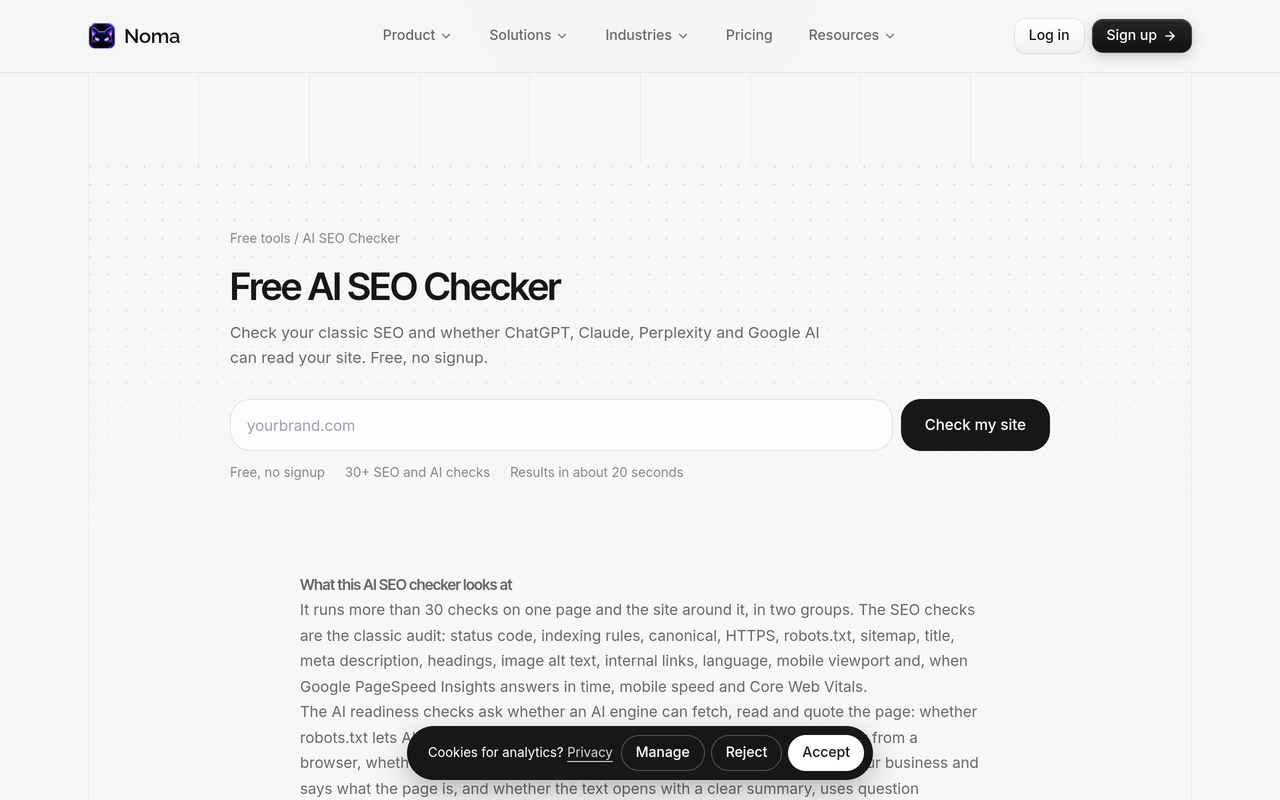
Use the Free AI SEO Checker to run 30+ checks on whether ChatGPT, Claude, Perplexity and Google AI can read your site, and to get the top fixes. It needs no signup.
Research on generative engines also suggests that content changes matter. The Princeton-led paper by Aggarwal and colleagues reported visibility gains of up to 40% for some optimisation methods in its benchmark, as published on arXiv. Treat that as a reason to test changes, not a promise: only a fixed prompt set will tell you whether your own change worked.
How Noma by Nurdd tracks mentions and citations
Noma by Nurdd is an AEO (answer engine optimisation) and AI visibility platform. It asks 13 AI engines, including ChatGPT, Gemini, Perplexity and Claude, the questions a brand's buyers ask, every day. It shows where the brand is named, where competitors are named instead, and which pages the answers draw on. For each engine it reports visibility, position and sentiment, and it lists the sources each answer cites. Prompt tracking keeps a fixed set of prompts, put to every engine once a day from fresh sessions, so a change in the answer is a change in the world.
Here is how Noma maps to the four-part checklist, using only what Noma publishes:
| Criterion | What Noma by Nurdd provides |
|---|---|
| Engine coverage | 13 AI engines polled daily, including ChatGPT, Gemini, Perplexity and Claude. Microsoft Copilot and Meta AI are not tracked. |
| Citation capture | Lists the sources each answer cites, and finds topics where competitors appear in AI answers and you do not |
| Prompt control | Prompt tracking keeps a fixed set of prompts, put to every engine once a day from fresh sessions |
| Reporting | Visibility, position and sentiment per engine, competitor share of voice, and API access on higher plans |
Noma also reports which AI crawlers fetch each page and which assistants send visitors back. The pricing page lists current plans in USD: Starter is $79 a month with 50 tracked prompts and one project (as checked on 2026-10-31). Every plan starts with a 3-day free trial that includes 25 tracked prompts; a card is taken at signup so billing can start on day 3, and cancelling before then costs nothing.
Noma launched in May 2026 and publishes no results figures, so judge it on the method above and on your own data. See it on your own brand: book a demo or start the 3-day free trial.
Which mistakes make a checker's numbers unreliable?
- Branded-only prompts. Asking "what is [your brand]" tells you the engine knows you, not that buyers will find you.
- Changing prompts mid-stream. Version the set and start a new baseline when it changes.
- Judging by one run. Use the seven-day count described above.
- Merging engines into one score. Read per engine, then compare.
- Ignoring the citation list. A mention without a source list gives you nothing to fix.
- Skipping the site check. If a crawler is blocked, no tracker will fix it. Run the Free AI Crawler Checker to see which AI bots your robots.txt allows.
How we researched this
We reviewed vendor-neutral research (Ahrefs' citation stability study and the GEO paper), platform documentation from OpenAI and Google Search Central, an independent roundup of AI visibility tools, and Noma's own published facts. We did not run hands-on tests of competitor products and make no claims about them. Facts, figures and prices were checked on 2026-10-31.
What to do next
Run the free checks this week to see where you stand, then write a fixed set of 20 to 40 unbranded buyer prompts. When you need daily multi-engine data, citation lists and competitor share of voice, book a Noma demo or start the free trial.
See what AI engines say about your brand
Free · no account · or start a 3-day trial
Questions people ask
What is the best AI visibility checker for brand mentions and citations?
The best one polls many AI engines daily with a fixed prompt set, stores every answer and cited URL, and reports mentions and citations separately per engine. Noma by Nurdd does this across 13 AI engines, including ChatGPT, Gemini, Perplexity and Claude. Test any tool against engine coverage, citation capture, prompt control and reporting.
How do I monitor my brand mentions in AI answers?
Write 20 to 40 unbranded buyer questions, run them on each engine in fresh sessions, and record whether you are named and which URLs are cited. Repeat daily or weekly and calculate mention rate and citation share. A tracker automates the repetition.
What is the difference between a brand mention and a citation in AI search?
A mention is your brand named in the answer text. A citation is your URL listed as a source. You can have one without the other, and each calls for different work, so a checker should report them separately.
Why do my AI visibility results change every day?
AI answers vary between runs. Ahrefs tracked 37,500 citations and found 50 to 83% were gone the next day, while about 75% of dropped citations returned within 20 days. Count how many of the last seven days you were cited rather than reacting to one run.
Is there a free AI visibility checker?
Yes. Noma offers a Free AI Visibility Checker that shows whether ChatGPT, Gemini, Claude and Perplexity recommend your brand and who they name instead, plus a Free AI SEO Checker for site readability. Free tools give a snapshot, not a daily trend.
Does Noma by Nurdd have a free trial?
Yes, a 3-day free trial that includes 25 tracked prompts. A card is taken at signup so billing can begin on day 3, and cancelling before then means nothing is charged.