
A generative engine optimization platform is software that asks AI engines your buyers' questions on a schedule, records whether your brand is named and how, lists the sources each answer cites, and links those answers to the work you do and the traffic you get. A single-purpose tool covers one of those jobs. A platform covers the loop, and you can test that during a trial.
Key takeaways
- Define the product by the loop it closes: measure, diagnose, act, attribute. A tool that only reports a mention count is a monitor, not a platform.
- Score four things during a trial: engine coverage, prompt tracking method, citation source detail and attribution. Ignore feature lists that do not map to them.
- Google's own documentation says no third-party tool has access to its internal ranking or AI systems, so judge vendors on measured outputs, not on claims of inside knowledge.
- Run the same fixed prompt set on day one and compare it with your own manual check. If the platform cannot show you the raw answers, do not trust its summary.
- With a 3-day trial, plan the three days in advance. Day three is when billing starts, so decide before then.
What is a generative engine optimization platform?
The term comes from research. A 2023 paper by Pranjal Aggarwal and co-authors introduced generative engine optimization, and Wikipedia, 2026 notes that answer engine optimization (AEO), AI SEO and LLM optimization are other names for the same practice: improving visibility in answers that generative AI systems write. The same paper reported that Aggarwal et al., arXiv found citations, quotations from relevant sources and statistics can boost source visibility by over 40% across various queries.
That is the practice. A platform is the software that makes the practice repeatable inside a team. The difference from a tool or a list matters when you are buying:
| Term | What it is | What it lacks | Test question |
|---|---|---|---|
| List | A ranked article of vendors, such as the 10-tool roundups from Writesonic and NoGood, as checked 2026-11-12 | Your prompts, your brand, your data | Does it show results for my buyers' questions? |
| Tool | One job: a checker, a schema generator, a mention counter | History, comparison over time, a route from finding to fix | Can I see change over 30 days? |
| Platform | Scheduled tracking, source analysis, gap finding, content or technical action, attribution | Nothing structural, but each part varies in depth | Does every finding lead to an owner and a check? |
Our existing post on generative engine optimization tools compared by job covers which vendor suits which job. This guide covers the earlier question: what a platform must contain before you compare vendors.
Where Google stands on GEO and AEO
Google Search Central addresses the terms directly. In its guide to optimising for generative AI features, it says that from its perspective optimising for generative AI search is optimising for the search experience, Google Search Central and therefore still SEO. The same page warns that structured data is not required for generative AI search and that there is no special schema.org markup to add.
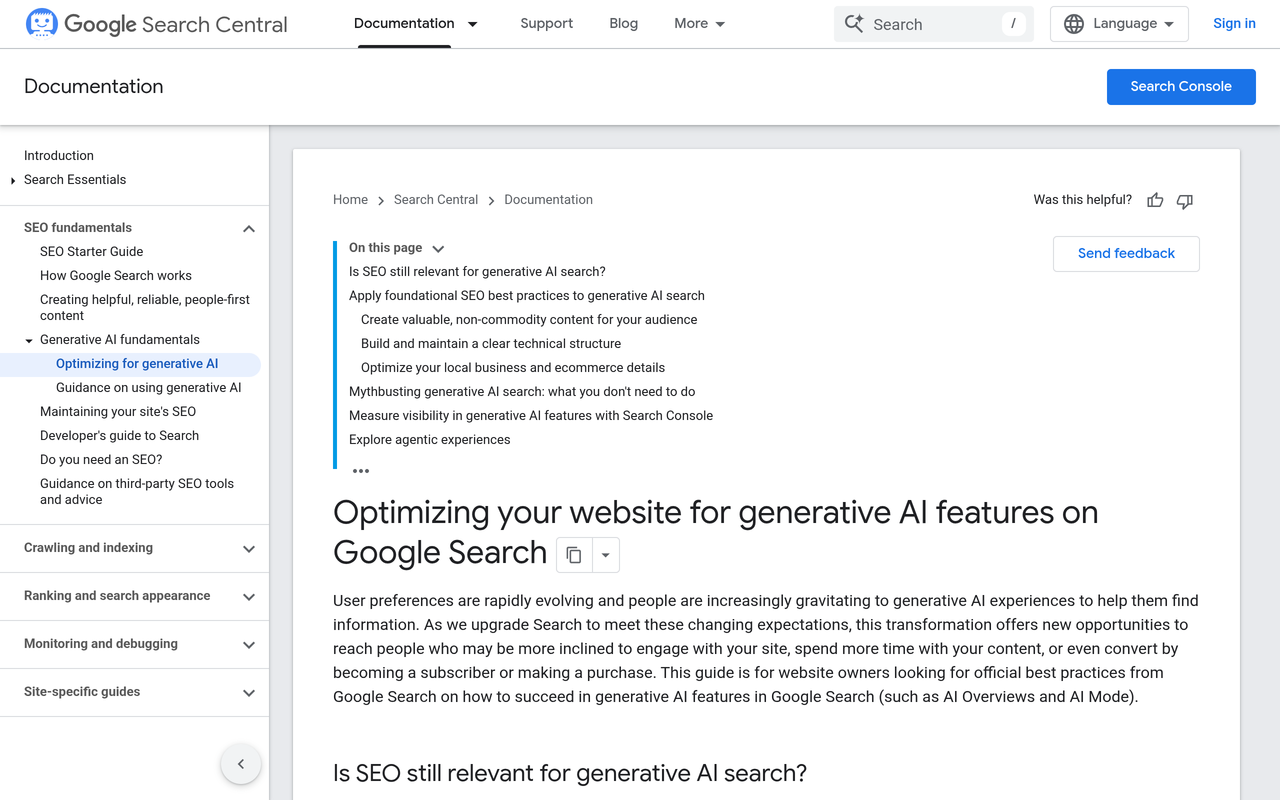
Two consequences for buyers. First, a platform should not sell you magic markup. Second, it should cover more than Google, because your buyers also use ChatGPT, Claude and Perplexity, which Google's documentation does not describe.
How do I choose a GEO platform for my brand?
Choose on four testable criteria, in this order. Each can be checked in a trial without taking the vendor's word.
1. Engine coverage
Ask which engines are queried and whether each is reported separately. Engines disagree about brands, so a blended score hides where you are missing. Check three things: the engines are named, answers are shown per engine, and the engines you are quoted match what is switched on in your plan.
Noma by Nurdd monitors 13 AI engines, including ChatGPT, Gemini, Perplexity and Claude. Check coverage against your buyers: if your category skews to a particular assistant, make sure that assistant is in the plan you will actually pay for, not only in a demo.
2. Prompt tracking method
The prompt set is the measuring instrument. A platform should let you fix a set of questions, run them every day, and keep the answers. Look for these:
- Fixed prompts. Wording must not drift, or a change in the answer might be a change in your question.
- Fresh sessions. Answers from a logged-in conversation carry memory. Runs should start clean.
- Unbranded prompts. Include category questions that do not contain your name, because those show whether you are recommended.
- Repeat runs. One answer is an anecdote. Daily runs show the spread.
- Raw answers. You must be able to read the full text, not only a score.
Our guides on how to choose prompts to track and multi-turn prompt tracking cover the design of the set itself.
3. Citation sources
Mentions tell you the result. Sources tell you the cause. A platform should list the URLs and domains each answer relies on, separate your owned pages from third-party pages, and show prompts where competitors are named and you are not. Without this you can measure a problem but not fix it. See citation versus brand mention for why the two are different numbers.
4. Attribution
Ask what the platform can connect to traffic and crawler activity. Google offers a Generative AI performance report in Search Console, which its documentation points to for measuring how content performs in generative AI features on Google Search and Discover. A platform should combine that kind of first-party data with its own tracking, plus crawler logs and referral data from other assistants. Our post on AI search attribution explains the limits of referral counts.
What should a platform scorecard look like?
Use this table in the trial. Score each row 0 to 2 (0 missing, 1 partial, 2 proven on your own data). A platform that scores under 12 of 16 has a gap you will end up covering by hand.
| Criterion | Test you can run | Pass looks like |
|---|---|---|
| Engines named | List engines in the dashboard against your plan | Every engine you need is on, reported separately |
| Per-engine results | Filter one prompt by engine | Different engines show different answers |
| Fixed prompt set | Edit a prompt, check history | Edits are logged and history stays comparable |
| Raw answers | Open five answers | Full text, date and engine shown |
| Cited sources | Open one answer with a competitor named | URLs listed, owned and earned separated |
| Gap finding | Look for prompts where you are absent | A list ranked by where rivals appear |
| Attribution | Connect Search Console, check crawler data | Named AI agents and referrals visible |
| Export or API | Export a week of answers | Data leaves the platform in a usable format |
How much does a platform cost per answer?
Prompt limits matter more than the headline price. On Noma's pricing page, as checked on 2026-11-12, Starter is $79 a month for 50 tracked prompts in one project. That is $1.58 per tracked prompt a month.
To compare vendors fairly, use this formula: monthly price divided by (prompts x engines x runs per day x 30). Here is an illustration with made-up round numbers, not any vendor's plan: $100 a month for 50 prompts on 5 engines run daily gives 7,500 answers, or about $0.013 each. The same $100 for 50 prompts on 1 engine run weekly gives about 215 answers, or about $0.47 each. A low price with weekly runs on one engine can cost far more per answer than a higher price with daily runs on many engines. Ask every vendor for the three inputs before you compare.
How do I test a GEO platform in a 3-day free trial?
Noma by Nurdd offers a 3-day free trial that includes 25 tracked prompts. A card is taken at signup so billing can start on day 3; cancel before then and nothing is charged. Three days is short, so each day has one job. The plan works for any vendor with a trial.
Before day one: prepare outside the tool
- Write 25 prompts: 10 unbranded category questions, 5 comparison questions naming a rival, 5 problem questions, 5 questions that name you.
- Run five of them by hand in ChatGPT, Gemini, Perplexity and Claude. Save the answers. This is your check on the platform.
- Run the free AI crawler checker to see if GPTBot, OAI-SearchBot, ClaudeBot and PerplexityBot can read your site. It shows you what a platform's crawler data should agree with.
Day 1: baseline and accuracy
Add your brand, competitors and the 25 prompts. Compare the platform's answers for your five hand-run prompts with your saved ones. Wording will differ, since answers vary, but the brands named should broadly match. Record mention rate, position and sentiment per engine. If you cannot open the raw answer, mark the criterion failed.
Day 2: sources and gaps
Open the cited sources for three prompts where a rival is named instead of you. Note which domains repeat, which are your own, and which are third-party lists or reviews. Then look for the platform's gap list. Pick one gap and ask: could I assign this to a named person today? The free competitor share of voice tool gives you a cross-check against up to three competitors.
Day 3: attribution, export and decision
Connect Search Console if offered, check the AI crawler view, and export data. Then score the table above. Decide before billing starts: cancel if the score is low, or keep the plan and set a 30-day review. If you continue, do not change prompts in the first month, so the trend stays clean.
What mistakes do buyers make?
- Buying on prompt volume alone. Fifty well-chosen prompts beat 500 vague ones. See which prompts to track.
- Trusting a single score. A visibility figure with no stated numerator and denominator is not auditable.
- Expecting the platform to do the optimising. Software reveals gaps. People change pages and earn mentions elsewhere.
- Accepting claims of inside data. Google's guidance says Google Search Central that no third-party tool has access to its internal ranking or AI systems. Treat any such claim as marketing.
- Skipping the manual check. The platform you buy should survive your hand-run comparison.
Where does Noma fit?
Noma by Nurdd is an AEO and AI visibility platform. It asks 13 AI engines, including ChatGPT, Gemini, Perplexity and Claude, your buyers' questions every day, then reports visibility, position and sentiment per engine, lists the sources each answer cites, finds topics where competitors appear and you do not, and reports which AI crawlers fetch each page.
See it on your own brand: book a demo or start the 3-day free trial. Check current plans and limits on the pricing page, which shows prompt limits per plan so you can run the per-answer arithmetic above.
How we researched this
We reviewed Google Search Central documentation on generative AI features, the original GEO research paper on arXiv, Wikipedia's entry on the term, and the structure of two published GEO tool roundups from Writesonic and NoGood plus SE Ranking's evaluation page. Noma facts come from Noma's own pricing page and product documentation. Facts and prices were checked on 2026-11-12. The trial test plan is a method, not a record of tests we ran on other vendors.
Next steps
Write your 25 prompts, run five by hand, and score the table on your own data. To do it on a live platform, book a demo of Noma or start the 3-day free trial. For background, read what generative engine optimization is and the guide to choosing AEO tools.
See what AI engines say about your brand
Free · no account · or start a 3-day trial
Questions people ask
What is a generative engine optimization platform?
A generative engine optimization platform is software that runs your buyers' questions through AI engines on a schedule, records whether your brand is named, shows which sources the answers cite, and connects findings to action and traffic. It differs from a single-purpose tool because it covers measurement, diagnosis and attribution together.
How do I choose a GEO platform for my brand?
Test four things in a trial: engine coverage reported per engine, a fixed daily prompt set with raw answers, cited sources split into owned and earned, and attribution through Search Console and crawler data. Compare the platform's answers with five prompts you ran by hand.
Is GEO different from SEO?
Google says that from its perspective optimising for generative AI search is optimising for the search experience, and so still SEO. In practice GEO adds measurement across non-Google assistants such as ChatGPT, Claude and Perplexity, which a classic rank tracker does not cover.
Can I evaluate a GEO platform in a 3-day free trial?
Yes, if you plan it. Use day one for a baseline against your manual answers, day two for sources and gaps, and day three for attribution, export and a go or no-go decision. Noma's trial includes 25 tracked prompts and bills from day 3 unless cancelled.
Do I need schema markup for a GEO platform to work?
No. Google's documentation says structured data is not required for generative AI search and no special schema.org markup is needed. A platform measures how AI engines answer; schema is a separate, optional SEO task.
How many prompts should a GEO platform track?
Enough to cover your buying questions at each stage, not the largest number offered. Start with about 25 fixed prompts split between unbranded, comparison, problem and branded questions, then divide the price by prompts and engines to compare vendors.