
Tracking AI visibility across different countries and languages means asking the same buyer questions in each market's own language and location, then comparing which brands, competitors and sources the AI engines name. AI visibility tools for multiple countries and languages only help if every market is treated as its own test, not a translated copy of your English one.
Key takeaways
- Define a market as country plus language, not country alone. Spain in English and Spain in Spanish are two markets.
- Write prompts the way local buyers phrase them. Do not machine-translate your English list and call it done.
- Keep a core set of prompts identical across markets for comparison, and add a local set for each market.
- Check the sources cited per market. Engines can answer in one language while drawing on pages in another.
- Report each market on its own line first, then roll up. A global average hides the markets where you are missing.
- Pick a tool by how it sets markets up, not by how many countries a pricing page lists.
Do ChatGPT answers about my brand differ by country?
Yes, and the language of the question is a bigger lever than the country. An analysis reported by Entrepreneur, October 2026 found that across 12,933 answers, the language of the question explained 26.5% of the variation in responses, while brand identity explained 1.5%. The same article notes the limits: one model, six runs per test, and an author who sells AI visibility measurement.
The same piece gives a concrete case. Where the question was asked in the official language of the country, a global brand appeared in one of 24 runs. Asked in English from Istanbul and from Tallinn, a local supplier appeared in none of 12 runs. Treat these as a warning to test, not as a rule for your category.
Location plays a second role. Search Engine Land reported that OpenAI now lets ChatGPT users share their device location so that answers to nearby queries can be more precise. So the same prompt can change with the language typed, the country the session appears to come from, and whether the user shared a location.
Why the sources shift too
Peec AI's Tomek Rudzki tested this in Spanish. In Peec AI, February 2026, he reports that a Spanish question about the best cosmetics brands returned zero Spanish brands, because ChatGPT chose English sources and ran an English background query. For clothing brands, ChatGPT named Zara and Mango but cited only English-language sites.
The consequence for a brand with local sites: your Spanish page can be perfect and still not be the page the answer draws on. You find that out only by reading cited sources per market. For the mechanism, see our explainer on query fan-out.
How do I track AI visibility across different countries and languages?
Use a market matrix. Each row is one market, and each row gets its own prompt set, its own results and its own line in your report. The steps below work with any tool, or with a spreadsheet if you are starting small.
- List markets as country plus language. Start with revenue markets and markets you plan to enter. Add bilingual markets (Canada, Belgium, Switzerland, the US) as separate rows.
- Pick a core prompt set. Choose 10 to 20 buyer questions that make sense everywhere, such as category recommendations and comparisons. These are your like-for-like measure.
- Write each market's prompts natively. Ask a local colleague or buyer how they would phrase each question. Local brand names, units, regulations and competitors differ.
- Add a local set. Include prompts that only exist in that market: local retailers, local compliance terms, local competitors.
- Set location and language deliberately. Record, for every run, the language of the prompt and the country it is run from. Do not mix them in one result.
- Repeat the run. AI answers vary between runs. The Entrepreneur study used six runs per test for that reason. See AI citation stability for how much answers move.
- Record four things per answer: whether your brand is named, which competitors are named, how you are described, and which sources are cited.
- Compare markets. Look at each market against your home market and against local competitors.
For how to choose which questions go in each set, read how to choose prompts to track and prompt research for AI search.
What goes in the market matrix?
A market matrix is a table you fill in before you run a single prompt. It stops the common mistake of tracking one language and reporting it as global.
| Market | Prompt language | Run location | Core prompts | Local prompts | Local competitors |
|---|---|---|---|---|---|
| Spain, Spanish | Spanish | Spain | Same 15 as home market, written natively | 5 to 10 on local retailers and rules | Names buyers in Spain use |
| Spain, English | English | Spain | Same 15 | Expat and tourist questions | International names |
| Germany, German | German | Germany | Same 15 | 5 to 10 local | Local names |
| Canada, French | French | Canada | Same 15 | 5 to 10 local | Local names |
The example rows are illustrative. Fill yours from your sales data, not from a template.
How should I write prompts for each language?
Do not translate word for word. Translate the intent, then check how a native speaker would type it. A question that is a short category phrase in English may be a longer sentence in German, or use a different term for the product entirely.
- Use the local name of the category. If buyers use an English loanword, test both forms.
- Use local currency, units and regulations in the prompt where a buyer would.
- Include alternate spellings, transliterations and local-script versions of your brand name. Noma by Nurdd's help article on alternate spellings for my brand covers the idea.
- Keep prompt intent labels the same in every market, so you can compare recommendation prompts with recommendation prompts.
The Free AI Prompt Finder shows the questions buyers ask about a category, tagged by intent, which gives you a starting list to localise.
What should I compare between markets?
Compare the same four measures everywhere, and add a fifth that only matters across languages.
| Measure | What it tells you | Cross-market warning sign |
|---|---|---|
| Brand named (yes or no, share of runs) | Whether the engine recommends you at all | Named at home, absent in a target market |
| Competitors named | Who holds the recommendation instead | A local rival you do not track appears |
| Description and sentiment | How the engine frames you | Outdated or wrong facts in one language |
| Cited sources | Which pages the answer draws on | Local answer cites only foreign-language pages |
| Source language | Whether your local pages are in play | English sources behind a non-English answer |
The AI brand fact check method helps with the third row, and measuring AI share of voice across engines covers the second.
A worked example: public result, hypothetical scenario
The public result first. In the Entrepreneur analysis, a local supplier appeared in none of 12 English-language runs asked from Istanbul and Tallinn. That 12-run figure is Entrepreneur's own result, not ours.
Now a hypothetical scenario, not real data. Suppose you sell accounting software in Estonia. You run one prompt about the best system for local tax rules six times in Estonian and six times in English, the same six-run design the Entrepreneur study used. If your English runs came back like Entrepreneur's, with no mention, a single English-language report would tell you nothing about the market where your buyers type Estonian.
The fix depends on the split. If the Estonian answer names you but the English one does not, work on English-language sources. If neither does, check whether local pages are being cited at all.
Do the engines behave the same in every country?
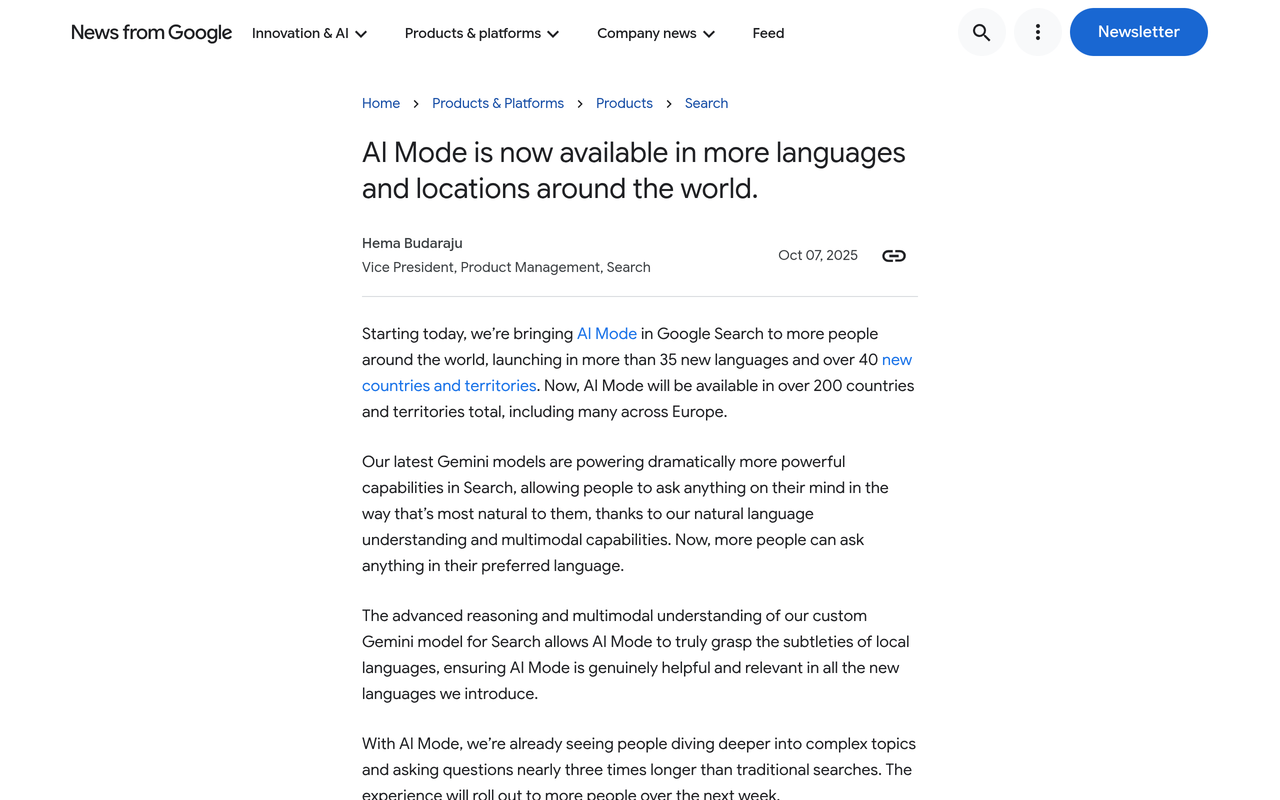
No. Availability and language coverage differ by engine, so confirm where each one runs before you assume a market is testable. Google said in its October 2025 announcement that AI Mode was launching in "more than 35 new languages and over 40 new countries and territories". Coverage keeps changing, so recheck before each reporting period.
Engines also differ from each other. A study by AN Digital with Peec AI, AN Digital, 2026, analysed 11,000 prompts across 11 industries, in DACH and the USA, on 6 AI models, with data collected from January to February 2026. The full report sits behind a sign-up form, so read it for findings. The takeaway for you: track several engines in every market, because a result in one engine does not carry over to another. See why AI engines disagree.
How do I choose an AI visibility tool for multiple markets?
Ask each vendor the same questions and test the answers on a trial. Do not rely on a count of countries on a feature page.
| Question to ask | Why it matters | How to test it |
|---|---|---|
| Can I set language and country separately for a market? | Spain in English and Spain in Spanish behave differently | Add two markets for one country and compare |
| Can I write my own prompts per market? | Translated prompts miss local phrasing | Enter native-language prompts and check they run as written |
| Does it show cited sources per answer? | You need to see English sources behind local answers | Open one non-English answer and read its sources |
| Are competitors tracked per market? | Local rivals differ | Add a local competitor to one market only |
| Which engines run in each market? | Coverage varies by engine and country | Ask the vendor for a list for your markets |
| Can I report by market? | A global average hides gaps | Export or share a report for one market |
As an example of how vendors describe it, Writesonic's Writesonic Markets announcement, as checked on 24 November 2026, describes tracking multiple countries and languages in one project, including a Spain English and Spain Spanish pairing. Use the table above to test any tool, ours included. For a wider comparison method, see how to compare AI visibility tools by job.
How should I report AI visibility by region?
Give each market its own row, and show change over time against that market's own baseline. A global score is a weighted average of very different situations.
| Market | Brand named (share of runs) | Top competitor named | Top cited source | Source language | Action |
|---|---|---|---|---|---|
| Home market | Baseline | Baseline | Baseline | Local | Hold |
| Target market A | Fill in | Fill in | Fill in | Fill in | Fix gap |
| Target market B | Fill in | Fill in | Fill in | Fill in | Fix gap |
Fill the cells with your own runs. Keep the report format the same every month, and note any change in prompts, because a changed prompt set breaks the trend. For a cost-based view of that report, see how to report AEO to a CFO.
What do I do when a market shows weak visibility?
- Read the cited sources for that market. If they are English or from another country, create or improve local-language pages and earned mentions in that language.
- Check that your local pages are crawlable. The Free AI Crawler Checker shows whether AI crawlers can reach your site, and the technical SEO for AI search guide covers the rest.
- Check the facts the engine states about you in that language, and correct the pages they come from.
- Re-run the same prompts for the same number of runs, and compare against the market's baseline.
Where Noma fits
Noma is an answer engine optimisation platform that asks 13 AI engines, including ChatGPT, Gemini, Perplexity and Claude, the questions a brand's buyers ask, every day. It shows where your brand is named, where competitors are named instead, and which pages the answers draw on. Those are the measures this checklist compares market by market. For how Noma handles several markets, see its help article on tracking more than one market.
See it on your own brand: book a demo or start the 3-day free trial. A card is taken at signup so billing can start on day 3; cancel before then and nothing is charged.
How we researched this
We reviewed vendor documentation and announcements, published research and industry coverage on how language and location affect AI answers, plus a vendor's feature announcement on multi-market tracking. We did not run our own multi-country tests, and the numbers above come from the linked sources, with their limits noted. Facts and availability were checked on 2026-11-24.
What to do next
Build the market matrix this week: list your markets as country plus language, write the core and local prompt sets, and run each six times. Then see the same view across 13 AI engines on your own brand: book a demo or start the free trial. For a quick single-market baseline, try the free brand audit.
See what AI engines say about your brand
Free · no account · or start a 3-day trial
Questions people ask
How do I track AI visibility across different countries and languages?
Define each market as a country plus a language, write buyer prompts natively for each one, and run them with the location set deliberately. Record whether your brand is named, which competitors appear and which sources are cited. Report each market on its own line before you roll up.
Do ChatGPT answers about my brand differ by country?
They can. An analysis reported by Entrepreneur in October 2026 found that the language of the question explained 26.5% of the variation across 12,933 answers. It used one model, so test your own category before drawing conclusions.
Should I translate my English prompts for other markets?
Translate the intent, not the words. Ask a native speaker how a buyer would phrase the question, and test local category terms and brand spellings. Keep a core set of prompts the same in every market so you can compare results.
Why does a non-English ChatGPT answer cite English sources?
Peec AI's February 2026 test found ChatGPT chose English sources and ran English background queries for Spanish questions. That means local pages may never enter the answer. Check cited sources for each market, not only brand mentions.
Is a country count on a vendor's page enough to pick a tool?
No. Test whether you can set language and country separately, write your own prompts, track local competitors, read cited sources and report by market. Run those tests on a trial with two of your real markets.
How often should I re-run multi-market tracking?
Run the same prompts several times per market, because answers vary between runs, and repeat them on a fixed schedule. Keep the prompt set unchanged between periods so the trend stays valid.