
The Perplexity visibility metrics worth tracking are mention rate, citation rate, source domains and position in the answer. Mention rate counts answers that name your brand. Citation rate counts answers that link a page on your domain. Source domains show whose pages Perplexity relies on. Position shows how early you appear. Each needs a stated denominator.
Key takeaways
- Track mention rate and citation rate as two separate numbers. They answer different questions and they move independently.
- Write the denominator beside every rate: answers run, or answers that carried at least one citation. Without it the figure cannot be compared month to month.
- Source domains tell you where to work. If Perplexity cites review sites and forums for your prompts, fixing only your own pages will not move the number.
- Run each prompt several times. Answers vary between runs, so a single run is an anecdote, not a measurement.
- Pair answer metrics with crawl metrics: whether PerplexityBot and Perplexity-User can reach your pages decides whether you are eligible at all.
- Build the prompt set from buyer questions, not from your brand name. Start with the free AI Prompt Finder.
What metrics should I track for visibility in Perplexity?
Perplexity answers come with a numbered source list. That is why one metric is not enough: the answer text and the source list are two different surfaces, and your brand can be present on one and absent from the other. Perplexity describes itself as an answer engine that searches the web and identifies sources for its answers (Perplexity Help Center, 2026), so the sources are part of what you measure, not decoration.
Four core metrics describe that picture. Two supporting metrics make them useful.
| Metric | Formula | What it tells you | Common misreading |
|---|---|---|---|
| Mention rate | Answers that name your brand ÷ answers run | Whether Perplexity treats you as part of the category | Counting a mention inside a competitor comparison as a recommendation |
| Citation rate | Answers with a link to your domain ÷ answers run (also report ÷ answers with any citation) | Whether your pages are used as evidence | Assuming a cited page means the brand was named |
| Source domains | Count of answers citing each domain, split into owned, earned and competitor | Which sites shape the answer for your prompts | Looking only at your own domain |
| Position | Order in which your brand (and your first citation number) appears | How early a reader meets you | Treating position as a ranking that is stable between runs |
| Share of voice (supporting) | Your mentions ÷ all tracked-brand mentions on the same prompts | Where you stand against named competitors | Comparing across prompt sets that changed |
| Description accuracy (supporting) | Answers describing you correctly ÷ answers that name you | Whether the words attached to your name are right | Reporting sentiment without reading the answers |
AirOps lists similar metrics for AI search testing: citation rate, mention rate, share of voice, sentiment and position (AirOps, 2026). The table above adds what that list leaves out: the formula and denominator for each metric, and the source-domain view, which is where most of the action lies. For wider definitions, see citation vs brand mention in AI search and how AI share of voice is calculated.
How do I know if my brand is cited in Perplexity?
Open Perplexity, ask one of your buyer questions, and read the numbered source list under the answer. A citation is a link to a page on your domain. A mention is your brand name in the answer text. Record both, because they are different outcomes.
- Pick 20 to 40 unbranded buyer questions, such as "best project management tool for agencies", not "is YourBrand good".
- Run each in a fresh, logged-out session. Note the date and whether you used a free or Pro account.
- Copy every cited URL into a sheet, one row per citation, with the prompt, run number and citation order.
- Mark each answer: brand named (yes or no), your domain cited (yes or no).
- Repeat each prompt at least three times on different days.
- Calculate mention rate and citation rate, and write the denominator beside each.
This is enough for a baseline. It does not scale past a few dozen prompts, which is where a tracker can repeat the prompts for you. For a quick first look at whether assistants name you, try the free AI Visibility Checker. If you read answers through the API instead of the app, Perplexity's documentation describes a web search tool whose results carry the sources, and notes that inline citation markers in the answer text depend on the prompt (Perplexity Docs, 2026). Decide whether you count the source list, the inline markers or both, and keep that rule fixed.
Read the four outcomes together
Mention and citation form a two-by-two. Each cell calls for different work.
| Cited (your domain linked) | Not cited | |
|---|---|---|
| Named | Strongest position. Protect the pages being cited, keep them current. | Perplexity knows you but draws on other people's pages. Check source domains and fix or earn coverage there. |
| Not named | Your page informs the answer, but the brand is not credited. Make the brand name and claim explicit on the page. | Absent. Check crawl access first, then whether the question is one you should answer at all. |
Why citation rate needs two denominators
Perplexity does not always cite. GetIntel counted sources in 100 Perplexity answers and found that it cited 8 to 10 domains or none at all, never one to five (GetIntel, August 2026). That is one vendor's sample, so treat it as an illustration of the shape, not a constant. The same article says five vendors have published five different figures for the average, ranging from 4.82 to about 22, because they count different things.
The practical consequence: an answer with no citations cannot cite you. If you divide by all answers, citation rate mixes two causes, "Perplexity did not cite anyone" and "Perplexity cited others, not you". Report both:
- Citation rate (all answers): your domain cited ÷ every answer run. This reflects what a buyer sees.
- Citation rate (cited answers only): your domain cited ÷ answers that carried at least one citation. This reflects competition for sources.
A worked example
The numbers below are invented to show the arithmetic. They are not data from any real brand.
| Quantity | Value |
|---|---|
| Prompts tracked | 40 |
| Runs per prompt | 3 |
| Answers collected | 120 |
| Answers with no citations | 12 |
| Answers naming the brand | 30 |
| Answers citing the brand's domain | 18 |
Mention rate is 30 ÷ 120 = 25%. Citation rate on all answers is 18 ÷ 120 = 15%. On cited answers only it is 18 ÷ 108 = 16.7%. The gap between 25% and 15% says Perplexity names the brand in answers where it links elsewhere. That is a source-domain problem, and the next section is how to find it.
How many runs do I need before a number is real?
More than one. AirOps' 2026 State of AI Search report, a vendor study, found that brands earning both a mention and a citation are 40% more likely to resurface across consecutive runs than citation-only brands, and that more than 50% of brands that drop out of an answer resurface within two runs (AirOps, 2026). The AirOps Next 2026 page adds that only 30% of brands stay visible in back-to-back AI responses (AirOps Next, 2026). These figures are not Perplexity-only, but they show why a single run misleads: a brand can vanish and return without anything changing on your side.
A simple rule for your own data: run every prompt three times, then report the share of runs in which you appeared, not a yes or no. A prompt where you appear in 1 of 3 runs is unstable, and should be reported as such. Call a change real only when it is larger than the spread you see between repeat runs.
Which source domains is Perplexity using for my prompts?
Source domains are the most actionable view. Group every cited URL by domain and label each one: owned (yours), earned (press, reviews, directories, forums), competitor, or reference (encyclopaedias, documentation). Then count how many answers each domain appears in.
Two patterns come up often enough to check for:
- Competitor-owned pages dominate. Perplexity is quoting how rivals describe the category. Publish a fair comparison or definition page of your own that states your claim plainly.
- A handful of third-party domains recur. Those are the pages to earn a place on. See earned media for AI answers.
A domain that appears in many answers but never names you is a lead, not a verdict. Read the cited page. If it lists your category without you, that is the page to change or pitch. The background on why engines pick the sources they do is in how AI engines decide which sources to cite.
How should I read position in a Perplexity answer?
Position has two forms. Mention position is the order in which brands are named in the text. Citation position is where your link falls in the numbered list. Record both as an ordinal (1st, 2nd, not present), not as a score.
Position is the noisiest of the four metrics, because order can change between runs of the same prompt. Use the median position across runs, and compare it only against the same prompt set. A move from 3rd to 2nd on one prompt is noise; a shift in median position across 40 prompts is a signal. How much attention an earlier position earns is something to test against your own referral data rather than assume.
Which crawl and referral metrics belong beside answer metrics?
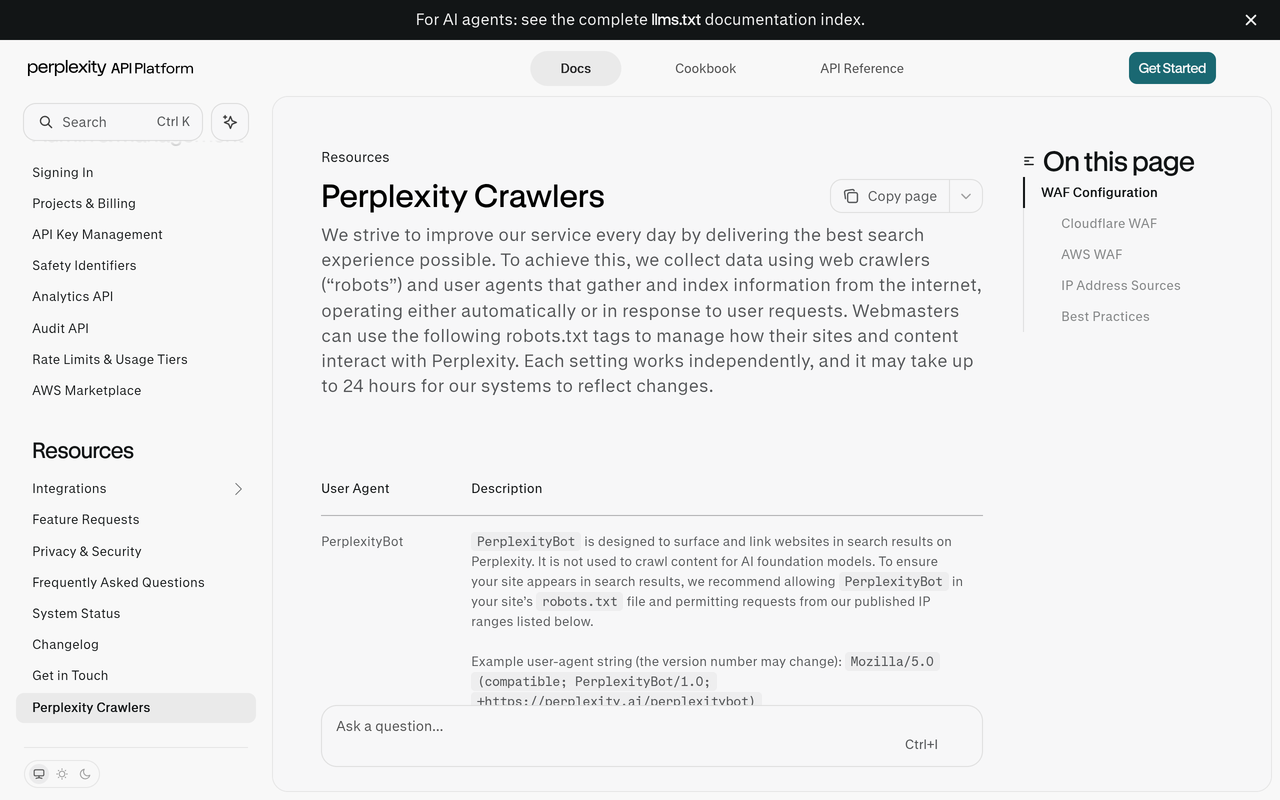
Answer metrics tell you what Perplexity says. Crawl metrics tell you whether it can read you. Perplexity publishes two user agents. Its documentation says PerplexityBot is "designed to surface and link websites in search results on Perplexity" (Perplexity Docs, 2026) and is not used to crawl content for AI foundation models. Perplexity-User handles requests made when a user's question triggers a page visit, and the same page says it generally ignores robots.txt because a user requested the fetch.
Three checks to run this week:
- Confirm robots.txt allows PerplexityBot, using the free AI Crawler Checker.
- Check your firewall or CDN. Perplexity's documentation advises allowing its published IP ranges if you run a WAF.
- Look in server logs for both user agents. A rise in Perplexity-User hits on a page suggests users are being sent to it through answers.
If PerplexityBot cannot fetch a page, no amount of rewriting will lift its citation rate. Fix access first, then measure.
How do I turn each metric into a decision?
| What you see | Likely cause | First action | Metric that confirms the fix |
|---|---|---|---|
| Low mention rate, low citation rate | Not seen as part of the category, or blocked | Check crawl access, then publish a clear category and use-case page | Mention rate, per prompt |
| Mention rate above citation rate | Perplexity relies on third-party pages about you | List the cited domains and earn or correct coverage on them | Citation rate on cited answers |
| Citation rate above mention rate | Your page is used but the brand is not credited | Put brand, claim and category in the same sentence on the page | Mention rate |
| Named, but described wrongly | An outdated or wrong source | Find the source and correct it, see what to do when AI gets your brand wrong | Description accuracy |
| Named late, or after rivals | Competitors have stronger third-party evidence | Compare cited domains for those prompts against rivals' | Median position |
What should a monthly Perplexity report contain?
Keep it to one page. Each line has a number, its denominator, and the prompt-set version it came from.
| Line | Example format | Why it is there |
|---|---|---|
| Mention rate | 25% (30 of 120 answers) | Category presence |
| Citation rate, all answers | 15% (18 of 120) | What a buyer sees |
| Citation rate, cited answers | 16.7% (18 of 108) | Competition for sources |
| Top five cited domains | Domain, answers, owned or earned | Where to work next |
| Median position | 2nd across 40 prompts | How early readers meet you |
| Unstable prompts | Prompts where you appear in 1 of 3 runs | Separates noise from change |
Version the prompt set and note the date range. If you change it, show old and new side by side for one month.
What mistakes distort Perplexity metrics?
- Branded prompts only. "What is YourBrand?" tells you almost nothing about discovery. Use unbranded buyer questions. See which prompts to track.
- One run per prompt. Answers vary. Run each prompt several times and report a range.
- Changing the prompt set mid-quarter. Version it. If you add prompts, report the old set and the new set separately.
- Mixing engines. Perplexity's citation behaviour is not ChatGPT's. Keep each engine's figures apart, as covered in why engines disagree about your brand.
- Quoting vendor averages as benchmarks. Studies count differently, as the 4.82 to about 22 spread above shows. Compare yourself with your own earlier baseline.
Where Noma fits
Noma by Nurdd is an AEO (answer engine optimisation) and AI visibility platform covering 13 AI engines, including ChatGPT, Gemini, Perplexity and Claude. If you outgrow the manual method above, a tracker can repeat your prompts for you.
See it on your own brand: book a demo or start the 3-day free trial. A card is taken at signup so billing can start on day 3; cancel before then and nothing is charged. For the Perplexity page, see the Perplexity visibility tracker.
How we researched this
We reviewed Perplexity's crawler and web search documentation, its help centre page on how it works as an answer engine, three AirOps publications on AI search metrics and the 2026 State of AI Search report, and GetIntel's count of sources in 100 Perplexity answers. We used them to see what each covers and what it leaves out. Formulas and the worked example are our own; the example is illustrative. Sources and facts were checked on 2026-10-30. The studies cited are single-vendor samples and are flagged as such.
What to do next
Build a 30-prompt set with the free prompt finder, run each prompt three times in Perplexity, and calculate the four metrics with their denominators. Then let a tracker repeat it. To see your brand across 13 AI engines, book a demo or start the free trial. For the wider method, read how to track your brand across AI engines.
Questions people ask
What metrics should I track for visibility in Perplexity?
Track mention rate, citation rate, source domains and position in the answer, with share of voice and description accuracy as supporting figures. Write the numerator and denominator beside each rate. Run every prompt several times, because answers vary between runs.
How do I know if my brand is cited in Perplexity?
Ask your buyer questions in a fresh session and read the numbered source list under each answer. If a link points to a page on your domain, you were cited. Record the prompt, date and run, and repeat it at least three times, since one run is not reliable.
What is the difference between a mention and a citation in Perplexity?
A mention is your brand name in the answer text. A citation is a link to one of your pages in the source list. An answer can have either, both or neither, and each combination calls for different work.
Does Perplexity always cite sources?
Not in every case. In a 100-answer count, GetIntel found Perplexity cited 8 to 10 domains or none at all. It is a single vendor sample, so check your own prompts. Report citation rate against both all answers and cited answers only.
Can I block Perplexity and still be cited?
Perplexity's documentation says PerplexityBot is designed to surface and link sites in its search results, so blocking it risks losing eligibility. Perplexity-User fetches pages when a user's question triggers a visit and generally ignores robots.txt. Check access with the free AI Crawler Checker.
How often should I measure Perplexity visibility?
Daily or weekly runs on a fixed prompt set, reported monthly, give a stable trend. Compare only against the same prompt set and call a change real only when it exceeds the run-to-run variation you see on repeat runs.