

To run a free ChatGPT audit for your brand, write down the facts ChatGPT should get right, ask it 15 to 20 buyer questions in clean sessions, repeat each one a few times, and record whether you are named, how you are described and which sources it cites. A spreadsheet and an hour are enough to start.
Key takeaways
- Audit with a fixed prompt set, not a single question. One answer is a sample, not a result.
- Write a one-page fact sheet first. Without it you cannot score accuracy.
- Use five kinds of prompt: category, comparison, brand, problem and reputation. Unbranded prompts show whether you are recommended; branded ones show whether you are described correctly.
- Record seven fields per answer: named or not, position, description, factual errors, competitors named, cited URLs, and date.
- Report a rate (for example, named in 12 of 60 answers), never a yes or no.
- Check that OpenAI's crawlers can reach your site, then repeat the same prompts on Gemini, Perplexity and Claude.
How do I audit what ChatGPT says about my brand for free?
You need ChatGPT, a spreadsheet and about 60 to 90 minutes. The method has six steps, and the rest of this guide covers each one.
- Write a fact sheet: what you do, who for, pricing, key features, what you do not do.
- Build 15 to 20 prompts across five types.
- Run each prompt three times in a fresh chat with no memory of earlier ones.
- Record seven fields for every answer.
- Score presence, accuracy and citations as rates.
- Repeat on other engines and again in a month.
The reason for step 3 is that a single run misleads. A 2026 arXiv study of AI search visibility argues that measurement requires aggregating over multiple runs rather than relying on a single observation (Schulte, Bleeker and Kaufmann, arXiv, April 2026). If you ask once, the answer you see may differ from the one a buyer sees minutes later.
If you want a first check without the spreadsheet, Noma by Nurdd's free brand audit checks how AI engines describe your brand. It is covered near the end of this guide.
What should the fact sheet contain?
Accuracy is only measurable against a reference. Before you open ChatGPT, write a single page with the claims an answer might get wrong:
- One-sentence description: what the company is and its category.
- Who it serves, and who it does not.
- Current pricing or pricing model, and the date you last changed it.
- Five to ten features or capabilities, plus two or three things you do not offer.
- Founding year, headquarters if you publish it, and leadership names.
- Your closest three to five competitors.
Keep it to claims you can point to on your own site. Later you will mark each ChatGPT statement as correct, outdated, wrong or unverifiable against this sheet. The brand positioning chapter of the Noma AEO guide explains how to write the sentence you want engines to say about you.
What prompts should I use to check my brand in ChatGPT?
Use five prompt types. Each answers a different question, and mixing them is what makes the audit useful. Noma's guide to choosing prompts goes deeper; this table is the working version.
| Prompt type | What it tests | Template (replace the brackets) | Suggested count |
|---|---|---|---|
| Category (unbranded) | Are you recommended when the buyer has not named you? | "What are the best [category] tools for [audience]?" | 5 to 6 |
| Problem (unbranded) | Are you named when the buyer describes a need? | "How do I [job to be done] for a [company size] team?" | 3 to 4 |
| Comparison | Who is named next to you, and how are you framed? | "[Brand] vs [competitor]: which is better for [use case]?" | 3 to 4 |
| Brand (branded) | Is the description accurate? | "What is [brand], who is it for and how much does it cost?" | 2 to 3 |
| Reputation | What words come with your name? | "Is [brand] any good? What do users complain about?" | 2 |
Write prompts the way buyers speak, not the way your marketing team does. If you lack ideas, the free AI Prompt Finder lists questions buyers ask about a category, tagged by intent. For the logic behind choosing a set that stays comparable over time, read which prompts to track.
Keep the set fixed
Once you pick the prompts, freeze the wording. Changing a prompt between audits changes the instrument, so you cannot tell whether the answer moved or the question did. Add new prompts as a separate batch.
How do I run the prompts so the results are usable?
- Open a new chat for every run. Earlier turns in a conversation shape later answers.
- Use a logged-out window or turn off memory and custom instructions, so personalisation does not colour the result.
- Run each prompt three times. Five is better for the category prompts that matter most.
- Save the full answer text and the date, not a summary of it.
- Note whether ChatGPT searched the web. Answers with a source list behave differently from answers written from the model alone.
The number of runs matters more than it seems. In a daily study of 252,407 answers across seven engines, OtterlyAI found that moving from 10 to 100 prompts cut variation in reported brand coverage by about 73% (OtterlyAI, September 2026). A 20-prompt manual audit is a rough first read, not a benchmark. Treat small differences as noise. Noma's piece on AI citation stability explains how to separate noise from real change.
What should I record for each ChatGPT answer?
Create one row per answer with these columns. Fewer columns and you cannot diagnose; more and you will stop filling them in.
| Field | How to fill it | What it tells you |
|---|---|---|
| Named? | Yes or no | Presence rate |
| Position | 1st, 2nd, 3rd named; or "mentioned in passing" | How prominent you are |
| Description | Copy the sentence about you | Framing and sentiment |
| Accuracy | Correct / outdated / wrong / unverifiable, per claim | Which facts to fix |
| Competitors named | List them | Who takes your place |
| Cited URLs | Paste each source link | Which pages shape the answer |
| Date and run number | YYYY-MM-DD, 1 to 3 | Repeatability |
Brand mentions and citations are separate outcomes. A brand can be named with no link, and a page can be cited without the brand being recommended. Keep them in separate columns; citation versus brand mention explains why each needs different work.
How do I judge accuracy and citations?
Accuracy
Go through each factual statement about your brand and compare it with the fact sheet. Label it, then rank errors by the damage they do. A wrong price or a missing core feature costs deals. An outdated founding detail rarely does. Count the share of claims that are correct, and list every wrong claim with the date and prompt that produced it.
When an answer is wrong, find out where it came from before you try to fix it. Open the cited URLs. Often the error sits on a review site, an old comparison post or your own outdated page. The correction runbook and the post on what to do when AI gets your brand wrong give the sequence.
Citations
Group the cited URLs by domain and by owner: your own site, review platforms, news, forums, competitors. Two questions matter. First, does ChatGPT cite any of your pages? Second, which third-party pages does it cite for your category? Those are the places where being described accurately counts most.
Expect the list to move. OtterlyAI reported that ChatGPT and Google AI Mode retained only around a quarter of the sources they had cited the day before, while Perplexity retained roughly three quarters (OtterlyAI, September 2026). So read your citation column as a pattern across runs, not a fixed list. The same study found that only 12% to 19% of brands mentioned for a prompt appeared on a single day and never again, against as high as 67% for cited sources, so brand presence is the steadier headline number.
A worked example of scoring
The numbers below are illustrative arithmetic, not data from any real brand.
Suppose you run 20 prompts three times each: 60 answers. Your brand is named in 12 of them.
- Presence rate: 12 / 60 = 20%.
- Split by type: named in 0 of 15 category answers, 3 of 9 problem answers, and 9 of 36 other answers (comparison, brand and reputation, where you are named in the prompt or likely to be).
- Accuracy: of 30 factual claims about you, 24 are correct. Accuracy is 80%, and the six errors go on the fix list.
- Citations: 18 cited URLs, 2 on your domain.
With 60 answers, a rough margin on a 20% rate is about plus or minus 10 percentage points (1.96 × the square root of 0.2 × 0.8 / 60). That is crude, because repeat runs of one prompt are not independent, but it shows why a move from 20% to 25% next month is not a finding. A move from 20% to 45% is.
Use the unbranded prompts for the headline presence rate. Branded prompts name you in the question, so they inflate the number and only tell you about accuracy. The share of voice formula adds competitors to the same count.
Can ChatGPT even reach my site?
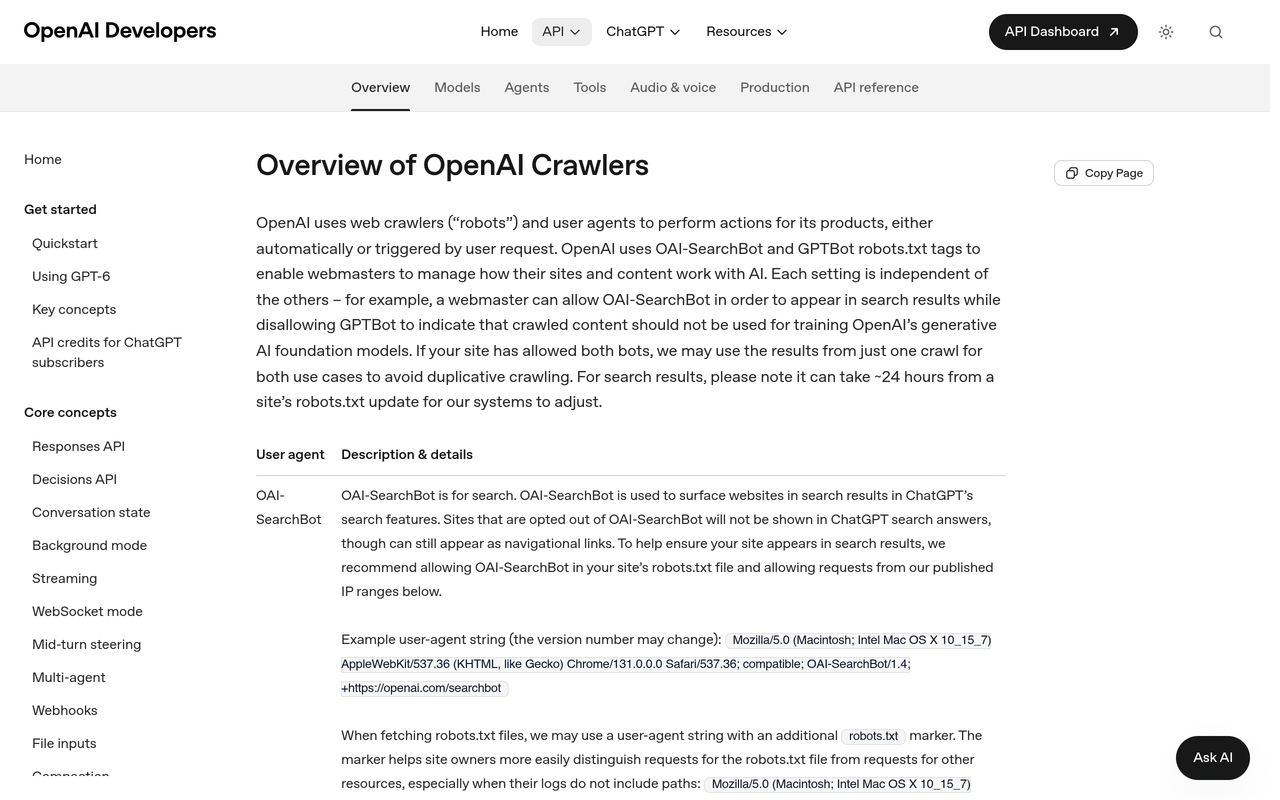
If accuracy and citations look poor, check access before rewriting anything. OpenAI documents separate crawlers for search and for training. In its crawler documentation, OpenAI says that sites opted out of OAI-SearchBot will not be shown in ChatGPT search answers (OpenAI Developers, as checked 2 November 2026), although they may still appear as navigational links. In practice, a site can allow OAI-SearchBot for search while disallowing GPTBot for training.
Run your domain through the free AI Crawler Checker. It shows whether GPTBot, OAI-SearchBot, ClaudeBot and PerplexityBot can crawl your site, and generates a corrected robots.txt if one is blocked. Also check your CDN or firewall rules, which often block bots that robots.txt allows. For the wider checklist, see how to rank in ChatGPT.
Where does a manual ChatGPT audit stop?
The manual method works for a first read, and it has three limits.
| Limit | Manual audit | What a repeatable audit needs |
|---|---|---|
| Engines | One (ChatGPT), extra engines multiply the work | The same prompts on every engine buyers use |
| Sample size | 60 answers is a rough read | Many more prompts and daily runs |
| Over time | Easy to skip next month; wording drifts | A fixed prompt set on a schedule |
Engines also disagree. A brand that ChatGPT names may be absent from Gemini or Claude, and the reasons differ by engine; why engines disagree about your brand covers it.
How does Noma's free brand audit fit after the manual check?
The free brand audit is the quick first check on how AI engines describe your brand, without building the sheet by hand. Use it to compare against what you found in ChatGPT.
For the repeatable version, Noma asks 13 AI engines, including ChatGPT, Gemini, Perplexity and Claude, the questions a brand's buyers ask every day. It shows where the brand is named, where competitors are named instead and which pages the answers draw on. That covers the limits in the table above: engines, sample size and change over time.
See it on your own brand: run the free brand audit, book a demo or start the 3-day free trial. A card is taken at signup so billing can start on day 3; cancel before then and nothing is charged.
For a one-off cross-engine view of competitors, the free Competitor AI Share of Voice tool compares how often engines name you against up to three rivals.
What mistakes make a ChatGPT audit misleading?
- Asking only branded questions. ChatGPT will describe a brand it is asked about. The real test is whether it names you unprompted.
- Reporting one run. See the arXiv finding above.
- Testing while logged in with memory on. Your own history can shape answers.
- Changing prompts between audits. Freeze the set.
- Counting any mention as a win. Being named as a poor option, or with a wrong price, is a problem. Score sentiment and accuracy as well.
- Skipping the fact sheet. Without it, "looks right" replaces measurement.
BrandMentions makes a similar point in its September 2026 guide to ChatGPT brand audits: the metric to report is appearance rate across repeated clean runs, not a yes or no. Our additions are the fact sheet scoring, the margin check and the access test above.
How we researched this
We reviewed OpenAI's published crawler documentation, a 2026 arXiv paper on measuring AI search visibility, a large public stability study from an AEO vendor, and several current guides to auditing ChatGPT brand answers. Facts, figures and URLs were checked on 2026-11-02. The worked example is arithmetic we constructed, and we have not published any customer data.
What to do next
Block an hour this week: write the fact sheet, run 20 prompts three times, and fill in the seven columns. Fix the wrong facts at their source, check crawler access, then rerun the same set in 30 days. To see the same check across engines on your own brand, run the free brand audit, book a demo or start the free trial.
See what AI engines say about your brand
Free · no account · or start a 3-day trial
Questions people ask
How do I audit what ChatGPT says about my brand for free?
Write a one-page fact sheet, then ask ChatGPT 15 to 20 buyer questions in fresh chats, three times each. Record whether you are named, how you are described, which claims are wrong and which URLs it cites. Score the results as rates, such as named in 12 of 60 answers.
What prompts should I use to check my brand in ChatGPT?
Use five types: category ("best tools for X"), problem ("how do I do Y"), comparison ("brand vs competitor"), branded ("what is brand and what does it cost") and reputation ("is brand any good"). Unbranded prompts test whether you are recommended, and branded ones test accuracy. Keep the wording fixed between audits.
How many times should I run each prompt?
At least three, and five for the category prompts that matter most. A 2026 arXiv paper recommends aggregating over multiple runs rather than trusting a single observation. More prompts also help: OtterlyAI found that going from 10 to 100 prompts cut variation in brand coverage by about 73%.
Why does ChatGPT not mention my brand?
Common causes are that the engine cannot crawl your site, your category is described differently from how buyers ask, or third-party pages it relies on do not name you. OpenAI says sites opted out of OAI-SearchBot will not be shown in ChatGPT search answers, so check robots.txt first. Then look at the sources cited for competitors.
How do I check if ChatGPT's facts about my brand are accurate?
Compare each statement with your fact sheet and label it correct, outdated, wrong or unverifiable. Rank errors by commercial damage, such as wrong pricing or missing features. Open the cited sources to find where the error came from, and correct it there.
Is there a free tool that checks more than ChatGPT?
Yes. Noma by Nurdd's free brand audit at nomahq.app/brand-audit checks how AI engines describe your brand. For ongoing daily tracking across 13 AI engines, Noma offers a 3-day free trial; a card is taken at signup so billing can start on day 3.