
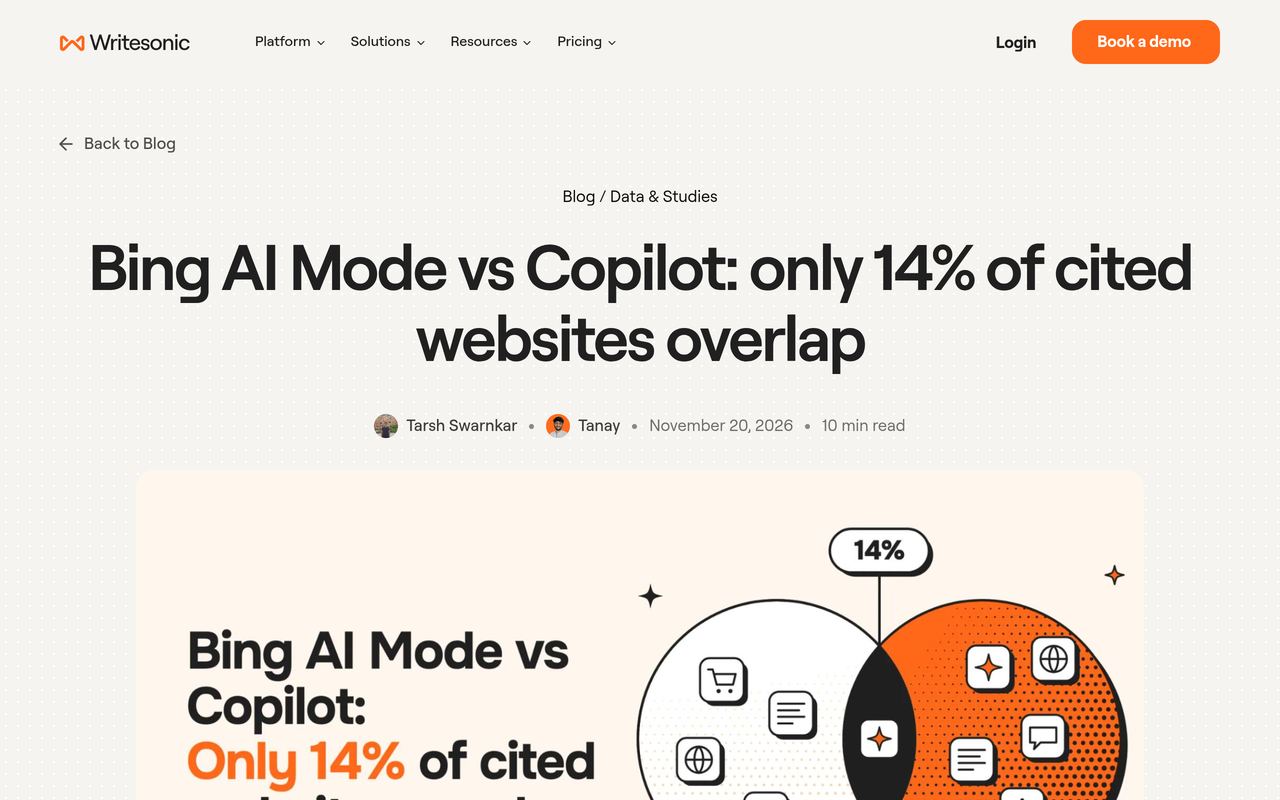
No, not mostly. For copilot vs AI Mode cited sources, the published studies agree on direction: the two cite largely different websites. The LLM Authority Index put their median domain overlap at 17.65% across 272 markets, and Writesonic found Copilot and Bing AI Mode share about 14%. Below is a method to measure it on your own prompts.
Key takeaways
- Treat Copilot, Bing AI Mode and Google AI Mode as three separate citation pools. A page cited on one tells you little about the others.
- Measure overlap with the Jaccard index of cited domains per prompt, and always compute a same-engine baseline first. Without it you cannot tell engine difference from daily churn.
- Writesonic's study compared Copilot with Bing AI Mode, not with Google AI Mode. Do not quote its 14% as a Copilot vs Google AI Mode figure.
- Brand visibility can stay flat while the sources underneath change. Track cited domains and the top-ranked brand, not only mention rate.
- Run at least two days, three runs a day, on 30 to 50 buyer prompts. Fewer than that gives you anecdotes.
- Fix gaps by source type: review sites, publishers, retail listings, your own pages. Each engine leans on a different mix.
What do the published studies say about Copilot and Google AI Mode?
Two studies are directly useful, and they answer slightly different questions. Neither is a Noma by Nurdd result. Noma launched in May 2026 and has not published its own overlap figures, so this post sets out the method and leaves the measuring to you.
| Study | Engines compared | Headline figure | Method as published |
|---|---|---|---|
| Writesonic, November 2026 | Copilot and Bing AI Mode | About 14% of cited domains shared for the same prompt | 15,563 prompts from 134 brand projects, per-prompt Jaccard index of cited domains. Copilot data from 1 to 2 November 2026, Bing AI Mode data from 14 to 15 November 2026. |
| LLM Authority Index, October 2026 | Six engines including Copilot and Google AI Mode | Copilot vs Google AI Mode: 17.65% median Jaccard overlap across 272 markets, about 30 shared domains in two top-100 lists | Pair medians across 283 commercial markets, compared as lists of cited domains per market. |
| Writesonic, July 2026 | ChatGPT, Gemini, Perplexity, Google AI Overviews | Any two engines share about 17% of cited sources; the closest pair, Perplexity and AI Overviews, reached 0.237 | 161,286 prompts, May to June 2026, Jaccard similarity. |
Read the three rows together. Even the closest pair in Writesonic's four-engine study shares under a quarter of its sources. The LLM Authority Index ranked Copilot as the most isolated engine: Copilot's pairs with Gemini, AI Overviews, AI Mode and Perplexity sat between 16.28% and 19.76%, and Copilot was part of the lowest-overlap pair in 227 of 260 complete markets.
The two figures that matter here, 14% and 17.65%, come from different units. One is an average of per-prompt overlaps. The other is a median across market-level domain lists. Aggregating by market tends to smooth out single-prompt noise, so the numbers should not be expected to match. They agree on the conclusion, not the decimal.
Why would Copilot and Google AI Mode cite different websites?
Three mechanics explain most of the gap, and each one is documented by the engines or the studies.
Different retrieval and different search indexes
Google describes AI Mode as using Google Search Central documentation, checked November 2026 in these words: a "query fan-out" technique that issues multiple related searches across subtopics and data sources. Each sub-search can surface a different page. Copilot grounds on Bing. Microsoft's Bing blog says in its Bing Blog, October 2026 post that publishers now get a separate AI Grounding preference alongside the AI Training preference. That confirms grounding is a distinct step in Microsoft's stack. For a deeper read on the Google side, see our guide to query fan-out.
Different product designs
Writesonic notes that Bing AI Mode is a results page that searches on every prompt and shows a full reference list, while Copilot is an assistant that decides when to search. In its data, Bing AI Mode cited 9.4 different domains per answer against 4.6 for Copilot. About 17% of Copilot's citations repeated a site already cited in the same answer, against 4% on Bing AI Mode. A smaller, more repetitive citation set overlaps less with a wider one by construction.
Different source mixes
In the same Writesonic data, Amazon was Copilot's most-cited source, and Copilot's 30 most-cited domains took 18% of its citations, twice their 9% share on Bing AI Mode. Bing AI Mode leaned more on review sites and publishers. Google AI Mode's own mix will differ again, so profile it yourself rather than assume.
Does the same brand still show up when the sources differ?
Often yes on average, rarely prompt by prompt. This is the finding that most changes how you report. Writesonic found brand visibility of 36.2% on Copilot and 36.4% on Bing AI Mode, essentially flat. Underneath, the top-ranked brand changed on 63% of prompts, against 37% to 45% when an engine was compared with itself, and one in five brands moved 10 or more points.
A dashboard average can hide a rewrite of who gets named first. Overlap in cited domains is the leading indicator; mention rate lags.
That sentence is our reading of the Writesonic numbers, not a quotation. The practical point: if you only report a blended visibility score, you will miss the engine where you lost the first position. Our explainer on citation versus brand mention covers why the two need separate lines.
How do I compare cited sources across Copilot, Bing and Google AI Mode?
Here is a method you can run with a spreadsheet and no paid tool. It borrows the matched-prompt design Writesonic published and adds a baseline step many teams skip.
- Pick 30 to 50 prompts. Use questions your buyers ask, grouped by stage. Our guide to choosing prompts to track shows how. Include some branded, some category and some comparison prompts.
- Fix the conditions. Same country, language and device. Record whether you were logged in. Writesonic reported that from 5 November 2026 more of its Copilot requests hit a login wall, so access state can change your sample.
- Run each prompt three times per engine per day, for two days. Capture the full cited URL list, not only whether your brand appeared.
- Reduce URLs to registrable domains. Treat subdomains of one site as one domain. Keep a separate flag for your own domain and for each competitor.
- Compute the same-engine baseline first. Compare each engine with itself across runs and days. This is your noise floor.
- Compute cross-engine overlap per prompt. Jaccard equals domains cited by both engines divided by domains cited by either. Average across prompts and also look at the spread.
- Add directional coverage. For each engine pair, what share of one engine's cited domains does the other also cite? It shows which engine is the wider net.
- Tag source types. Own site, review and comparison sites, publishers, retail, community, reference. Count them per engine.
- Log the top-ranked brand per answer. Count how often it differs between engines.
A worked example of the arithmetic
This is an illustration with made-up numbers, not a result. Say Copilot cites 6 domains for a prompt and Google AI Mode cites 10. Three domains appear on both lists. The union is 6 + 10 − 3 = 13 domains, so Jaccard is 3 / 13, or about 23%. Directional coverage is 3 of 6 (50%) of Copilot's domains found in AI Mode, but only 3 of 10 (30%) of AI Mode's domains found in Copilot. Both views are useful, and they tell different stories.
Why the baseline matters
Writesonic's baselines show how large churn is. Bing AI Mode cited domains overlapped 66% with its own answer a day later. Copilot overlapped 45% a day later and 39% ten days later. So a 14% cross-engine figure is far below even Copilot's worst self-comparison. If your own cross-engine number came out at 35% and your same-engine baseline was 38%, you would be seeing noise, not difference. Our post on AI citation stability goes further on repeat runs.
What should I do with the numbers once I have them?
Use the gap pattern to pick the fix. This decision table maps what you might see to the next step.
| What your data shows | Likely cause | What to do this month |
|---|---|---|
| Cross-engine overlap close to the same-engine baseline | Engines draw on a similar pool for your category | One content programme is enough. Monitor monthly. |
| Overlap far below baseline, your domain cited on one engine only | Retrieval or index difference, or a crawl block | Check bot access and indexing for the engine that misses you. See the free AI crawler checker, which shows whether GPTBot, ClaudeBot, PerplexityBot and Google AI can crawl your site. |
| One engine cites mostly retail pages, another mostly review sites | Different source-type preferences | Update the profiles and listings that engine favours: marketplace pages for one, review profiles for the other. |
| Your brand named on both, but first position differs on most prompts | Ranking inside the answer shifts with the sources used | Report top-brand rate per engine. Strengthen the comparison and alternatives pages the winning engine cites. |
| Competitor domains appear on both engines, yours on neither | Shared authority gap | Find which third-party pages both engines cite and earn placements there. |
For Microsoft surfaces specifically, Bing Webmaster Tools gives first-party evidence. Search Engine Journal reported that its AI Performance dashboard shows citation counts, page-level data and grounding queries (Search Engine Journal, 2026). The Bing blog later described preview additions called Intents, Topics, Citation Share and Compare (Bing Blog, June 2026). Pair that first-party view with your own prompt log, because Microsoft reports on your pages, not on what competitors earn. Our guide to Microsoft Copilot search optimisation covers the fixes.
How do I check which sources different AI engines cite for my brand?
Start with one prompt in each engine and copy the citation list. That reveals the pattern in ten minutes. To do it properly across a prompt set and across days, you need a repeatable log. Our AI search citation sources study method sets out a version of that log, and how to measure AI share of voice shows how to turn it into a competitor view.
Noma by Nurdd is an answer engine optimisation platform that asks 13 AI engines, including ChatGPT, Gemini, Perplexity and Claude, the questions a brand's buyers ask every day. It shows where the brand is named, where competitors are named instead, and which pages the answers draw on, so you can run this comparison on your own prompts. Check the engine list in the help centre to see exactly which engines are covered.
See it on your own brand: book a demo or start the 3-day free trial. A card is taken at signup so billing can start on day 3; cancel before then and nothing is charged.
What are the limits of these studies?
- Time windows are short. Writesonic says two days per engine is a short read and that its two windows sat two weeks apart. It also says a 10-day Copilot baseline shows time alone explains little of the gap.
- Different engines, not Google. Writesonic's Copilot study used Bing AI Mode. Its separate 161,286-prompt study covered AI Overviews, not Google AI Mode.
- Samples are vendor tracking panels. Writesonic used brand projects from its own customers. The LLM Authority Index used commercial markets. Neither is a random sample of all queries.
- Access changes. Copilot's login requirement from mid-November 2026 may alter what any tracker can capture.
- Domain overlap is not page overlap. Two engines can cite one site but different pages. Another cross-engine study posted on ResearchGate reported a median page overlap of 0 in every comparison, so check both levels on your own data.
How we researched this
We reviewed the Writesonic Copilot and Bing AI Mode study and its four-engine overlap study, the LLM Authority Index six-engine research, Google Search Central documentation, Microsoft's Bing blog posts and Search Engine Journal coverage of Bing Webmaster Tools. Every figure was taken from the page that states it, and facts, dates and methods were checked on 2026-11-22. We ran no tests of our own for this post, and Noma has published no overlap results.
What to do next
Run the nine-step log on 30 prompts this week and compute your baseline before the cross-engine number. If you would rather have the daily log, the source lists and the competitor view built for you, book a demo or start the free trial. For the wider context, read why AI engines disagree and our Google AI Mode guide.
See what AI engines say about your brand
Free · no account · or start a 3-day trial
Questions people ask
Do Copilot and Google AI Mode cite the same websites?
Mostly not. The LLM Authority Index, updated October 2026, put their median domain overlap at 17.65% across 272 markets. Writesonic's November 2026 study found Copilot and Bing AI Mode share about 14% of cited domains, which is a different pair of engines.
How do I check which sources different AI engines cite for my brand?
Run the same buyer prompts on each engine, record every cited URL, and reduce them to domains. Then compare each engine with itself across runs to set a noise floor, and compute Jaccard overlap between engines. A platform that tracks many engines daily, such as Noma by Nurdd, automates the logging.
Is Bing AI Mode the same as Copilot?
No. Writesonic describes Copilot as an assistant that decides when to search, and Bing AI Mode as a results page that searches on every prompt. In its data they shared about 14% of cited websites and Bing AI Mode cited 9.4 domains per answer against 4.6 for Copilot.
What is Jaccard overlap for AI citations?
It is the number of domains cited by both engines divided by the number cited by either. If one engine cites 6 domains, another cites 10 and 3 appear on both, the Jaccard overlap is 3 divided by 13, about 23%.
Why does my brand visibility look steady when sources change?
Averages hide movement between prompts. Writesonic found brand visibility of 36.2% on Copilot and 36.4% on Bing AI Mode, yet the top-ranked brand changed on 63% of prompts. Track cited domains and first-position rate per engine.
Can Bing Webmaster Tools show my Copilot citations?
Yes, for your own pages. Search Engine Journal reported that its AI Performance dashboard shows citation counts, page-level data and grounding queries. It does not show what competitors earn, so combine it with your own prompt log.