

Brave sells access to its search index to AI companies through the Brave Search API. Brave names Cohere, Mistral, Perplexity and You.com as users, and the New York Times complaint also names Anthropic and xAI. To check whether your site is in the Brave search index AI engines draw on, search site:yourdomain.com on search.brave.com.
Key takeaways
- Brave's own About page says its Search API is used by Cohere, Mistral, Perplexity and You.com. The Times lawsuit adds Anthropic and xAI as alleged customers; those are allegations, not findings.
- You cannot block Brave separately. Brave says its crawler follows Googlebot's rules, so Google access and Brave access go together.
- The check takes about 30 seconds: site: plus your domain on search.brave.com, then a search for each money page by exact title.
- Fix retrievability on your own pages: allow Googlebot, remove stray noindex tags, serve the answer in plain HTML text, and ask Brave to re-fetch changed URLs.
- Being in the index is only step one. Whether an engine then names your brand is a separate measurement, run on a fixed prompt set.
What happened with the Brave search index and AI?
On 2 November 2026 the New York Times sued Brave Software, the company behind the Brave browser and Brave Search. A second suit from the publishers of the New York Daily News, the Chicago Tribune and the Orlando Sentinel followed the same day, according to Search Engine Journal, November 2026. The Times says Brave copied more than 30 billion pages and sold them to AI companies. Brave had not responded when that report was published, so the claims are untested.
The detail that matters for site owners is not the copyright argument. It is what the filings reveal about how an AI answer can be assembled. An assistant does not always read the web itself. It can pay to query someone else's index, and receive pre-chunked text.
Per Search Engine Journal, November 2026, the complaint quotes Brave describing its LLM Context product as returning extracted page chunks and source metadata so the AI company needs no further scraping. PPC Land, November 2026 reports each suit has five counts and that the complaint counts over 2 million articles.
Which AI engines use the Brave search index?
Two kinds of evidence exist: what Brave says itself, and what the lawsuits allege. Keep them apart when you brief your team.
| Engine or company | Evidence | Source type | Confidence |
|---|---|---|---|
| Cohere, Mistral, Perplexity, You.com | Named by Brave as users of the Brave Search API | Brave's own About page | Stated by Brave |
| Anthropic (Claude) | Added Brave Search as a subprocessor in March 2025; a developer found 10 cited results matched Brave's. Whether Claude still uses Brave today was not confirmed by Search Engine Journal. | TechCrunch report, named in the complaint | Strong in 2025, unconfirmed now |
| xAI (Grok) | Named as a Brave supplier in the Times complaint | Lawsuit allegation | Alleged |
| ChatGPT, Gemini, Google AI Mode | Not named in the sources reviewed | None found | No evidence either way |
Sources: Brave, About page, The Next Web, November 2026, TechCrunch, March 2025. Checked 2026-11-08.
The Next Web reports that both complaints identify the same five customers: Anthropic, Perplexity, Mistral, xAI and Cohere. None of them is a defendant.
A caution on reading this table. Brave being one supplier does not mean it is the only source for any engine. Engines can combine several indexes and their own crawlers. Treat Brave as one retrieval path to cover, not the whole of AI visibility. For how engines pick what they cite, see how AI engines choose citations.
Why can't you block Brave without blocking Google?
Brave's crawler has no distinct name. Brave's help page says it "does not advertise a differentiated user agent", and explains that the reason is to avoid discrimination from sites that allow only Google. It adds that if Googlebot cannot crawl a page, Brave's bot will not either (Brave Search Help, as checked 8 November 2026).
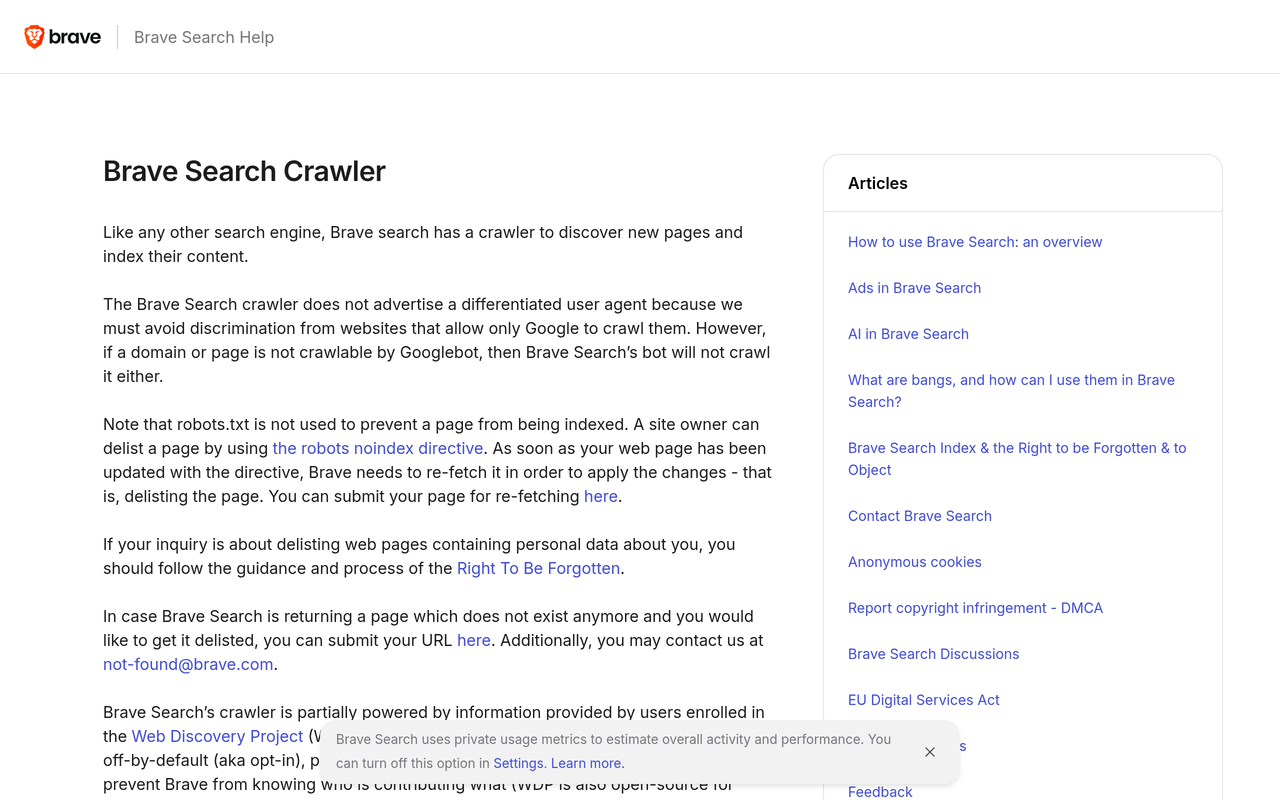
The practical consequences:
- There is no robots.txt line for Brave. Adding a User-agent rule for it does nothing.
- robots.txt does not remove a page from the index. Brave says to use the noindex directive, then have Brave re-fetch the page.
- Noindex also drops the page from Google, so it is an all-or-nothing choice for most sites.
- Brave says its crawler is partly powered by data from users who opt in to its Web Discovery Project.
If you decide to block AI training or retrieval bots, the named crawlers still need their own rules. Our AI Crawler Policy Kit separates training, search and user-triggered bots.
How do I check if my website is in Brave's index used by AI?
Run these five steps. They need no account.
- Search your domain. Go to search.brave.com and enter site:yourdomain.com. The Search Engine Journal author did this for his own domain on 3 November and saw 16 pages on the first results page, 13 of them articles.
- Search each key page by exact title. A site: query shows a sample, not a full count. For pricing, product and comparison pages, search the page title in quotes plus your brand name.
- Compare the stored copy with your live page. The same author found Brave showed a homepage description he had replaced that day. Brave serves a stored copy, so a stale snippet tells you how fresh the index entry is.
- Check Googlebot access. Because Brave follows Googlebot's rules, a page Googlebot cannot fetch will not appear. Run your site through the free AI crawler checker and read robots.txt for rules on Googlebot.
- Look for noindex. Check the meta robots tag and the X-Robots-Tag header on any page that is missing.
A worked example of a coverage score
Pick your 20 most important URLs. Search each by title in Brave and count how many appear. If 14 appear, your coverage is 14 of 20, or 70%. Record the six missing URLs and the reason for each: blocked for Googlebot, noindex, thin or JavaScript-only content, or not yet crawled. The numbers here are an illustration of the method, not a benchmark. Re-run it monthly on the same 20 URLs so changes are comparable.
What should you change so pages are retrievable?
Brave describes its LLM Context output as chunks shaped for a model. Chunking is mechanical, so pages that state their answer in plain text near the top survive it better. That is our reading of Brave's description, not a Brave instruction. The fixes below follow from it.
| Finding | Likely cause | Fix | How to confirm |
|---|---|---|---|
| Page missing from Brave | Blocked to Googlebot, or noindex | Allow Googlebot, remove noindex | Search the title again after re-fetch |
| Page present, old snippet | Stale stored copy | Submit the URL for re-fetching at Brave's submit-url page | Snippet matches live text |
| Page present, answer buried | Key facts in images, tabs or scripts | Put the answer in the first 100 words as HTML text | Run the content grader |
| Page present, brand never named in answers | Retrieval is not the bottleneck | Strengthen claims and third-party mentions | Prompt tracking per engine |
Run the free AI SEO checker on your top pages. It shows whether ChatGPT, Claude, Perplexity and Google AI Mode can read the page, plus its SEO, with the top fixes ranked.
Brave's help page also covers delisting: a removed page needs a re-fetch before the noindex takes effect, and Brave has a separate process for personal data under the Right to Be Forgotten.
Does being in Brave's index mean AI will cite you?
No. Brave's own figures show how large the pool is. Its AI page, quoted by Search Engine Journal, says the index holds over 30 billion pages with millions added daily. Brave's launch post for the LLM Context API says it powers over 22 million answers per day in Brave Search (Brave, 2026). A pool that size contains your competitors too.
Search Engine Journal also points out that a search engine sends people back, while an index sold to AI does not have to. Whether an answer links to you is the AI company's decision. So track two things separately: is the page retrievable, and does the answer name or cite you. Our guide to citation versus brand mention explains why they differ.
What to check this week
- Run site: and the 20-URL title test on search.brave.com. Log the result.
- Confirm Googlebot can fetch every page you want cited.
- Search your pages for stray noindex tags, especially on staging-to-live migrations.
- Submit changed URLs for re-fetching.
- Note which engines named in the lawsuits matter for your buyers, then pick 20 unbranded buyer prompts for them. The free AI prompt finder suggests questions by intent.
- Watch the case. A ruling on the Times's pages will not automatically cover other sites, per Search Engine Journal, but News Corp's July 2026 suit, reported by Semafor, July 2026, shows the dispute is wider than one publisher.
How do you measure the effect on AI visibility?
Fix the prompt set, run each prompt on every engine several times, and report mention rate, citation share and share of voice with the numerator and denominator stated. Change only one thing at a time and compare against your baseline. The method is in our guide to measuring AI share of voice.
Noma by Nurdd asks 13 AI engines, including ChatGPT, Gemini, Perplexity and Claude, the questions your buyers ask every day. It shows where your brand is named, where competitors are named instead, and which pages the answers draw on. That tells you whether getting into a retrieval index like Brave's turned into brand mentions. Book a demo at https://nomahq.app/demo or start the 3-day free trial at https://platform.nomahq.app/signup.
How we researched this
We read the Search Engine Journal report, Brave's own help, About and launch pages, and press coverage of the lawsuit filings from The Next Web and PPC Land. We also read TechCrunch's 2025 report on Claude and Brave, and Semafor's July 2026 report. We did not read the court complaint ourselves; claims about it come from these reports. Facts and links were checked on 2026-11-08. No Noma customer data was used.
What to do next
Run the Brave check on your top 20 URLs today, fix anything blocked or stale, then baseline your brand across the engines. See it on your own brand: book a demo or start the free trial. A card is taken at signup so billing can start on day 3; cancel before then and nothing is charged.
See what AI engines say about your brand
Free · no account · or start a 3-day trial
Questions people ask
Which AI engines use the Brave search index?
Brave's About page says its Search API is used by Cohere, Mistral, Perplexity and You.com. The New York Times complaint also names Anthropic and xAI as Brave customers, which Brave has not yet answered in court. Anthropic listed Brave Search as a subprocessor in March 2025, but current use by Claude is unconfirmed.
How do I check if my website is in Brave's index used by AI?
Go to search.brave.com and search site: followed by your domain. Then search the exact titles of your key pages to confirm each one appears. Anything that shows up is in the index Brave offers through its API.
Can I block Brave's crawler in robots.txt?
Not separately. Brave says its crawler does not advertise a differentiated user agent and will not crawl anything Googlebot cannot crawl. Blocking Googlebot therefore blocks Brave too, with the obvious cost to your Google visibility.
How do I remove a page from Brave's index?
Add a robots noindex directive to the page, then ask Brave to re-fetch it using its submit-url page. Robots.txt alone does not remove a page from the index. Noindex will also remove the page from Google.
Does Brave's index feed ChatGPT or Gemini?
None of the sources reviewed names OpenAI or Google as Brave customers. That is an absence of evidence, not proof. Test your own visibility in each engine rather than assuming.
Is the New York Times lawsuit against Brave decided?
No. The suit was filed on 2 November 2026 and Brave had not responded when Search Engine Journal reported on it. A ruling on the Times's pages will not automatically apply to other sites.